The places east of the Dead Sea belong to several different biblical settings: Lot's escape to Zoar, Israel's wilderness approach, the defeat of Sihon, tribal inheritance, and later accounts concerning Moab. They cannot all be plotted as cities held by Israel at one moment. Read each place with its passage and period.
A Regional Map: Which Places Does It Actually Show?
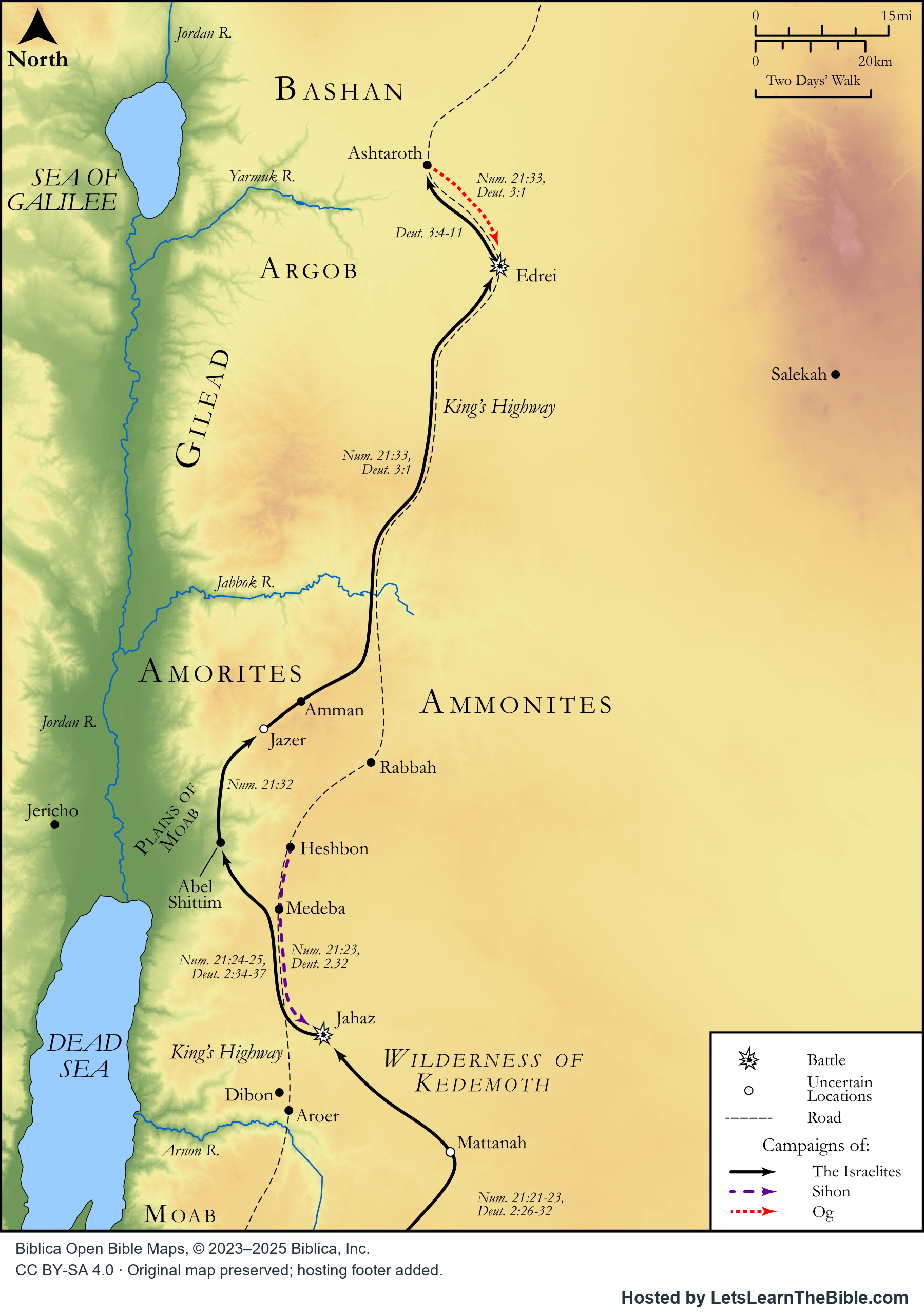
Begin with the Dead Sea on the west of this part of the map and the Arnon flowing toward it from the east. Follow the named places northward toward Heshbon rather than assuming that a modern border or the map's arrows describe every period in the Bible. The map does not label all the places in the following table, and their absence should not be filled with invented coordinates.
Twelve Places, Their Passages and Their Limits
| Place | Biblical setting | What to distinguish |
|---|---|---|
| Ar | Deuteronomy 2:9, 18 links Ar with Moab and the descendants of Lot. | Israel is told not to seize that protected possession. The passage does not make Ar an Israelite allotment. |
| Aroer | Deuteronomy 2:36 and Joshua 13:9, 16 locate this Aroer by the Arnon and include it in the eastern inheritance. | It is not identified as Sihon's capital: Numbers 21:26 names Heshbon as his city. Joshua 13:25 mentions an Aroer before Rabbah in another boundary setting. |
| Beth-jesimoth / Beth-jeshimoth | Numbers 33:49 uses it as one end of Israel's encampment by the Jordan; Joshua 13:20 lists Beth-jeshimoth in Reuben's inheritance. | An encampment extent and an inheritance list answer different questions. The spelling varies within the English text. |
| Bozrah | Jeremiah 48:24 names Bozrah among cities in the judgment concerning Moab. | First Chronicles 1:43–44 associates a person from Bozrah with Edom's kings. Do not assume every occurrence of the name establishes one identical location. |
| Dibon | Numbers 21:30 names it in the song concerning Sihon's territory; Numbers 32:34 says Gad built Dibon; Joshua 13:17 includes Dibon in Reuben's list. | A building notice is not identical to an allotment list. Numbers 33:45–46 names a station called Dibon-gad without supplying coordinates that prove every name form identical. |
| Jahaz / Jahazah | Sihon fights Israel at Jahaz (Numbers 21:23; Deuteronomy 2:32). Joshua 13:18 lists Jahazah in Reuben's inheritance. | Battle location and later tribal assignment should be labeled separately; the KJV also lists Jahazah among Reuben's Levitical towns (Joshua 21:36). |
| Kedemoth | Moses sends his offer of peace from the wilderness of Kedemoth (Deuteronomy 2:26); Joshua 13:18 and 21:37 name the town in Reuben and among Levitical towns. | The wilderness named after a place is not necessarily a precise campsite inside the town. |
| Kir-haraseth / Kir-hareseth / Kir-heres | Second Kings 3:25 names Kir-haraseth in the Moab campaign; Isaiah 16:7, 11 and Jeremiah 48:31, 36 contain related name forms in laments for Moab. | Compare the name forms and narrative settings; the passages do not provide a modern excavation coordinate or one permanent political status. |
| Mattanah | Numbers 21:18–19 places it in the movement from the wilderness toward Nahaliel and Bamoth. | This is an itinerary notice. The map marks its proposed location with an open circle, not a secure survey point. |
| Medeba | Numbers 21:30 includes it in the Sihon-related song; Joshua 13:9, 16 names the surrounding plain in the eastern inheritance. | A regional plain and an individual city are related descriptions but not interchangeable measurements. |
| Punon | Numbers 33:42–43 places this station between Zalmonah and Oboth. | The text gives the sequence. It does not provide a detailed road survey or a statement that Punon became a city of Reuben. |
| Zoar | Genesis 14:2, 8 identifies Bela with Zoar; Genesis 19:20–23 describes Lot reaching it during his escape from Sodom. | Lot later leaves Zoar for the mountain (19:30). This early narrative is not a list of Israelite tribal towns. |
Why Are Moab and Sihon's Land Treated Differently?
Deuteronomy 2:9 forbids Israel to contend with Moab for its land, explaining Ar as a possession given to Lot's descendants. Later in the same chapter, Israel is directed to confront Sihon, king of Heshbon. The distinction concerns the ruler, territory and instruction at that stage of the journey. It does not mean every place east of the Dead Sea receives one uniform command.
Numbers 21:13 calls the Arnon a border between Moab and the Amorites. Verse 26 explains that Sihon had earlier taken land from a former king of Moab as far as the Arnon. Israel's subsequent conquest of Sihon's territory must therefore be read with that earlier transfer, rather than described as a command to seize the Moabite possession protected in Deuteronomy 2. For a fuller comparison, see the protected neighbors and the two eastern kingdoms.
The later texts have their own settings. Second Kings 3 begins with Moab's tribute and rebellion, reports a campaign, and ends with the allied kings withdrawing after the Moabite king's sacrifice. It is not a statement of permanent Israelite occupation of every named city. Isaiah 16 and Jeremiah 48 are prophetic accounts concerning Moab, not dated administrative maps of Reuben. A place appearing in several of these texts needs a sequence of descriptions.
How Do Reuben, Gad and Levitical Towns Fit Together?
Numbers 32 describes Reuben and Gad requesting suitable cattle country, Moses requiring their participation in the western fighting, and the eastern grant that includes half of Manasseh. The chapter's building notices and Joshua 13's allotment lists should both be retained. Dibon is a useful example: Gad builds it in Numbers 32:34, while Joshua 13:17 names it within Reuben's inheritance. Neither statement should silently replace the other, and these passages do not narrate every intervening administrative arrangement.
Joshua 21:36–37, in the KJV text used here, lists Bezer, Jahazah, Kedemoth and Mephaath as Levitical towns contributed by Reuben. The Levitical assignment concerns towns and surrounding pasturelands within a tribal inheritance, not a separate continuous territory replacing the tribe. For the wider pattern, use the allotment guide's explanation of Levi and the refuge-city comparison.
Do the Camp Lists Establish One Exact Highway?
Numbers 21 places Mattanah in one sequence of travel; Numbers 33 names Punon, Dibon-gad and other stations before the encampment stretching from Beth-jesimoth to Abel-shittim. Reading a sequence tells us which place follows another in that account. It does not supply all distances, archaeological identifications or the course of every road.
The King's Highway is explicitly requested in Numbers 20:17 and 21:22, but the requests and their outcomes matter: Edom refuses passage and Israel turns away; Sihon also refuses and the confrontation follows. Those verses do not prove that Israel simply traveled the entire proposed highway or that every city in this guide stood directly on it. The illustrated road is the mapmaker's interpretation and should be read with those limits.
Where Did Lot Seek Refuge?
Genesis 19:20–23 answers with Zoar: Lot asks to escape to the small city, his request is granted, and he reaches it as the sun rises. His wife does not complete the escape with him; verse 26 describes her looking back and becoming a pillar of salt. Verse 30 then places Lot and his two daughters in the mountain after he becomes afraid to remain in Zoar. That sequence explains both the refuge and its temporary character.
The passage does not establish the city's exact position on a modern map. It also precedes the tribal inheritances discussed above. Keeping the early family narrative separate from the later national allotments preserves the reason Zoar belongs in a regional guide without making it an Israelite city in every period.
Sources and Limits
Primary passages checked in the King James Version text: Genesis 14:1–16; 19:1–30; Numbers 20:14–22; 21:10–35; 32; 33:41–49; Deuteronomy 2; 3:1–17; Joshua 12:1–6; 13; 21:34–40; 2 Kings 3; Isaiah 16; Jeremiah 48; 1 Chronicles 1:43–54. The map's independent source, license and uncertainty legend are identified above. This guide compares the textual references and the credited map; it does not claim to establish archaeological identifications.
Choose Dibon or Aroer and write each reference in a separate row. Label whether it records a battle, a building action, a tribal assignment or a later prophecy. Then compare that evidence with the question what a promised inheritance means. One location can be relevant to several narratives without having one unchanging status.