The northern part of this biblical place index includes Phoenician ports, Galilean towns and the more distant city of Damascus. They do not all belong to the same kingdom, period or kind of place. Tyre and Sidon belong in a study of Israel's northern setting because they appear in boundary descriptions and in accounts of Israel's neighbors; that does not mean Israel continuously governed them. For Jesus' ministry, Capernaum and the districts of Tyre and Sidon have direct narrative references, while Chorazin appears in his rebuke of unrepentant towns.
Use the coast, Hazor and Galilee as your starting points
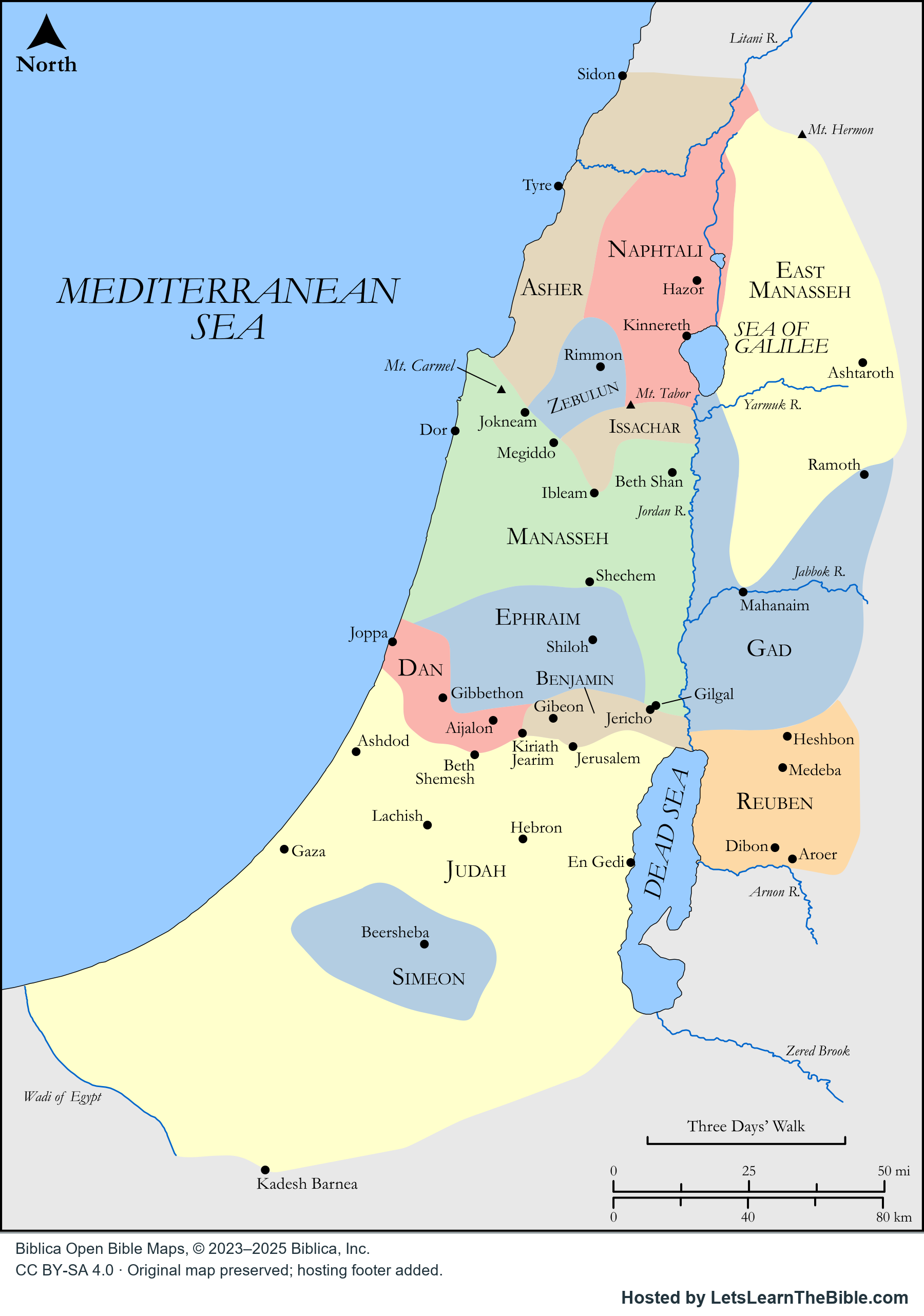
Find Sidon near the top of the coast, then follow the shore south to Tyre. Move inland to Hazor, above the Sea of Galilee. This gives three named reference points for the northern part of the index. The map's colored areas concern tribal allotments; they do not certify that every population inside a color was expelled or that those boundaries remained political borders in Jesus' lifetime.
Eight of this page's eleven entries are not labeled on this particular map. The table states those gaps so you can use its passages without guessing a point on the image. Especially distinguish the large Dan tribal label near the southern coastal region from the northern city called Dan in Judges 18. They are not interchangeable markers. This is a regional orientation map, not an eleven-city itinerary or a reconstruction of Jesus' route.
The linked place names in the index below open OpenBible.info's individual geographical records, with a map, modern identification candidates and the relevant biblical references. For the overview map's eight missing entries, these links restore a way to locate or compare the proposed sites. Use the names and candidate labels together: a confidence score is the compiler's relative assessment of its sources, not a surveyed certainty. If the record's map is unavailable, use its named modern site to orient yourself in the northern regional map around Tel Dan or the lake map around Tell Hum; these broad views are centered on the cited candidate locations, not plotted biblical routes.
Compare Capernaum's Tell Hum candidate with Chorazin's Khirbet Karraza candidate, then zoom out to compare the lake with Tel Dan and Damascus. Accho's record identifies Tel Akko, while Ptolemais identifies Acre and notes the city's movement toward the coast; keep the two historical footprints distinct. Ijon offers Tell Dibbine and an alternative at Marjaayoun. The Kedesh link is specifically Kedesh-naphtali in Judges 4:6, with several proposed sites, rather than a promise that one Kedesh point settles Barak's hometown. The Merom link is Waters of Merom, offering competing water features from the Lake Huleh area to other northern candidates. Compare these alternatives on that record's map; do not replace them with the separate town named Merom or a single certain battle pin.
Northern places: text, map coverage and a useful distinction
| Place | Passage and significance | Reading the map and the claim |
|---|---|---|
| Accho (Ptolemais) | Judges 1:31–32 says Asher did not drive out Accho's inhabitants. Acts 21:7 records Paul reaching Ptolemais from Tyre and staying with believers for one day. | Neither name is labeled here. The older index pairs these names, but the two passages themselves do not narrate a renaming or date it. |
| Capernaum | Matthew 4:12–17 says Jesus left Nazareth and settled at Capernaum beside the sea. Luke 4:31 describes his teaching there on Sabbaths. | Not labeled. Use the Sea of Galilee for broad orientation, not as a substitute for a marked town. Neither passage supplies the earlier article's exact year or Pentecost date. |
| Chorazin | Matthew 11:20–24 includes Chorazin, Bethsaida and Capernaum in Jesus' warning about mighty works and failure to repent. | Not labeled. The rebuke links the town with his works but does not provide a visit-by-visit itinerary. |
| Damascus | Acts 9:10–19 places Ananias, Saul's restored sight and his baptism in Damascus. | Not labeled. Its presence in this index does not make it an Israelite tribal city; do not infer its position from the map's eastern towns. |
| Dan | Judges 18:27–29 recounts the destruction of Laish and its rebuilding under the name Dan. Judges 20:1 uses “Dan even to Beer-sheba” in describing a national assembly. | The northern city is not labeled. The map's southwestern DAN names a tribal area. A northern geographical endpoint does not mean every famous member of that tribe lived in the northern city. |
| Hazor | Joshua 11:1–13 makes Hazor's king a leader of the northern coalition and describes the city's burning. 2 Kings 15:29 later names Hazor among Tiglath-pileser's captures. | Labeled inland north of the Sea of Galilee. Keep Joshua's campaign separate from the much later Assyrian campaign. |
| Ijon | 1 Kings 15:20 names Ijon in Ben-hadad's attack; 2 Kings 15:29 names it in the later Assyrian capture and deportation. | Not labeled. These are two separate attacks under different rulers, not one combined episode. |
| Kedesh | Judges 4:6–10 identifies Barak with Kedesh-naphtali and says he summons Naphtali and Zebulun there before the conflict with Sisera. | Not labeled. The added “Naphtali” in the passage helps prevent confusion with other similarly named places. |
| Merom | Joshua 11:5–8 calls the gathering place the waters of Merom. Joshua's sudden attack breaks the coalition assembled there. | Not labeled. This entry concerns waters and a battle setting; the passage does not call it a city or equate it with the Sea of Galilee. |
| Sidon | Joshua 19:28 mentions great Zidon in Asher's boundary description. Judges 1:31–32 says Asher did not expel its inhabitants. Matthew 15:21 places Jesus in the districts of Tyre and Sidon. | Labeled on the northern coast. A boundary reference, a statement about inhabitants and a later ministry journey answer different questions. |
| Tyre | Joshua 19:29 names the strong city Tyre in the boundary description. 1 Kings 5:1–12 describes Hiram's dealings with Solomon and the timber supply. Acts 21:3–6 places Paul with disciples at Tyre. | Labeled south of Sidon on the coast. Diplomatic and commercial relations with its king should not be rewritten as proof of permanent Israelite rule. |
Boundary descriptions do not settle who controlled the ports
Read Joshua 19:28–29 alongside Judges 1:31–32. The former locates Sidon and Tyre in a description of Asher's border; the latter explicitly describes Asher living among inhabitants it had not driven out, including Accho and Sidon. The practical lesson is to distinguish an allotted or described territory from a successfully occupied city. A map color cannot erase the narrative's statement about continued Canaanite inhabitants.
Tyre's relationship with Solomon supplies another kind of evidence. Hiram is king of Tyre, sending timber and arranging work and payment with Solomon (1 Kings 5:1–12). This is a relationship between rulers. For a reader comparing Old and New Testament geography, Acts 21 adds a later coastal journey: Tyre, then Ptolemais, with different lengths of stay. It does not turn that voyage into evidence about Asher's earlier conquest.
A town, a district and a rebuke are different kinds of ministry evidence
Capernaum has an explicit residence and teaching connection in Matthew 4:13 and Luke 4:31. Tyre and Sidon enter Matthew 15:21–28 as a district in which the encounter with the Canaanite woman takes place. Mark 7:24–31 likewise names the borders of Tyre and Sidon. This warrants a regional connection; it does not identify a surviving house or require a visit to every point inside the district.
Chorazin enters the selected passages through the comparison in Matthew 11:20–24. Jesus contrasts the response of Chorazin and Bethsaida with what Tyre and Sidon would have done. That rhetorical comparison is not a chronological travel list. Nor should Hazor's Old Testament prominence, or Saul's later experience at Damascus, be used to invent a Gospel visit to those places.
Two comparisons to try with the index
- Trace Tyre to Sidon on the image, then compare Joshua 19:28–29, Judges 1:31–32 and Matthew 15:21. Ask which text concerns boundaries, which concerns inhabitants and which concerns a ministry district.
- Find Hazor north of the lake. Compare Joshua 11 with 2 Kings 15:29, noting the named ruler and action in each account. Then look for Merom: its absence from this map is a reason to keep the textual place name distinct, rather than inventing an exact map position.
Sources and map limits
- Primary biblical passages: Joshua 11:1–13; 19:28–29; Judges 1:27–33; 4:4–10; 18:27–29; 20:1; 1 Kings 5:1–12; 15:20; 2 Kings 15:29; Matthew 4:12–17; 11:20–24; 15:21–28; Mark 7:24–31; Luke 4:16, 31; Acts 9:10–19; 21:1–7, King James Version.
- The credited Biblica map supplies regional cartographic context, with selected towns and tribal areas. It does not label every entry, establish an Accho–Ptolemais renaming date, or certify exact modern archaeological sites.
OpenBible.info individual geographical records, linked in the index, supply modern map locating access and site alternatives. The publisher's geocoding dataset supplies the candidate positions used to center the regional base-map links. These are geographical reference aids, separate from proof of a narrated event or the precise identity of a disputed site.