South central Israel brings together the Jordan crossing, Joshua's campaigns, Samuel and Saul, David's capture of Zion and places connected with Jesus and Peter. These events span different biblical periods. Use this guide to match a town to its passage before treating the names as stops on one itinerary.
Jericho precedes Ai in Joshua's crossing and conquest narrative. Gibeon and the valley of Aijalon belong to the same battle account in Joshua 10. Shiloh is where the tabernacle is set up and where the ark is fetched before its capture in battle. The sixteen-place table and event comparisons explain those connections and the limits of the evidence.
Map: locating towns within their regional setting
This Levitical-towns map gives a wider setting for four places in this guide: Gezer, Aijalon, Beth Horon and Gibeon. Find their cluster west of the Jordan and north of the Dead Sea. Their relative positions help orient a reader studying the central region, but the symbols classify Levitical towns; they do not mark Joshua's battle route.
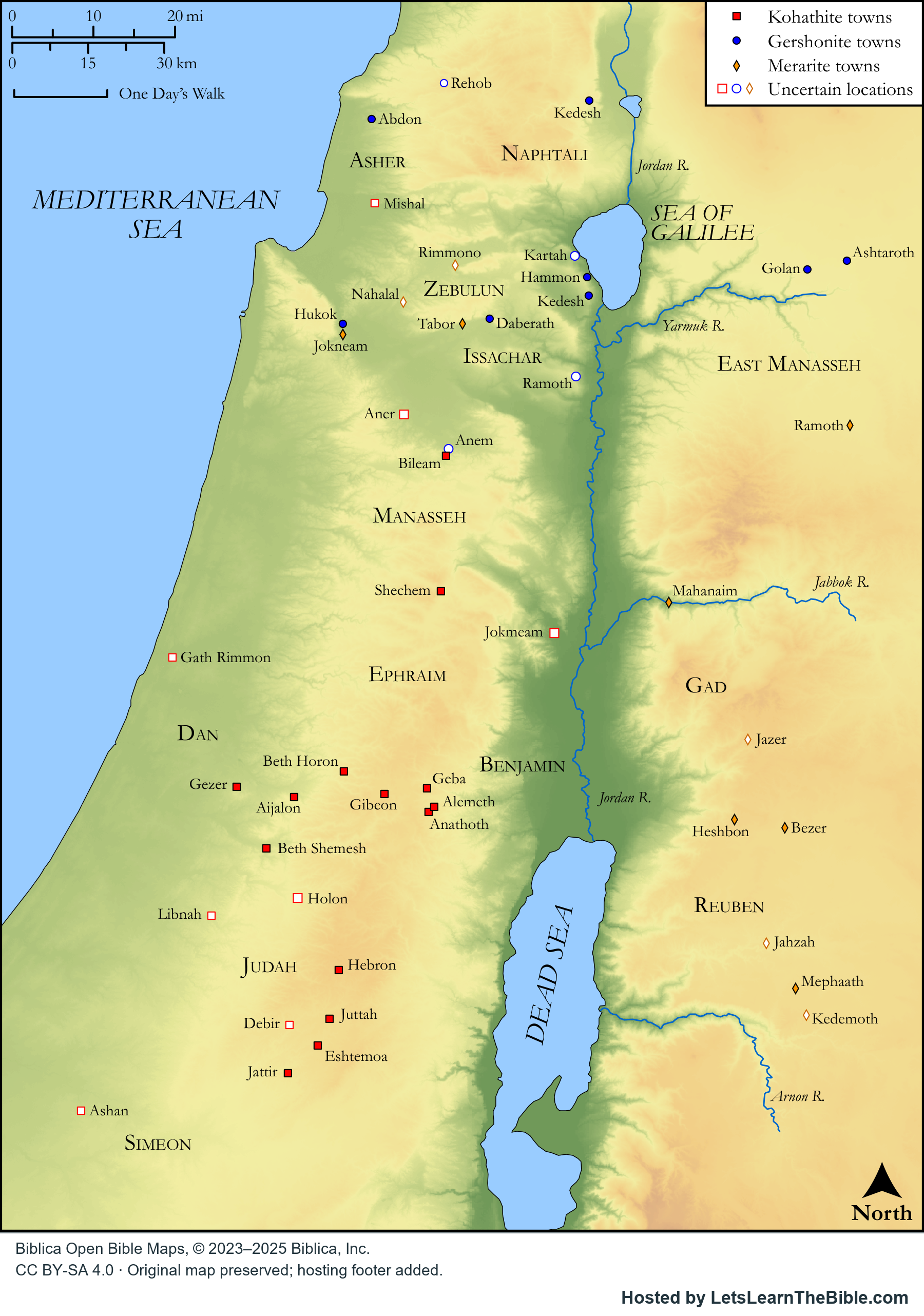
The map does not label all sixteen places below and is not a map of first-century ministry. Filled and open symbols distinguish the cartographer's location judgments, while colors and shapes distinguish Levitical groups. Use the passages in the table for events that the map does not depict.
Sixteen south central places
| Place | Biblical setting | What to distinguish |
|---|---|---|
| Ai | After Jericho, an initial Israelite attack fails (Joshua 7:2–5). Joshua 8 records the later successful attack and the city's destruction. | “After Jericho” is a sequence within this narrative, not a claim that Israel had never conquered towns east of the Jordan. |
| Aijalon / Ajalon | Joshua's appeal names the moon in the valley of Ajalon and the sun over Gibeon (Joshua 10:12–14; KJV spelling Ajalon). | Both names belong to one appeal during the defense of Gibeon, rather than two independently dated miracles. |
| Aphek / Antipatris | Aphek is a Philistine gathering place in 1 Samuel 4:1 and 29:1. Antipatris is an overnight destination while soldiers escort Paul toward Caesarea (Acts 23:23–35). | The biblical texts do not themselves say that Aphek was renamed Antipatris. Keep the two narrative names distinct when comparing a traditional regional association. |
| Beth-horon | Joshua 10:10–11 describes the pursuit through the ascent and descent of Beth-horon. First Chronicles 7:24 credits Sherah with building the lower and upper towns. | The building notice does not provide a full archaeological foundation history. The two Beth-horons should not be flattened into one unnamed point. |
| Bethany | The village of Mary, Martha and Lazarus, near Jerusalem (John 11:1, 18). Jesus raises Lazarus after four days in the tomb (11:17, 39–44). | This Bethany is not Bethabara beyond the Jordan in the KJV of John 1:28. Luke 10:38–42 does not itself name the village in its Martha and Mary account. |
| Bethel | Abram camps between Bethel and Ai (Genesis 12:8); Jacob names Bethel after his dream (28:10–22). Sons of the prophets are there in 2 Kings 2:3. | Abram's campsite, Jacob's naming account and the prophetic community are separate episodes, not one founding event. |
| Gezer | Joshua 16:3, 10 places it in Ephraim's setting and says the Canaanites remain under tribute. Judges 1:29 repeats their continued presence. | First Kings 9:15–17 later describes Pharaoh's capture and burning of Gezer, its gift to his daughter and Solomon's building work. “Never possessed” hides that later account. |
| Gibeah | Saul goes home to Gibeah after his public selection (1 Samuel 10:26); it is again his residence in 15:34. | These verses support a residence claim. They do not identify his birthplace or establish every later administrative arrangement. |
| Gibeon | Five Amorite kings attack it after its peace with Joshua, and Joshua comes to its defense (Joshua 10:1–11). | The sun-and-moon passage follows within this battle. Its duration is described as about a whole day, without specifying a modern astronomical mechanism. |
| Gilgal | Israel camps there after crossing the Jordan; Joshua sets up twelve memorial stones (Joshua 4:19–24). The people keep Passover there (5:9–12). | First Samuel 11:14–15 describes renewing the kingdom at Gilgal. Saul's earlier anointing is in 10:1; the public selection at Mizpah is in 10:17–24. |
| Jericho | Joshua 6 describes its encirclement, fall and destruction, with Rahab and her household spared. | Luke 10:30–37 uses the Jerusalem-to-Jericho journey in Jesus' Good Samaritan teaching. A story's setting is not a survey of a particular robbery site. |
| Jerusalem | Already named in Joshua 10:1. David later captures the stronghold of Zion and makes it the city of David (2 Samuel 5:6–9). | David does not first invent the name Jerusalem in that account. John 19–20 and Acts 2 concern later events around Jesus' death, resurrection and Pentecost. |
| Joppa | Peter raises Tabitha, also called Dorcas, and stays with Simon the tanner (Acts 9:36–43). His vision and Cornelius's messengers follow in Acts 10. | Simon the tanner's home is by the sea (10:6). These passages do not justify calling Joppa Israel's only usable harbor. |
| Lod / Lydda | Lod appears in the settlement list of Nehemiah 11:35. At Lydda, Peter meets Aeneas, bedridden for eight years, and tells him Jesus Christ heals him (Acts 9:32–35). | The two biblical name forms can be compared without claiming that either cited passage records a formal renaming. Peter then travels from nearby Lydda to Joppa. |
| Mizpah / Mizpeh | Listed among Benjamin's towns (Joshua 18:26). Samuel assembles Israel there, and it belongs to his judging circuit (1 Samuel 7:5–16). | First Samuel 10:17–24 places Saul's public selection there. Do not equate every biblical place called Mizpah merely because the name matches. |
| Shiloh | Israel sets up the tabernacle there and prepares allotments for seven tribes (Joshua 18:1–10). The ark is fetched from Shiloh before battle (1 Samuel 4:3–4). | The Philistines capture the ark in the battle (4:10–11), not in a narrated capture inside Shiloh. Neither passage supplies the old guide's exact calendar date. |
Jericho, Ai, Gibeon and Aijalon: follow the narrative
Joshua 4–6 proceeds from the Jordan crossing to a camp at Gilgal and then to Jericho. Joshua 7–8 turns to Ai, first with a defeat and then with a successful attack. This ordering answers the question about the first conquests west of the Jordan without forgetting the earlier eastern campaigns. It also prevents the map from suggesting that the initial attack on Ai was a straightforward success.
Gibeon and Aijalon form a different comparison. Joshua 10:1–5 says that Gibeon's peace with Israel provokes five Amorite kings. Gibeon asks for help; Joshua comes up from Gilgal, and the pursuit passes Beth-horon. The appeal about the sun over Gibeon and moon in Ajalon's valley occurs within that account. Verse 14 attributes the victory to the Lord fighting for Israel. The text's “about a whole day” should not be changed into an exact twenty-four-hour calculation or a claim to have explained the event's physics.
Keep Saul's three kingship settings and Shiloh's ark sequence separate
Several place names help organize Saul's rise. In 1 Samuel 10:1, Samuel privately anoints him. At Mizpah, the people assemble and Saul is publicly identified by lot (10:17–24). After Saul's rescue of Jabesh-gilead, Samuel calls the people to Gilgal to renew the kingdom (11:14–15). Calling the Gilgal gathering Saul's initial anointing merges separate events and misdirects a reader looking up the earlier passage.
Shiloh also requires a sequence. Joshua 18:1 says the tabernacle is set up there. The chapter then concerns seven tribes still awaiting their allotments; it does not make every tribal assignment begin at that moment. In 1 Samuel 4, Israel has already lost a battle when the elders call for the ark from Shiloh. The ark reaches the camp, another battle follows and the Philistines capture it. Describing only “the ark was captured at Shiloh” removes the movement that explains the account.
Bethany, Jerusalem, Lydda and Joppa in the later accounts
John places Bethany about fifteen furlongs from Jerusalem (John 11:18), making the journey between the two meaningful within the Lazarus account. The four days refer to Lazarus's time in the tomb, not the length of a trip. John 12:1–3 later returns to Bethany for a meal where Martha serves, Lazarus reclines at table and Mary anoints Jesus' feet.
For Jerusalem, distinguish the city from places near it. John 19:20 says the crucifixion site is near the city; 19:41–42 describes the nearby garden tomb. John 20 then recounts the empty tomb and Mary Magdalene's encounter with the risen Jesus. Acts 2 places the Pentecost gathering and its multilingual audience in Jerusalem. These passages provide the events without requiring an unsupported exact year or a count of the city's hills and sieges.
Acts 9–10 supplies a connected movement from Lydda to Joppa and then toward Caesarea. Peter first meets Aeneas at Lydda. Disciples from nearby Joppa ask him to come after Tabitha dies; following her restoration, he stays with Simon the tanner. Cornelius's messengers then seek him there. Read the vision alongside Peter's explanation in Acts 10:28: God has shown him not to call any person common or unclean. That movement explains why these coastal towns belong together in a study, even though the earlier Levitical map does not plot their first-century story.
Sources and identification limits
The comparisons use the King James Version: Genesis 12 and 28; Joshua 4–10, 16 and 18; Judges 1:29; 1 Samuel 4, 7, 10–11, 15:34 and 29; 2 Samuel 5; 1 Kings 9:15–17; 2 Kings 2:1–5; 1 Chronicles 7:20–29; Nehemiah 11:31–36; Luke 10; John 11–12 and 19–20; and Acts 2, 9–10 and 23:23–35. Biblical names, related spellings and the licensed map are compared at the level these sources support. An exact modern site, a formal renaming or a foundation date requires additional evidence; none is inferred merely from a familiar name.