The middle and northern parts of this index connect the coastal plain, Galilee and the hill country through sixteen biblical place names. Some entries are cities, while Gennesaret can refer to a district and Samaria can name either a city or a wider region. For the page's three main questions: Mary Magdalene is traditionally associated with Magdala; the “battlefield of Israel” description refers broadly to the Jezreel–Megiddo setting; and Revelation's Armageddon passage describes a gathering without giving a detailed modern battlefield map.
Start with four places actually labeled on this map
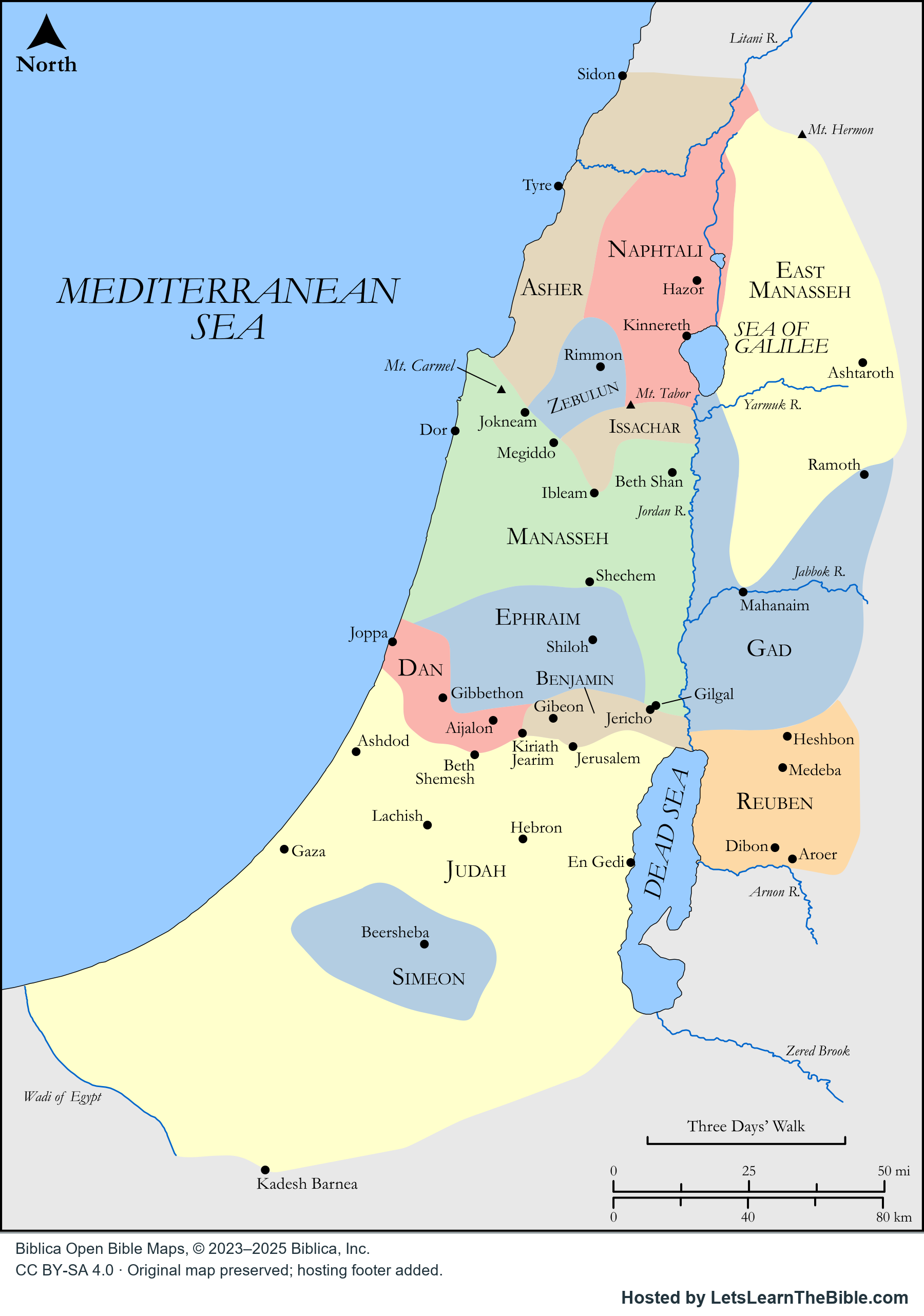
Find Dor on the Mediterranean coast. Move inland to Megiddo, then farther east to the label Beth Shan, west of the Jordan. Follow the central hill country south to Shechem. These four names establish a useful regional frame for the index. They do not plot a single biblical journey, and their placement does not identify a modern street, excavation trench or exact battlefield.
The image's main subject is tribal allotments. It leaves twelve of the sixteen entries below unlabeled, including the Gospel towns of Cana, Nain, Nazareth and Magdala. Use the “Map coverage” column to see this directly. The map cannot decide which ancient name corresponds to a disputed modern site, and its tribal colors should not be read as Roman-period political boundaries.
The linked place names below open OpenBible.info's individual geographical records for all twelve entries omitted from this overview. Each supplies a map and the modern site identification or alternatives on which its position depends. Use a record's candidate labels with its map; its confidence assessments summarize the compiler's sources and are not exact archaeological probabilities. For a broad comparison or if a record's map is unavailable, open the Galilee view centered on Nazareth or the hill-country view centered on the Samaria city candidate. These base-map views provide orientation, not reconstructed journeys.
On the Galilee view, compare Nazareth and Nain with Magdala's Majdal candidate and Gennesaret's El Ghuweir district on the western side of the lake. The Gennesaret point represents a region, not a town gate or a precise landing. Cana's record presents Horbat Qana, Kefr Kenna and Ain Qana as alternatives; Endor's record likewise presents several proposed sites. Magdala's map locates the record's conventional Majdal identification without settling the name and origin questions discussed below. For the royal narratives, use Jezreel's in Issachar record (Tel Yizre'el), Samaria's settlement record, Dothan's Tel Dotan and Tirzah's Tell el Farah. The Sychar record compares Askar with a proposed Shechem identification at Tell Balatah; neither should be treated as certified by a map marker. The Caesarea link identifies coastal Caesarea Maritima, not inland Caesarea Philippi.
The complete north-central place index
| Place | What the selected passage says | Map coverage and caution |
|---|---|---|
| Bethshan | 1 Samuel 31:8–13 describes Saul's body fastened to Beth-shan's wall and its retrieval, with his sons' bodies, by men from Jabesh-gilead. | Labeled “Beth Shan,” west of the Jordan. Distinguish the location of the displayed bodies from the battle in which Saul died. |
| Caesarea | Acts 8:40 brings Philip to Caesarea; 12:19–23 places Herod there. Acts 23:23–35 describes Paul's guarded transfer to Felix, and 24:27 records two years passing while Paul remains bound. | Not labeled. This is the Caesarea in those coastal travel and administrative accounts; do not substitute a similarly named town simply because it appears on another map. |
| Cana | John 2:1–11 locates the wedding and the transformation of water into wine at Cana of Galilee, calling it the beginning of Jesus' signs. | Not labeled. The passage does not make Cana the place of the preceding temptation or give a modern wedding-site coordinate. |
| Dor | Joshua 12:23 lists Dor's king among defeated rulers; Judges 1:27 later says Manasseh did not drive out Dor's inhabitants. | Labeled on the coast. A defeated king and the continuing presence of inhabitants are different statements, not reasons to omit either text. |
| Dothan | Genesis 37:13–28 follows Joseph from the search for his brothers at Shechem to Dothan, the pit and the sale connected with the journey to Egypt. | Not labeled. Shechem is a marked point in the story's sequence, but its dot is not a marker for Dothan. |
| Endor | 1 Samuel 28:3–20 records Saul's disguised visit to the woman with a familiar spirit at Endor, against the background of the Philistine threat. | Not labeled. The passage's account of the encounter should not be replaced with a claim that a mapped hill proves how contact with the dead occurred. |
| Gennesaret | Matthew 14:22–36 narrates Jesus walking on the sea, the disciples' fear, and the subsequent landing in the land of Gennesaret with healings there. | Not labeled. The disciples thought they saw a spirit; the narrator identifies the person as Jesus. The landing district is not the point on the water where they first saw him. |
| Jezreel | 2 Kings 9:30–37 places Jezebel's death at Jezreel. In 10:1–11, Ahab's sons are in Samaria; their heads are sent to Jezreel, where Jehu also kills those remaining of Ahab's house. | Not labeled. The city and the broader valley must be distinguished; the account does not say every family member was killed in one city. |
| Magdala | Matthew 15:32–39, in the KJV, places Jesus' arrival in the coasts of Magdala after the feeding of four thousand. Luke 8:2 names Mary Magdalene. | Not labeled. Her traditional association with Magdala and the limits of the place-name evidence are discussed below. |
| Megiddo | 2 Kings 23:29–30 places Josiah's death in his encounter with Pharaoh-nechoh at Megiddo and his subsequent transport to Jerusalem. | Labeled inland from Dor. Revelation's Armageddon is a separate interpretive question; this dot does not mark the movements of an end-time army. |
| Nain | Luke 7:11–17 locates the encounter with a widow's funeral procession near Nain's gate and describes Jesus restoring her only son to life. | Not labeled. The passage supplies the narrative setting, without identifying a surviving modern gate. |
| Nazareth | Matthew 2:19–23 describes the family's settlement at Nazareth after Egypt. Luke 4:16 calls it the place where Jesus had been brought up; Matthew 4:13 then says he left for Capernaum. | Not labeled. These passages support a sequence of places. A Harmony of the Gospels may arrange that sequence, but an exact 27 AD or Pentecost timetable is not stated in these verses. |
| Samaria | 1 Kings 16:23–28 says Omri reigned at Tirzah, bought Shemer's hill, built on it and named the new city Samaria. John 4 also uses Samaria for a region through which Jesus travels. | The city is not labeled. A regional reference in John should not automatically be turned into a visit to Omri's city. |
| Shechem | Genesis 12:4–6 brings Abram to Sichem; Joshua 20:7 lists Shechem among the cities of refuge. 1 Kings 12:25 says Jeroboam built Shechem and lived there. | Labeled in the central hill country. These different periods explain why a town can appear in patriarchal, legal and royal narratives. |
| Sychar | John 4:4–10 locates Sychar near Jacob's parcel of land and the well. Verses 28–30, 39–42 trace the woman's report and the townspeople's response to Jesus. | Not labeled. John names Sychar, not Shechem, in this encounter; the map's Shechem dot cannot establish that the two are identical. |
| Tirzah | 1 Kings 14:17 brings Jeroboam's wife to Tirzah; 16:23 says Omri reigned there for six years before the account of his building at Samaria. | Not labeled. Neither the return of Jeroboam's wife nor the reign formula gives an exact date when a capital was first moved there. |
What can we say about where Mary Magdalene came from?
Magdala is the traditional answer. For an explicit statement of that tradition, Benedict XVI's address of July 22, 2012 calls Mary a native of the village of Magdala on the Sea of Galilee and connects her epithet with that place. Luke 8:1–3 itself identifies her as Mary Magdalene, says seven demons had gone out of her, and places her among women supporting the ministry. It does not provide a residence history or a household address.
The name and site are subjects of historical discussion. In the published abstract of her 2014 research on Magdala, Joan E. Taylor questions straightforward equivalences among Magdala, Magadan and other lake settlements, and considers more than one explanation of “Magdalene.” That is a scholarly argument, not proof that Mary came from another specific town. The practical conclusion is to preserve the traditional association while avoiding a claim that these Gospel verses certify her home at a particular excavated building.
Where is the “battlefield of Israel,” and what does Armageddon say?
The “battlefield of Israel” description points broadly to the Jezreel–Megiddo setting, rather than one battlefield used by every biblical army. The Jezreel Expedition places Jezreel between Megiddo and Bet Shean in the Jezreel Valley; Tel Aviv University's Megiddo introduction explains Megiddo's strategic position on the Egypt–Mesopotamia route and its repeated imperial battles. Begin with the marked Megiddo and Beth Shan for regional orientation, but note that this image does not label Jezreel or draw its valley. Specific accounts supply their own locations: Judges 4:6–7 names Mount Tabor and the river Kishon in the summons to Barak, while 2 Kings 23:29–30 names Megiddo in Josiah's fatal encounter. Those events should not be merged into a single battle.
Revelation 16:12–16 describes spirits associated with the dragon, beast and false prophet gathering kings for the great day of God; verse 16 names the gathering place Armageddon. Revelation 19:19–21 describes the beast and kings making war against the rider and his army, but does not repeat that place name or supply a road plan. The university introduction describes the Megiddo–Armageddon identification as one made by many historians and theologians. That interpretation does not justify presenting a small hill on this map as the surveyed spot where Satan will personally fight Jesus. The dragon, beast and assembled kings also should not be treated as one interchangeable character.
Read Shechem, Tirzah and Samaria as a sequence of royal references
1 Kings 12:25 associates Jeroboam's residence with Shechem, and 14:17 brings his wife to Tirzah. The more explicit transition in 16:23–24 says Omri reigned at Tirzah for six years, then recounts his purchase of the hill and construction of Samaria. These references help explain the index's progression without adding an unsupported calendar year or claiming that each passage formally announces a capital transfer.
Compare that royal narrative with John 4: the setting there is Samaria as a region, with Sychar and Jacob's well specified within the encounter. The place names perform different jobs. A route across a region, a city founded by a king and a city named in a conversation should remain distinguishable even when a summary map uses few labels.
A short comparison exercise
- Find Dor, Megiddo, Beth Shan and Shechem. For each, choose one reference from the table and ask whether it concerns conquest, inhabitants, a king or a refuge city. The map supplies positions; the passage supplies the event.
- Compare Matthew 14:34–36 with 15:32–39. Identify which landing follows the walking-on-water account and which follows the feeding of four thousand. This prevents Gennesaret and Magdala from becoming one episode.
- Read Revelation 16:16 and 19:19–21 separately. Write down what each actually names before drawing any conclusion about a modern location.
Sources and limits
- Primary biblical passages: Genesis 12:4–6; 37:13–28; Joshua 12:23; 20:7; Judges 1:27; 4:6–7; 1 Samuel 28:3–20; 31:8–13; 1 Kings 12:25; 14:17; 16:23–28; 2 Kings 9:30–37; 10:1–11; 23:29–30; Matthew 2:19–23; 4:12–17; 14:22–36; 15:32–39; Luke 4:16; 7:11–17; 8:1–3; John 2:1–11; 4:4–10, 28–30, 39–42; Acts 8:40; 12:19–23; 23:23–35; 24:24–27; Revelation 16:12–16; 19:19–21, King James Version.
- Benedict XVI's 2012 address states the traditional Magdala association; Taylor's 2014 research abstract summarizes an alternative scholarly treatment of the name and site.
- The Jezreel Expedition and Tel Aviv University introductions supply geographical and strategic context, while the biblical passages identify particular narrated events.
- The credited Biblica map provides selected town labels and an allotment framework. It does not chart all sixteen entries, modern site identifications or a future battle.
OpenBible.info individual geographical records, linked in the index, supply modern map locating access and site alternatives. The publisher's geocoding dataset supplies the candidate positions used to center the regional base-map links. These are geographical reference aids, separate from proof of a narrated event or the precise identity of a disputed site.