The Transfiguration of Jesus: Vision, Mountain and Meaning
Original reader questions: What is the transfiguration of Jesus? Was it real? Where and when did it occur? What does it prophetically mean?
The Transfiguration is the Gospel scene in which Peter, James and John see Jesus' changed appearance, Moses and Elijah, and an overshadowing cloud, and hear the command to listen to the Son. The accounts present something the disciples see and hear; calling it a vision does not by itself mean an unreal dream. They identify a mountain setting and a relative interval, but do not name the mountain or supply a modern calendar date.
A Display of Glory Beside the Teaching about Suffering
The scene follows the confession of Jesus' identity and his teaching that he must suffer, be killed and rise again. Matthew and Mark locate the earlier conversation in the Caesarea Philippi region. Peter resists the suffering prediction; Jesus teaches about taking up the cross and speaks of the Son of Man's glory. Reading that setting keeps the mountain's splendor connected to the difficult message the disciples have just heard.
Matthew 17:1–8 describes Jesus' face shining like the sun and his clothes becoming white as light. Mark 9:2–8 emphasizes an extraordinary whiteness beyond a launderer's work. Luke 9:28–36 places the change during prayer and says Moses and Elijah appear in glory, discussing the departure Jesus is to accomplish at Jerusalem. Luke's KJV wording calls that subject his “decease.”
Peter proposes three shelters. Mark explains that he does not know what to say because they are afraid; Luke likewise says he does not know what he is saying. The cloud and voice redirect attention to Jesus, and the scene ends with Jesus alone. Matthew adds Jesus' touch and reassurance when the disciples fall afraid. These details give the account its movement: glory is disclosed, the disciples respond inadequately, and the voice commands them to listen.
The Accounts Do Not Describe an Ordinary Dream
Matthew 17:9 calls the experience a vision when Jesus tells the disciples not to report it until his resurrection. The term describes what they have seen; that verse does not define visions as events that can exist only inside an individual's imagination. Mark calls the subject of the command the things they have seen. Luke says the disciples, though heavy with sleep, see Jesus' glory when awake.
Second Peter 1:16–18 presents the mountain testimony as eyewitness experience of Jesus' majesty and of a voice heard from heaven. Within these texts, the Transfiguration is treated as a disclosure to witnesses, rather than dismissed as their ordinary sleeping dream. Reporting that claim accurately is different from pretending a modern map can independently verify a supernatural event.
The accounts name Moses and Elijah but do not explain the mechanics of their appearance. They should not be rewritten as anonymous stand-ins, nor should this scene alone be made to settle the entire Christian debate about the condition of the dead. Its explicit center is the Son and the command to hear him.
Where Are Hermon and Tabor?
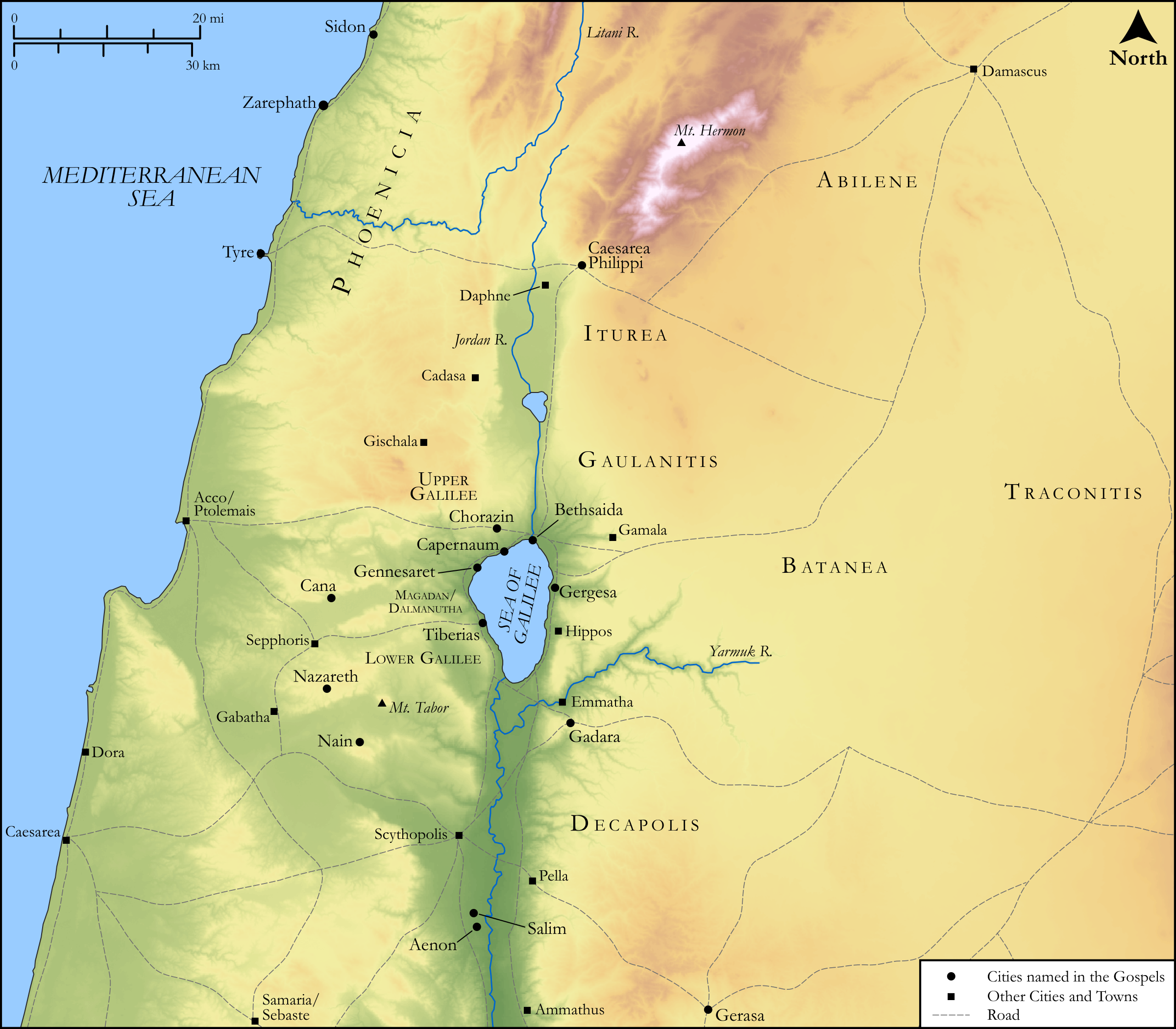
Look first for Caesarea Philippi north of the Sea of Galilee. Hermon lies farther north on the map. Tabor appears near Nazareth, southwest of the lake. Their different positions explain why choosing a mountain changes a proposed itinerary; the geographical comparison does not choose the event's location.
Matthew and Mark say a high mountain, while Luke refers to a mountain where Jesus goes to pray. None supplies the name Hermon or Tabor. The preceding Caesarea Philippi notice makes Hermon a geographical proposal worth considering, but an interval of six days leaves unreported movement. Proximity to the last named town cannot become proof that the group climbs a particular peak.
The USCCB NABRE note to Matthew 17:1 records the identifications with Tabor and Hermon and emphasizes the scene's theological mountain setting. That is an attributed edition's interpretation, not a fresh archaeological finding. Here both named mountains remain comparison points, and the actual location remains unnamed by the Gospel writers. For the wider sequence and the separate Jerusalem material in John, see the Transfiguration timeline comparison.
Separate the Text from the Reconstruction
| Reader question | Evidence in the accounts | Limit |
|---|---|---|
| Who witnesses it? | Peter, James and John accompany Jesus; the three Gospel accounts name them. | The scene does not present a public gathering of all the apostles. |
| Is it called a vision? | Matthew 17:9 uses that word; the accounts describe sight, speech and a voice heard. | The word alone does not prove the event is an unreal dream or explain Moses and Elijah's state. |
| Where is the mountain? | A mountain setting; Caesarea Philippi belongs to the preceding narrative in Matthew and Mark. | No Gospel names Tabor, Hermon, a summit or a road. |
| When does it happen? | After six days in Matthew and Mark; about eight days after the sayings in Luke. | No named month, AD year, festival date or hour of the night. |
| Why Moses and Elijah? | They converse with Jesus; Luke specifies his coming departure at Jerusalem. | A Law-and-Prophets symbolism is an interpretation of these figures, not the scene's own explicit caption. |
| How does it relate to future glory? | The preceding sayings concern the kingdom and glory; 2 Peter recalls majesty while speaking of power and coming. | That connection supplies no date for Jesus' return or schedule of resurrection events. |
A Relative Interval, Rather Than a September Date
Matthew 17:1 and Mark 9:2 say after six days. Luke 9:28 says about eight days after these sayings. Inclusive counting is one proposed explanation of the expressions, but none of the three accounts sets out its counting method. A careful comparison preserves both forms instead of replacing them with a single date that no passage prints.
Luke says the next scene, after the descent, occurs on the following day (9:37). This gives a useful local sequence without proving the exact hour of the Transfiguration. The disciples' sleepiness is not a clock reading. Nor does Jesus' habit of prayer on other occasions establish that every prayer episode must occur after sunset.
Peter's shelters may invite comparison with tabernacles, but Mark and Luke explicitly mention his confused response. The proposal does not date the event to the autumn festival. John 7 names an approaching Feast of Tabernacles but does not narrate this scene or explicitly synchronize it with the mountain. A September date in AD 29, or a particular Feast of Trumpets sunset, consequently needs evidence beyond these passages.
Listen to the Son: Glory Does Not Remove the Cross
The most direct interpretation is given by the voice: listen to the Son. That command comes after the disciples have struggled with Jesus' announcement of suffering. Luke's conversation about his coming departure, and Matthew and Mark's descent discussions about resurrection and Elijah, keep glory and suffering together. The display is not permission to ignore the teaching they find unwelcome.
There are also substantial scriptural echoes. Exodus 24:12–18 describes a mountain, six days, a cloud and divine glory. Exodus 34:29–35 describes Moses' shining face. Deuteronomy 18:15–19 commands attention to the prophet God raises up. Comparing these texts helps explain why Christian readers recognize a setting of revelation and authority. The comparison is an interpretive reading, not a claim that the mountain has thereby been identified as Sinai.
Moses and Elijah are often understood as representing the Law and the Prophets. That reading fits their scriptural roles, but the Gospel dialogue does not state an exhaustive symbolic key. Likewise, the placement after kingdom-and-glory sayings, and 2 Peter's appeal to the mountain testimony, support reading the scene as a foretaste of Jesus' majesty. They do not make the Transfiguration identical to the final return or determine that return's festival date.
Christian hope concerning believers' transformation has wider textual support: Philippians 3:20–21 speaks of bodies conformed to Christ's glorious body, and 1 John 3:1–3 connects seeing him and becoming like him with present purity. Those passages can inform reflection on the mountain's glory. They do not identify every figure in the scene as a diagram of one complete resurrection timetable. The scene's practical demand remains the one the disciples hear: attend to Jesus.
Sources and Reading Limits
- Matthew 16:13–17:13 and Mark 8:27–9:13: confession, suffering, kingdom sayings, mountain and descent.
- Luke 9:18–45 and 2 Peter 1:12–21: prayer, conversation, sight and hearing, and the next-day descent.
- Exodus 24:12–18; 34:29–35; Deuteronomy 18:15–22; Philippians 3:20–21; 1 John 3:1–3: comparisons concerning revelation, listening and future glory.
- John 7:1–13: the separately narrated festival setting.
- USCCB NABRE Matthew 17 notes: an attributed interpretive discussion of the mountain, glory and vision.
- Biblica's map metadata supplies the license; NT005 supplies regional orientation rather than an event-location claim.
Scriptural narration is paraphrased from the KJV. Mountain identifications, harmonized dates and proposed symbolic connections are kept distinct from the details the passages actually state.