The six cities of refuge were Kedesh, Shechem and Hebron west of the Jordan, and Bezer, Ramoth in Gilead and Golan east of it. Joshua 20:7–9 appoints them as places where someone who killed unintentionally could flee from the avenger of blood and receive a hearing. Their purpose combined immediate refuge with judgment, followed by protected residence under defined conditions.
Map and Reading Key
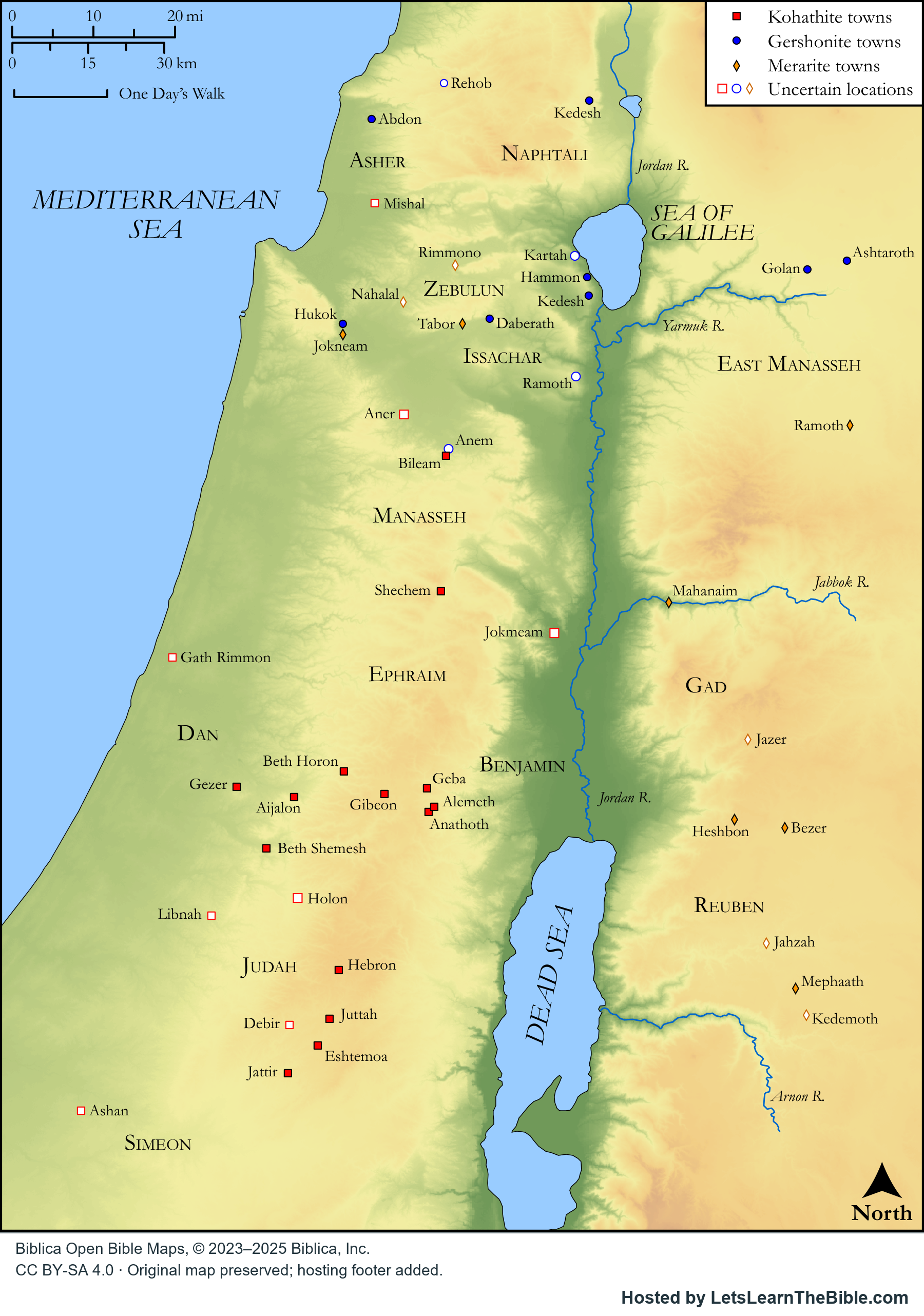
On the western side, find the northern Kedesh in Naphtali, then Shechem in the central hill country and Hebron farther south in Judah. On the eastern side, find Golan in Bashan, Ramoth in Gilead and Bezer in Reuben's portion. The map uses the short label “Ramoth” for the eastern city.
Two repeated names need care: the refuge Kedesh is the northern one in Naphtali, not the other Kedesh nearer the Sea of Galilee; Ramoth in Gilead is east of the Jordan, not the western Ramoth. Ancient site identifications, especially the eastern locations, should be treated as approximate rather than confirmed modern coordinates. The map's symbols show its own selected identifications; they do not settle every question about a site's position.
The Six Cities, Their Tribes and Their Locations
| City | Side of Jordan | Biblical setting | How to identify it in the map and text |
|---|---|---|---|
| Kedesh | West | Galilee, hill country of Naphtali. | The northern Kedesh, north of the Sea of Galilee. Joshua 20:7; 21:32. |
| Shechem | West | Hill country of Ephraim. | The central western city. Its refuge assignment is explicitly Ephraim's, not western Manasseh's. Joshua 20:7; 21:20–21. |
| Hebron / Kirjath-arba | West | Hill country of Judah. | The southern western city. Joshua 20:7; 21:11–13. |
| Bezer | East | Wilderness or plain country of Reuben. | The southeastern city in the map's Reuben region. Deuteronomy 4:43; Joshua 20:8; 21:36. |
| Ramoth in Gilead | East | Gilead, in Gad. | The eastern Ramoth, north of Bezer; also called Ramoth-gilead. Deuteronomy 4:43; Joshua 20:8; 21:38. |
| Golan | East | Bashan, in Manasseh. | The northeastern city, beyond the Sea of Galilee. Deuteronomy 4:43; Joshua 20:8; 21:27. |
The land around a city, the tribe contributing it and the Levites living there are related but different descriptions. Numbers 35:6–7 includes the six refuge cities within the forty-eight Levitical towns, rather than adding six to make fifty-four. At Hebron, Joshua 21:11–13 specifically distinguishes the city and pasturelands assigned to Aaron's descendants from Caleb's fields and villages. See the Hebron comparison and Levi's place in the tribal inheritance.
Why Were These Cities Appointed?
Exodus 21:12–14 already distinguishes a fatal attack committed deliberately from a death for which a place of flight will be provided. It also says that a person who kills by deceit can be taken even from the altar. Sacred space therefore does not supply an unrestricted escape from responsibility for intentional killing.
Numbers 35 develops the arrangement: six cities, three on each side of the Jordan, are to protect an accused killer from dying at the avenger's hand before standing before the congregation in judgment. Deuteronomy 4:41–43 names the three eastern cities set apart by Moses; Joshua 20 records the appointment of all six. The protection is available to Israelites and to resident strangers or sojourners among them (Numbers 35:15; Joshua 20:9).
How Did the Law Distinguish Unintentional Killing from Murder?
Deuteronomy 19:4–6 gives a concrete example: two neighbors go to cut wood, an axe head slips from its handle, and one is killed. The survivor had not previously hated the victim. Flight prevents the avenger, pursuing in anger, from taking a life that the passage says was not deserving of death.
Numbers 35:16–24 examines the weapon, the circumstances and prior hostility. It describes fatal attacks with lethal implements, hatred, ambush and enmity, as well as a sudden act without enmity or an unseen person struck without an intention to harm. These cases are matters for judgment. An accused person's claim that the death was accidental does not itself decide the outcome.
Deuteronomy 19:11–13 addresses someone who hates a neighbor, lies in wait, kills and then flees to a refuge city. The elders are to fetch that person and hand him over to the avenger of blood. Protection from immediate retaliation and exoneration of intentional murder are therefore separate questions.
What Happened After Someone Arrived?
| Stage | What the passages require | What the stage does not establish |
|---|---|---|
| 1. Flight and explanation | The person comes to the gate, states the case to the elders and receives a place to stay (Joshua 20:3–4). | Arrival is not the final judgment of innocence or guilt. |
| 2. Protection pending judgment | The congregation must hear the case; Numbers 35:12 and Joshua 20:9 protect against death before that judgment. | The avenger's pursuit alone does not decide the case. |
| 3. Congregational judgment | The congregation judges between the slayer and the avenger under the stated distinctions (Numbers 35:22–25). | A single witness cannot supply the testimony required for a death sentence (35:30). |
| 4. The decision and its consequences | For the protected slayer, the congregation orders return to the refuge city and residence there. Deliberate murder is subject to death under Numbers 35:16–21 and Deuteronomy 19:11–13. | The same outcome does not apply to every person who enters the city. |
| 5. Residence and eventual return | The protected slayer stays until the high priest's death, after which return to the person's own land is permitted (Numbers 35:25–28). | A favorable judgment alone does not permit immediate return home. |
The avenger of blood is the person from whom the slayer flees and, in the murder cases, the person charged with executing the killer (Numbers 35:19–25). These passages regulate that role through judgment and the distinction between kinds of killing. They do not provide a complete rule here for ranking which relative must fill it. Calling the avenger invariably the nearest relative would require further evidence.
What Were the Conditions of Protected Residence?
Protection after judgment depends on remaining within the refuge city's boundary until the high priest dies. Numbers 35:26–28 states that if the slayer goes outside and the avenger kills him there, the avenger is not held guilty of bloodshed under this law. The city's protection is therefore bounded, not an unconditional guarantee of safety wherever the slayer goes.
The high priest's death permits the protected slayer to return to the land of his possession. This follows the judgment and the period of residence; the text does not make the priest's death a substitute for a hearing. Nor can payment buy either outcome away. Numbers 35:31 forbids a ransom for a murderer liable to death, and verse 32 forbids payment allowing a refugee to return home before the priest's death.
The chapter ends by connecting these rules to innocent blood, the pollution of the land and the Lord's presence among Israel (35:33–34). Its concern includes both preventing wrongful killing and taking deliberate killing seriously.
What Does the Text Say About Access and Roads?
Deuteronomy 19:3 requires preparation of the way and division of the land into three parts. Verse 6 explains the practical concern: a long journey could allow an angry avenger to catch the person fleeing. That supports attention to access. It supplies no maximum one-day journey, guaranteed travel time, road width or wording for signposts, so those details should not be attributed to this passage.
The six actually appointed cities are named in Joshua 20. Deuteronomy 19:8–9 also gives a conditional instruction to add three more if the territory is enlarged and the stated obedience conditions are met. That prospective command should be distinguished from a list of nine towns already established. Neither these verses nor this map supplies three additional appointed names.
Sources and Limits
This guide independently compares Exodus 21:12–14; Numbers 35; Deuteronomy 4:41–43 and 19; and Joshua 20–21, checked in the King James Version text. Read the principal refuge laws and the appointment narrative together. The geographical descriptions follow the biblical regional names and the credited Biblica map; precise archaeological identifications have not been established by this comparison.
The stages table is an explanatory comparison of these passages, not a claim to recover every hearing practice in ancient Israel. The discussion does not use later road traditions as though they were stated in Joshua. A useful reading exercise is to trace which verses concern admission, which concern judgment, and which concern residence after judgment: each answers a different part of the refuge question.