Joshua 13–19 describes Israel's land being assigned to tribes on both sides of the Jordan River. Reuben, Gad and half of Manasseh had received their inheritance under Moses east of the river. Joshua, Eleazar the priest and the tribal leaders distributed the western inheritance. The map below helps locate those allotments; the colored areas represent approximate tribal portions, rather than proof of permanent control of every town.
Map of the Tribal Allotments
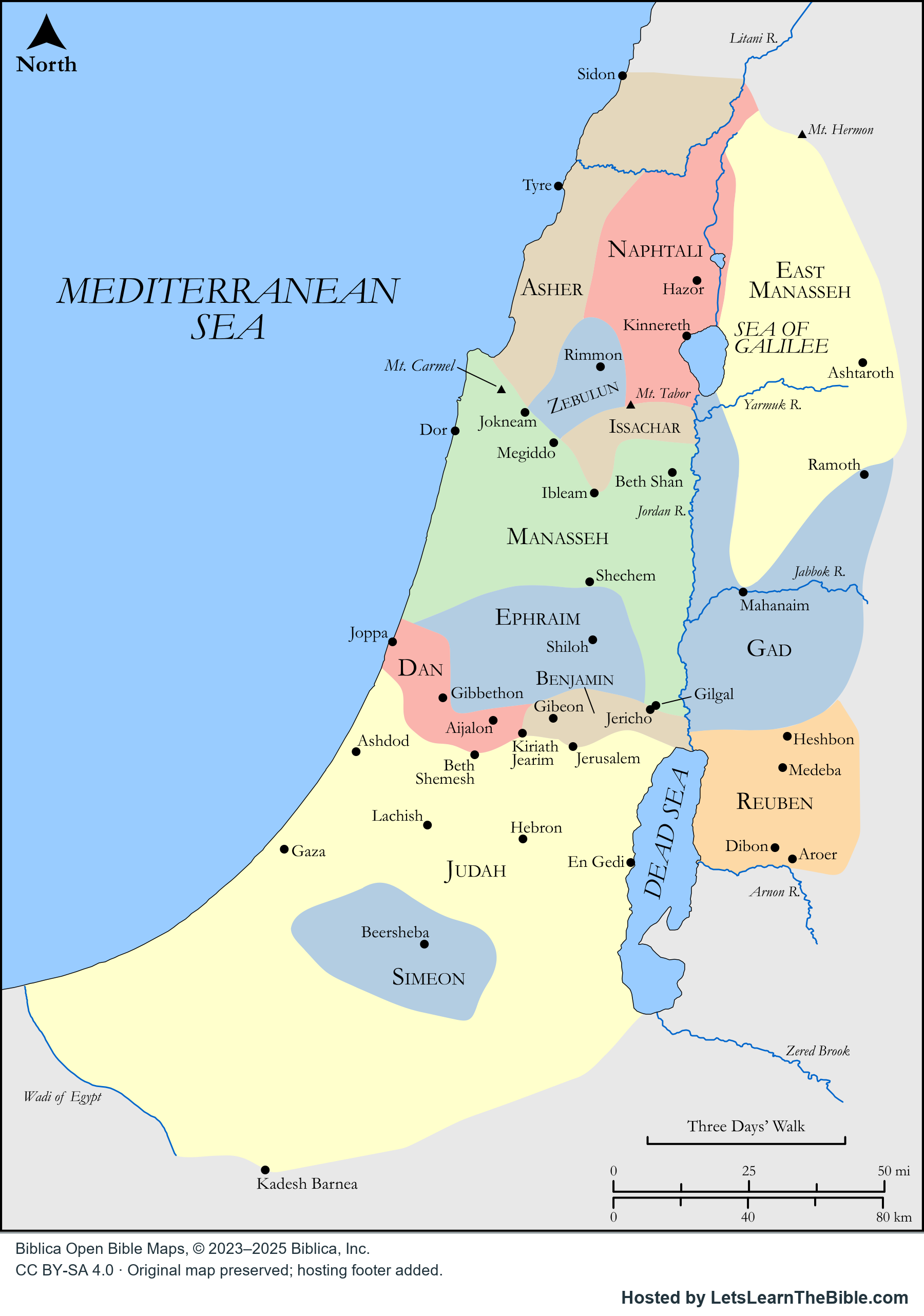
Start with the Jordan, running from the Sea of Galilee toward the Dead Sea. Reuben, Gad and eastern Manasseh lie to its east; the larger group of western allotments lies between the river and the Mediterranean. From south to north on the eastern side, the map places Reuben near the Dead Sea, Gad farther up the Jordan and Gilead, and Manasseh toward Bashan. This is a way to orient the map, not a measurement of every ancient boundary.
Where Were the Twelve Tribal Portions?
| Tribe | Where to look on the map | Biblical reading and qualification |
|---|---|---|
| Reuben | East of the Dead Sea and lower Jordan. | Joshua 13:15–23 lists the plain around Medeba and Dibon and the Arnon boundary. |
| Gad | East of the Jordan, north of Reuben, in the Gilead region. | Joshua 13:24–28 names Jazer, Gilead, Mahanaim and Jordan-valley towns. |
| Manasseh | Two portions: Bashan and part of Gilead in the east; central land north of Ephraim in the west. | Joshua 13:29–31; 17:1–13. The two halves belong to one tribe. |
| Ephraim | Central hill country west of the Jordan, south of western Manasseh. | Joshua 16; 17:7–10. Ephraimite towns could lie within Manasseh's inheritance, so a single clean color line simplifies the account. |
| Judah | The large southern western allotment, including Hebron. | Joshua 15 gives boundaries and towns. Its coast-town list is an allotment statement, not a guarantee of lasting occupation. |
| Simeon | Within Judah's southern portion, around Beersheba. | Joshua 19:1–9 explains that Judah's portion was larger than it needed, and Simeon's towns came from it. |
| Benjamin | Between Judah and the house of Joseph, extending to the Jordan. | Joshua 18:11–28 lists Jericho, Gibeon and Jerusalem among its cities. |
| Dan | The initial western allotment near the coastal plain, west of Benjamin. | Joshua 19:40–48 also records Dan's capture and renaming of Leshem. The map's initial allotment should not be confused with that later northern settlement. |
| Issachar | North of western Manasseh, toward the Jordan and the Jezreel area. | Joshua 19:17–23 names Jezreel, Shunem and a boundary reaching the Jordan. |
| Zebulun | In the northern interior, near Issachar and below Naphtali on the map. | Joshua 19:10–16 follows its border through named places including Sarid and Jokneam. |
| Asher | The northwestern side, along the Mediterranean coast. | Joshua 19:24–31 traces the allotment toward Carmel, Sidon and Tyre; inclusion in a boundary list does not prove expulsion of every inhabitant. |
| Naphtali | The northeastern part of the land west of the Jordan, around the upper Jordan and west of the Sea of Galilee. | Joshua 19:32–39 includes Hazor, Chinnereth and Kedesh. |
The table has twelve tribal names, while the map labels Manasseh twice to show its eastern and western portions. Those labels do not create a thirteenth tribe. The color patches also omit the many town-level qualifications found in the text.
Why Ephraim and Manasseh, but No Territory for Levi?
Genesis 48:5 records Jacob receiving Joseph's sons Ephraim and Manasseh as his own, alongside Reuben and Simeon. Joshua 14:4 then explains the land list directly: Joseph's descendants are represented by two tribes, Manasseh and Ephraim, while the Levites receive towns with surrounding pasturelands instead of a separate territorial portion. “Joseph” has therefore not disappeared from the inheritance; his family is represented through his two sons.
Levi's different inheritance does not mean that Levites had nowhere to live. Numbers 35:1–8 requires forty-eight towns with surrounding land for their livestock, drawn from the other tribes' inheritances. Joshua 21:41–42 reports forty-eight towns with their pasturelands. Six serve as cities of refuge.
Numbers 18 distinguishes Aaron's priestly household from the other Levites who assist in sanctuary service. It also assigns offerings and tithes for their support; Deuteronomy 18:1–8 describes the Lord as their inheritance. Calling every Levite a priest obscures that distinction. Their residence among the tribes belongs alongside their religious service.
How Was the Land Divided?
The allocation takes place in stages. Moses' eastern grants are recalled in Joshua 13. Joshua 14 introduces the western division by lot under Eleazar, Joshua and the family heads. Judah's allotment and the house of Joseph's portions follow in chapters 15–17.
In Joshua 18, the congregation gathers at Shiloh and the tabernacle is set up there. Seven tribes still lack their allotted inheritance. Joshua sends representatives to describe the land by its cities, has it divided into seven portions, and casts lots before the Lord at Shiloh. Chapters 18–19 describe the remaining allotments, ending with Joshua's own town, Timnath-serah. This account supplies a process and an order; the map is a summary of its resulting portions.
Caleb's grant at Hebron also needs a distinction within an allotment. Joshua 14 gives Hebron to Caleb, while Joshua 21:11–13 assigns the city and its pasturelands to Aaron's descendants as a refuge city and distinguishes the fields and villages retained by Caleb. See Hebron's different inheritance and civic roles.
Did Allotment Mean Complete Occupation?
Joshua itself gives reasons to distinguish the two. Chapter 13 begins with much land still to be possessed and nevertheless commands its division. Judah fails to expel the Jebusites from Jerusalem (15:63); Canaanites remain in Gezer under tribute (16:10); and Manasseh does not expel the inhabitants of several listed towns (17:11–13). A colored district cannot erase these statements.
At the same time, Joshua 21:43–45 affirms that the Lord gave Israel the land, that they possessed and inhabited it, and that his good promises did not fail. The farewell in Joshua 23 celebrates that faithfulness while still speaking of remaining nations and warning against covenant disobedience. The book describes a real inheritance and settlement together with unfinished local possession. For the broader comparison with later kings, see the different meanings of possession and rule.
From Egypt to the Promised Inheritance
Jacob's words to Joseph place Ephraim and Manasseh within the family while they are still in Egypt and look ahead to a return to the land (Genesis 48:3–6, 21). By the time of Joshua's western allotments, Moses has already distributed the eastern inheritance. That family and leadership background explains the names on this map more directly than a detailed calendar of Joseph's life or the exodus.
Joshua 14:7–10 gives Caleb's age as forty at the spying mission and eighty-five at his request for Hebron, with forty-five years between the promise and that request. These are Caleb's figures, not a stated age for Joshua. The allotment chapters do not name a B.C. year for the division. An exact year such as 1398 B.C. depends on an additional chronology and is not used to date this map.
Sources and Map Limits
The explanations and table are this site's comparison of Genesis 48; Numbers 18 and 35; Deuteronomy 18; and Joshua 13–21 and 23, checked in the King James Version text. Read Joshua's allotment chapters and farewell alongside the map. The map is an existing Biblica publication with its own attribution above; it is not a new archaeological reconstruction by this site.
For a close reading, choose one town in the table and compare its allotment, its residents and any special function given to it. Shechem is especially useful: Joshua 20:7 identifies its hill-country setting in Ephraim, and 21:20–21 names it among Ephraim's Levitical towns. Approximate map colors should be read in light of those explicit identifications.