The cities east of the Jordan belong to several different biblical settings: the kingdoms of Sihon and Og, Israel's eastern tribal lands, Jacob's journeys, the monarchy and Jesus' ministry. A single list can help you find a name, but it should not make every place part of the same journey or imply that every ancient site has been located precisely.
This guide compares twenty place names with the passages that explain their importance. For the two common Gospel questions, start with Bethabara and Bethsaida. For a regional overview, use the Sihon and Og map alongside the place table.
Map: the eastern kingdoms and the Jordan
Find the Jordan River between the Sea of Galilee and the Dead Sea. East of it, this map locates Heshbon, Jazer, Rabbah, Ashtaroth, Edrei and Salekah, with Abel Shittim near the lower Jordan. The arrows explain the campaigns against Sihon and Og in Numbers 21 and Deuteronomy 2–3. They do not trace Jesus' ministry or a journey visiting all twenty places below.
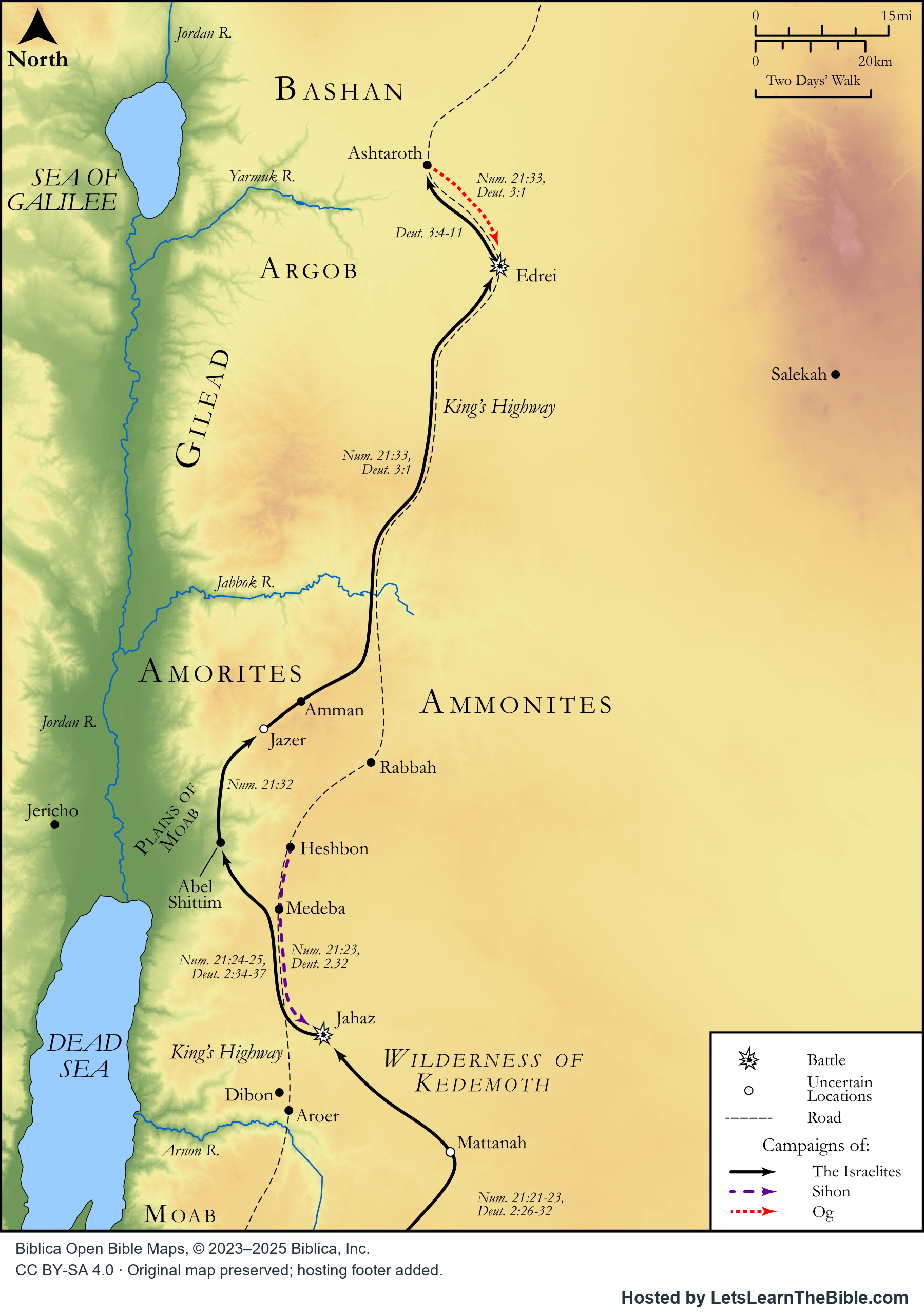
Read the legend before drawing conclusions: open circles indicate uncertain locations, including Jazer and Mattanah. The dashed road is the mapmaker's reconstruction of the King's Highway. Its presence is not evidence that every city in this article stood on that road. Several places in the table are outside this map's purpose or are not labeled.
Twenty places east of the Jordan
| Place | What the passage says | Reading or location caution |
|---|---|---|
| Aphek | Ahab defeats Ben-hadad's forces; survivors enter Aphek, where a wall falls on 27,000 men (1 Kings 20:26–30). | The chapter identifies the battle's setting by name, without establishing a modern archaeological coordinate. Do not assume every biblical Aphek is this one. |
| Ashtaroth | Og is associated with Ashtaroth and Edrei in the summary of eastern conquests (Joshua 12:4; 13:12). | Genesis 14:5 names Ashteroth-karnaim in an earlier campaign. Similar naming does not by itself establish that every reference describes the identical settlement. |
| Bethabara | John is baptizing beyond the Jordan in the KJV wording of John 1:28. He later recounts seeing the Spirit descend upon Jesus (1:29–34). | John's testimony helps explain Jesus' identification; it does not supply a surveyed baptism site. See the Gospel comparison below. |
| Bethsaida | John 1:44 names it as the city of Andrew and Peter and says Philip came from there; John 12:21 again connects Philip with it. | Luke 9:10–17 places the feeding of five thousand in its vicinity. Mark 8:22–26 describes a blind man led outside the town before healing. |
| Bezer | A refuge city in the wilderness plateau assigned to the Reubenites (Deuteronomy 4:43; Joshua 20:8), also listed among Levitical towns (Joshua 21:36). | A refuge designation is a legal function, not proof of a battle or an identifiable surviving building. |
| Edrei | Og and his people meet Israel in battle at Edrei (Numbers 21:33–35). Joshua 12:4 connects it with his kingdom. | The biblical battle reference matters more here than an unsupported claim that the town's exact position on a highway is known. |
| Gadara / the Gadarenes | Mark 5:1–20 and Luke 8:26–39 place Jesus' encounter with a demon-possessed man in the country of the Gadarenes in the KJV. | The wording concerns a region. Matthew 8:28–34 uses “Gergesenes” in the KJV and describes two men; a city dot should not erase those differences. |
| Golan | A refuge city in Bashan for the Manassites (Deuteronomy 4:43; Joshua 20:8), allotted to Gershonite Levites with its pastureland (Joshua 21:27). | These passages explain its tribal and refuge roles, rather than narrating a specific conquest at its gates. |
| Heshbon | Sihon's royal city in Numbers 21:26; built by Reuben's descendants in Numbers 32:37; listed among towns contributed by Gad in Joshua 21:39. | Keep the different textual settings visible. Those statements do not themselves date a border transfer. |
| Jabesh / Jabesh-gilead | Judges 21:8–14 recounts killings and the taking of 400 young women. Saul later rescues Jabesh from an Ammonite threat (1 Samuel 11); its men recover Saul's body (31:8–13). | The violent provision of wives in Judges should be described plainly, without treating it as a model for readers to imitate. |
| Jazer | Numbers 32:1–3 includes the district in the eastern tribes' request. Joshua 13:25 associates it with Gad; Joshua 21:39 lists its Levitical pastureland. | The supplied campaign map marks its location as uncertain. A labeled point is therefore an aid to orientation, not a claim of excavation-level certainty. |
| Karkor | Gideon pursues Zebah and Zalmunna and attacks the surviving Midianite force near Karkor (Judges 8:10–12). | The narrative names the destination and captured kings; it does not give enough information here to certify a modern site. |
| Mahanaim | Jacob names the place after meeting God's angels (Genesis 32:1–2). It appears in eastern allotment and Levitical lists (Joshua 13:26, 30; 21:38). | In a later setting, David receives provisions there during Absalom's revolt (2 Samuel 17:24–29). These are distinct episodes. |
| Penuel / Peniel | Jacob's wrestling encounter gives rise to the name Peniel (Genesis 32:22–32). Gideon later tears down Penuel's tower and kills the city's men (Judges 8:17). | Genesis calls the wrestler a man; Hosea 12:3–4 speaks of an angel. Identifying the figure as Jesus is a theological interpretation, not an explicit name in either passage. |
| Rabbah | Joab campaigns against this Ammonite royal city; David takes it after Joab sends for him (2 Samuel 12:26–31). | Read the Ammonite-war context separately from the earlier Sihon and Og arrows. A modern place-name association needs evidence beyond this passage. |
| Ramoth-gilead | An eastern refuge city (Joshua 20:8). Ahab is wounded during the campaign there and dies (1 Kings 22:29–38). | In 2 Kings 9:1–6, Elisha sends a young prophetic messenger to anoint Jehu there; Elisha does not personally perform that anointing. |
| Salcah / Salchah | Salchah marks the extent of Og's former dominion in Deuteronomy 3:10 and Joshua 12:5. The map spells the name Salekah. | A kingdom's boundary list does not mean that the text describes a separate battle at every named town. |
| Shittim / Abel-shittim | Numbers 33:49 places the camp's extent between Beth-jesimoth and Abel-shittim. Joshua sends spies from Shittim, then departs for the Jordan (Joshua 2:1; 3:1). | This is an eastern starting point for the crossing narrative. The map's Abel Shittim label provides regional context. |
| Succoth | Jacob makes booths for his cattle there (Genesis 33:17). Its leaders later refuse Gideon's request for bread (Judges 8:4–7). | Judges 8:13–16 describes Gideon's punishment of its elders. It does not say he destroys the entire city along with Penuel. |
| Zaphon | Named among Gad's valley towns in Joshua 13:27, with Succoth and other places. | The allotment list supplies its role here; it does not attach an additional battle or Gospel event to the town. |
Where was Jesus baptized, and which disciples came from Bethsaida?
Jesus was baptized by John in the Jordan River (Mark 1:9–11; Matthew 3:13–17). These accounts give the river and the baptizer, without naming an exact point along the river. John 1:28 identifies the location of John's activity as Bethabara beyond the Jordan in the King James Version. The following verses contain John's testimony about Jesus, including his recollection of the Spirit descending. The careful answer is therefore that this passage connects John's witness with a location beyond the Jordan; it does not narrate the baptism itself at a precisely recoverable map point. Bethabara in this passage should also be distinguished from the Bethany near Jerusalem associated with Mary, Martha and Lazarus in John 11.
Bethsaida gives a more direct answer to the disciples question: John expressly connects Andrew, Peter and Philip with it. Adding James and John would go beyond the cited verses. Compare three different Bethsaida references rather than combining them into one scene: the disciples' hometown connection in John, the feeding near Bethsaida in Luke, and the blind man's healing after Jesus leads him outside the town in Mark.
The Gadarenes passages need similar care. Mark and Luke describe a country across the lake; Mark ends with the healed man reporting in the Decapolis (Mark 5:20). That regional description does not establish that the encounter happened inside Gadara's urban center. Matthew's KJV place-name and two-man description should remain visible when the accounts are compared.
Refuge cities are a different kind of map information
Deuteronomy 4:41–43 names Bezer, Ramoth and Golan for the eastern tribes. Joshua 20:8 repeats the eastern set after listing the western refuge cities; Joshua 20:7 is the western list, not the reference for Ramoth-gilead. These towns provided refuge in cases of unintentional killing while a claim was heard (Joshua 20:1–6). They should not be read as military campaign stops simply because they appear on a map of Israel.
Likewise, ownership, rebuilding and Levitical assignment describe different relationships to a town. Heshbon illustrates the issue: a former royal center, a town rebuilt in Numbers 32 and a town contributed in Joshua 21 need not be reduced to a single timeless tribal label. Compare the passages before constructing a chronology the text does not supply.
Penuel and Succoth: preserve the differences
Genesis 32 places Jacob near the Jabbok, records the wrestling encounter and explains his naming of Peniel. Genesis 33:17 then explains Succoth through the booths he makes. Judges 8 returns to these names in a pursuit narrative: both communities refuse bread, but the recorded punishments differ. Gideon punishes Succoth's elders and tears down Penuel's tower, killing its men. Saying that he simply destroyed both towns loses the distinctions that make the accounts useful for study.
Passages for further study
Place names and wording in this guide follow the King James Version. Read Numbers 21 and 32 with Deuteronomy 3–4 and Joshua 12–13, 20–21 for the eastern kingdoms and allotments. For Jacob and Gideon, compare Genesis 32–33, Hosea 12:2–6 and Judges 8. For the Gospel places, compare Mark 1:9–11; Matthew 3:13–17; John 1:19–44; 12:20–22; Luke 9:10–17; Mark 8:22–26; and the three accounts in Matthew 8:28–34, Mark 5:1–20 and Luke 8:26–39. These textual identifications and the licensed map support regional study; neither is presented as an archaeological certification of every site.