The land is called the Promised Land because God promised it to Abraham and his descendants, renewed the pledge to Isaac and Jacob, and later brought Israel into it. The name describes the relationship between the giver, the heirs and the inheritance. It is not the name of a modern country or a claim that every biblical land passage describes the same political boundary.
An Ancient Pledge: Who Received the Promise?
In Genesis 12:1–7, Abram obeys the call to leave his country and reaches Canaan. The narrative says that Canaanites are already in the land when the Lord promises it to Abram's descendants. Thus the pledge does not begin with an empty territory or with Abram already governing it. His arrival, the existing inhabitants and the promised inheritance are three distinct features of the account.
Genesis 13:14–18 expands the assurance as Abram looks around the land and continues living in a tent. Genesis 15 links the inheritance to a covenant, while also anticipating his descendants' affliction in another land and their eventual return (15:13–21). The promised future and the family's immediate circumstances do not coincide.
Genesis 17:7–8 calls the covenant everlasting and identifies the land as Canaan, where Abraham is a stranger. The chapter also requires covenant faithfulness and introduces circumcision as its sign. The land pledge should be read within that relationship rather than reduced to a detached guarantee of personal wealth. The narrative renews the promise to Isaac in Genesis 26:1–5 and to Jacob in 28:10–15. Those renewals explain why later passages speak of the land sworn to the fathers.
At Moses' call, Exodus 3:6–8 identifies God as the God of Abraham, Isaac and Jacob and joins deliverance from Egyptian oppression to a good, spacious land. During the Passover instructions, Exodus 12:25 looks ahead to keeping the service in the land God will give as promised. The connection is both geographical and religious: departure from Egypt leads toward a place where Israel is to remember and serve its deliverer.
Why Is It Called a Land of Milk and Honey?
Exodus 3:8 describes a land flowing with milk and honey. The image presents abundance, not rivers literally composed of those foods. Numbers 13:23–28 gives the expression a narrative setting: the scouts bring grapes, pomegranates and figs, acknowledge the land's abundance, and also report strong inhabitants and fortified cities. Productive land is not the same as an unopposed entry.
Deuteronomy 8:7–10 develops the picture through water, grain, vines, fruit, olive oil and honey. Its concern is a good land in which Israel can eat and be satisfied. The following verses warn against forgetting God and attributing prosperity solely to one's own power. Deuteronomy 6:1–12 similarly links the land of milk and honey to obedience and remembrance. These passages explain the description without requiring us to decide what kind of honey every occurrence denotes or to infer identical conditions at every location.
The contrast also appears in Numbers 14:6–9. Joshua and Caleb affirm the land's goodness while urging the people not to rebel. The description of fertility therefore belongs alongside the narrative's account of trust, fear and responsibility; it is not a prediction that life there would involve no difficulty.
Which Promised-Land Boundary Does This Map Show?
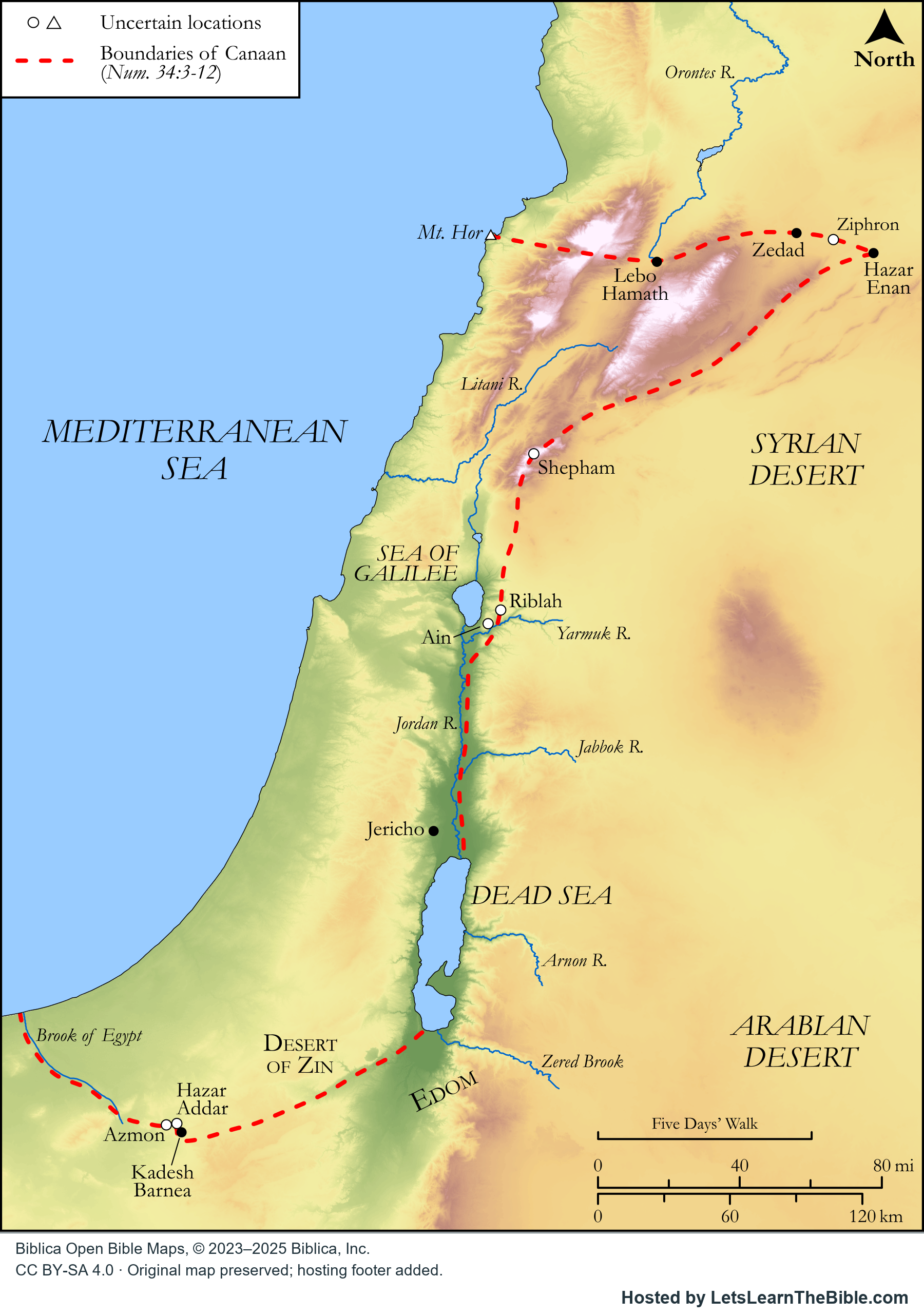
Genesis 15:18 names the river of Egypt and the Euphrates in a covenant declaration. Numbers 34 instead traces Canaan's boundary and immediately distinguishes the nine and a half tribes receiving their inheritance by lot from the two and a half whose inheritance is already east of the Jordan (34:13–15). A map of the latter chapter cannot simply be presented as the complete outline of the former.
Use the Mediterranean for the western side and the Jordan and Dead Sea for the eastern orientation shown here. The map interprets ancient place names, some explicitly uncertain; its line should not be treated as a modern boundary survey. For how individual tribes fit into the inheritance, continue with the allotments, Joseph and Levi. For the eastern approach, see the Dead Sea's eastern cities and the Sihon campaign.
Did a Promise Mean Immediate, Complete Possession?
| Kind of statement | Example | Question it answers |
|---|---|---|
| Promise | Genesis 12:7; 17:8 | What inheritance is God pledging, and to whom? |
| Boundary instruction | Numbers 34:1–15 | What limits are specified for the Canaan allotment in this instruction? |
| Allotment | Joshua 13:1–7 | What is to be assigned to the tribes, including land still to be possessed? |
| Possession and rest | Joshua 21:43–45 | How does the account affirm God's gift and Israel's actual dwelling in the land? |
| Remaining work and covenant warning | Joshua 23:4–16 | What peoples remain, and what responsibilities and dangers accompany life there? |
Joshua 21 says that God gave the land sworn to the fathers, that Israel possessed it and dwelt in it, and that his good promises came to pass. Those are real affirmations of fulfillment. Yet Joshua 13 opens with land remaining to be possessed, and Joshua 23 both celebrates fulfilled promises and speaks of remaining nations. Keeping all three passages in view avoids turning either the fulfillment or the unfinished local possession into something the book does not say.
The designation Promised Land therefore does not mean that no part was ever received. Nor does it mean every allotted place was permanently and uncontestedly controlled. For the later distinction between settlement, tributary communities and royal dominion, see the study of Israel's actual rule. That historical question requires more than the name of the inheritance.
Why Does Hebrews Call It the Land of Promise?
Hebrews 11:8–10 describes Abraham obeying the call and living in the land of promise as a stranger, in tents with Isaac and Jacob as fellow heirs. His posture is one of trust while awaiting a city whose maker is God. The chapter itself supplies the language that connects the land with a promise; there is no need to invent a later naming ceremony.
Verses 13–16 describe people who died in faith seeking a better, heavenly country. Later the same chapter speaks both of people obtaining promises (11:33) and of a shared completion still awaited (11:39–40). The discussion should preserve that range. Abraham's hope is not exhausted by a survey of ancient borders, but Hebrews should not be used to deny Joshua's explicit testimony that Israel received and inhabited the land. See the fuller Hebrews 11 comparison for that distinction.
Sources and a Reading Exercise
Primary passages checked in the King James Version text: Genesis 12:1–9; 13:14–18; 15; 17:1–14; 26:1–5; 28:10–22; Exodus 3; 12:21–28; Numbers 13:17–33; 14:1–10; 34; Deuteronomy 6:1–12; 8; 27:1–10; Joshua 13; 21:43–45; 23; Hebrews 11. The map has its own source and license above; it illustrates a particular passage rather than establishing every identification independently.
Read Genesis 17:8, Numbers 34:13–15, Joshua 13:1–7 and 21:43–45 in sequence. Beside each, write the speaker, recipients, action and time being described. Then ask whether your conclusion concerns a pledge, an assignment or an account of possession. This exercise explains why the land is called promised while keeping its different geographical and theological uses visible.