Before Joshua led Israel across the Jordan, the biblical narrative distinguished Canaan from neighboring lands that Israel was told not to seize. Deuteronomy 2 protects the possessions of Esau in Seir and of Lot's descendants in Moab and Ammon. The same account directs Israel against Sihon, and chapter 3 describes the defeat of Og. A map of the approach to Canaan must keep those different instructions and territories separate.
The encounters with Edom, Moab, Ammon, Sihon and Og belong to Moses' leadership before the Jordan crossing. Joshua inherits that situation; he does not lead all of these earlier events. The two maps below serve different purposes: one shows the Canaan boundary described in Numbers 34, and the other follows the earlier eastern campaigns. Together they orient the reader without pretending to be a single dated political survey.
Canaan's Boundary and Neighboring Lands
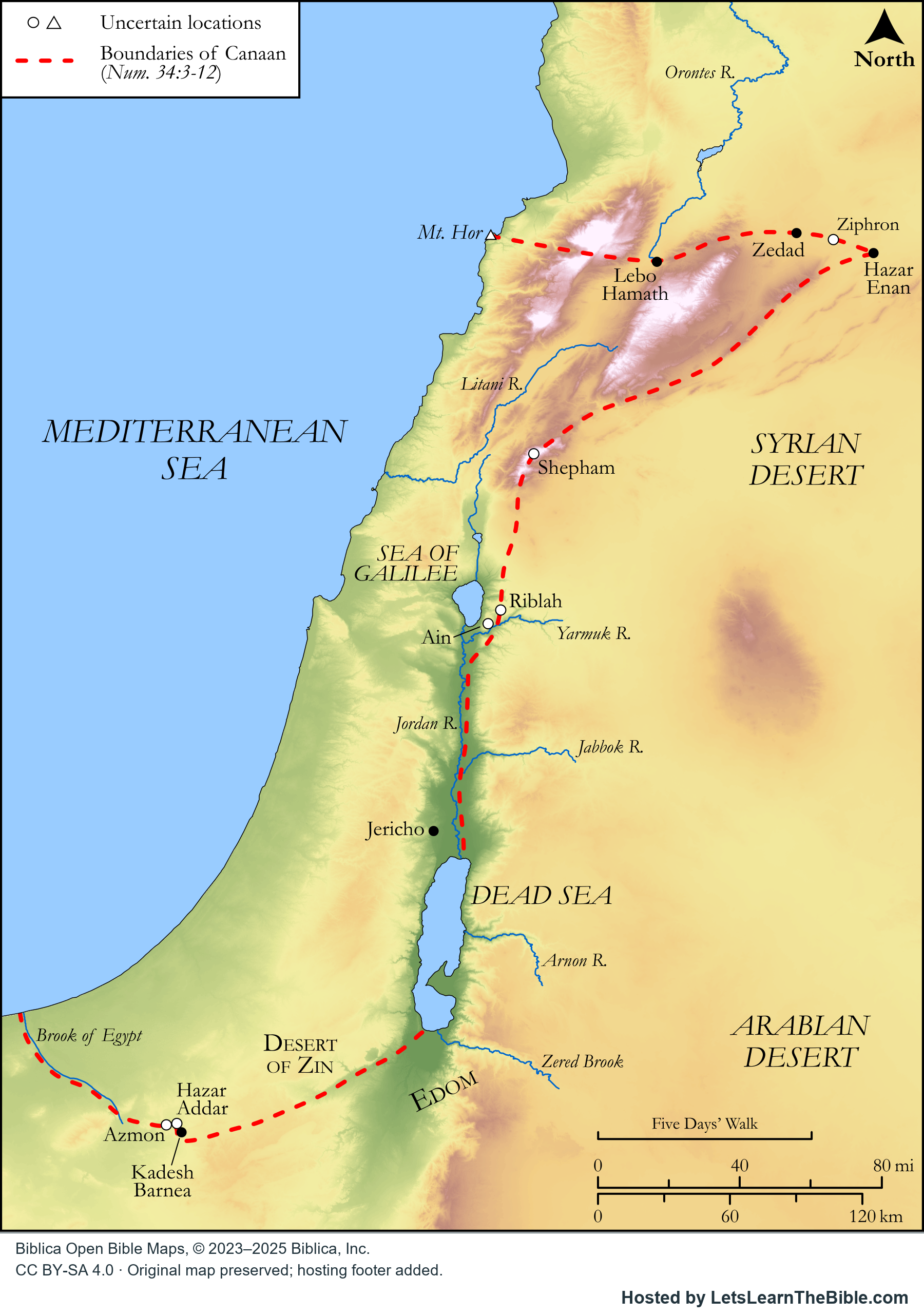
The Mediterranean forms the western boundary in Numbers 34. The passage's eastern line reaches the Sea of Chinnereth, shown as the Sea of Galilee, and then follows the Jordan to the Salt Sea, shown as the Dead Sea. Edom appears beyond the southern boundary. Numbers 34:13–15 assigns this Canaan inheritance to nine and a half tribes and distinguishes the inheritance already received by Reuben, Gad and half of Manasseh east of the Jordan.
On the campaign map below, the Arnon runs into the eastern side of the Dead Sea, the Jabbok enters the Jordan farther north, and Bashan lies toward the Sea of Galilee. These rivers help distinguish the territories discussed in the text. Their presence does not turn every regional label into a securely surveyed ancient national border.
Which Lands Were Protected, and Which Were Taken?
| People or kingdom | Regional setting in the account | Instruction or outcome | Read |
|---|---|---|---|
| Esau's descendants / Edom | Seir, beyond Canaan's southern boundary. | Israel is not given their land and must buy food and water instead of provoking them. | Deuteronomy 2:4–8 |
| Moab | Ar and the country south of the Arnon in the approach narrative. | Israel must not distress or fight Moab; Ar is given to Lot's descendants. | Deuteronomy 2:9, 18; Numbers 21:13 |
| Ammon | East of the Jordan, approached near the Jabbok border region. | Israel must not distress Ammon or take its protected possession. | Deuteronomy 2:19, 37; 3:16 |
| Sihon's Amorite kingdom | Heshbon and territory from the Arnon toward the Jabbok. | Sihon refuses passage and fights at Jahaz; Israel defeats him and takes his cities. | Numbers 21:21–32; Deuteronomy 2:24–36 |
| Og's kingdom | Bashan, including Edrei and the Argob region. | Og confronts Israel at Edrei; his kingdom is defeated and its land assigned to eastern Israelite tribes. | Deuteronomy 3:1–17; Numbers 32:33 |
The first three rows describe limits on this approach to Canaan. They are not interchangeable with Sihon's or Og's kingdom merely because all lie outside or east of the western allotments. Nor do they establish that the peoples concerned were friendly to Israel in every later period. This page concerns the instructions and regional distinctions in these particular passages.
Ammonites: What Was Israel Told to Leave Alone?
Deuteronomy 2:19 calls Ammon's people descendants of Lot and says that their possession is not to be given to Israel. After recounting Sihon's defeat, verse 37 explicitly says Israel did not enter the Ammonite land, the Jabbok places and mountain towns that the Lord had forbidden. Deuteronomy 3:16 again calls the Jabbok a boundary of Ammon when describing the eastern grants.
Numbers 21:24 describes Israel taking Sihon's land from the Arnon to the Jabbok, as far as the Ammonites, and notes the strength of Ammon's border. It does not say that all the land to the Jordan had just been taken from Ammon. The specific earlier transfer described in verse 26 is from a former king of Moab to Sihon.
Joshua 13:25 also uses the phrase “half the land of the children of Ammon” when describing Gad's allotment, while 13:10 and 27 refer to the cities and remaining kingdom of Sihon. That wording belongs in the comparison, but it does not itself narrate when every district changed hands. The passages give different descriptions of a borderland. They do not justify a confidently reconstructed story that Sihon recently took all of Ammon's western territory or that Israel ignored the prohibition in Deuteronomy 2.
Edomites: Why Was Seir Excluded?
Deuteronomy 2:4–5 calls the people of Seir Israel's brothers, the children of Esau, and grounds the restriction in the Lord's gift of Seir to Esau. Israel is not to provoke them, and is not promised even a foothold of their land in this instruction. Food and water are to be purchased (verses 6–8).
Numbers 21:4 describes Israel traveling around Edom on the way toward the Red Sea. The passage also records the people's discouragement and the bronze-serpent episode; the journey is more than a sequence of victories. For this map, the important distinction is the route around Edom and the protected possession of Seir, rather than an invented exact itinerary through every modern location.
Moabites: How Could Israel Take Former Moabite Land?
Deuteronomy 2:9 forbids Israel to fight Moab for its possession, identifying Ar as given to Lot's descendants. Numbers 21:13 calls the Arnon the border between Moab and the Amorites. Yet the later account places Israel in Heshbon and its surrounding towns. The chapter explains why these statements should be read together: Sihon had previously defeated a king of Moab and taken territory extending to the Arnon (21:26).
Israel's conquest in this episode is of Sihon's kingdom, which includes land with an earlier Moabite history. “Formerly Moabite” and “held by Moab at Israel's approach” are different descriptions. The transfer in Numbers 21 should therefore be located in its sequence instead of treating the name Moab as the same fixed territory in every verse.
Sihon, Og and the Eastern Inheritance
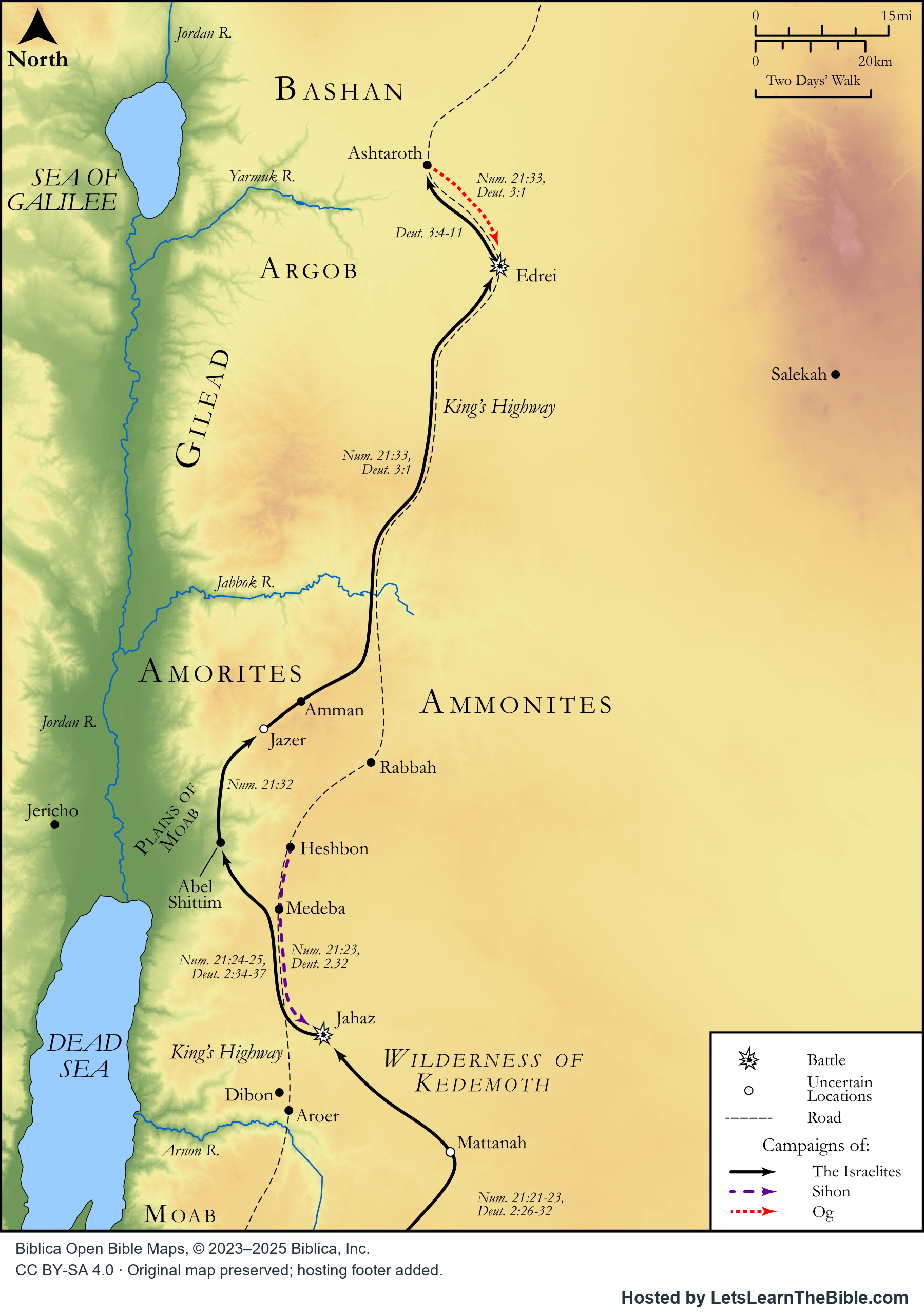
Israel asks Sihon for passage along the king's highway. He refuses, comes out to fight at Jahaz and is defeated (Numbers 21:21–25). Deuteronomy 2:30 attributes his obstinacy to the Lord and 2:34 explicitly records the destruction of men, women and children. Deuteronomy 3 describes the same destructive outcome in Og's kingdom. These accounts concern the taking of cities and the killing of their inhabitants, not only victory over opposing armies.
Numbers 32:33 names the lands given to Gad, Reuben and half of Manasseh as the kingdoms of Sihon and Og. The arrangement includes a shared obligation: the eastern fighting men are to assist the other Israelites in receiving their inheritance. Joshua 1:12–15 recalls that obligation before the crossing. The eastern grants should not be confused either with a command to seize all neighboring countries or with the later division of western Canaan.
For the peoples named within the conquest instructions, continue to the seven names in Deuteronomy 7. For the sequence of battles, see Moses' final conflicts and the opening campaigns under Joshua.
Sources and Map Limits
This comparison is independently written from Deuteronomy 2–3; Numbers 21, 32 and 34; Joshua 1, 12–13 and 23, checked in the King James Version text. Read the neighboring-land instructions, eastern campaign and Canaan boundary side by side.
The boundary map is based on Numbers 34, while the campaign map illustrates Numbers 21 and related passages. Neither supplies a verified date such as 1406 B.C., an exact modern border or seven securely delimited ethnic territories. Joshua 13 and 23 also distinguish assigned inheritance from land still to be possessed. These ancient instructions are examined in their literary and historical setting; the maps do not establish a modern political entitlement or an instruction for readers to wage war.