Deuteronomy 7:1 names seven peoples: the Hittites, Girgashites, Amorites, Canaanites, Perizzites, Hivites and Jebusites. They are the peoples named as Israel approaches the inheritance in that passage. The chapter commands their destruction and the removal of their worship, while also warning Israel against serving their gods. Understanding the list requires following those names through the narrative, rather than assigning each a precise territory that the text never supplies.
The Seven Names and Their Narrative Settings
| Name | What the compared passages actually locate or describe | What the evidence does not establish |
|---|---|---|
| Hittites | Joshua 9:1 places the name among the peoples whose kings hear of Israel; 11:3 includes Hittites among mountain peoples. | These verses do not map the entire Anatolian Hittite empire or give an exact boundary for a local Hittite district. |
| Girgashites | Deuteronomy 7:1 names them among the seven. | The compared conquest passages do not supply a securely identifiable Girgashite capital or an exclusive territory to shade on this map. |
| Amorites | Sihon is an Amorite king east of the Jordan; Joshua 10:5 names five Amorite kings in the western hill country. | The name cannot be confined to Sihon's kingdom or treated as disappearing after his defeat. |
| Canaanites | Joshua 11:3 speaks of Canaanites on the east and west; Judges 1 describes them remaining in several towns and regions. | Each occurrence should not automatically be read as the same small, sharply bounded district. |
| Perizzites | Joshua 11:3 includes them in the mountains; Judges 1:4–5 places them with Canaanites in the fighting at Bezek. | These locations do not provide a complete Perizzite national boundary. |
| Hivites | Joshua 9:7 calls the Gibeon delegation Hivites; 11:3 also names Hivites under Hermon in the land of Mizpeh. | The name is not limited by these passages to one settlement around Shechem. |
| Jebusites | Joshua 11:3 includes them among mountain peoples; Judges 1:21 explicitly places Jebusites in Jerusalem. | A reference to the king of Jerusalem or a capture of the city does not by itself show that every Jebusite was expelled. |
The list answers who is named in Deuteronomy 7. It is not a modern population census, and its seven names are not seven demonstrated, non-overlapping polygons. Related lists also differ: Deuteronomy 20:17 and Joshua 12:8 name six peoples without the Girgashites. The seven-name list should be quoted from its own passage rather than silently inserted into every other list.
A Regional Map and Its Limits
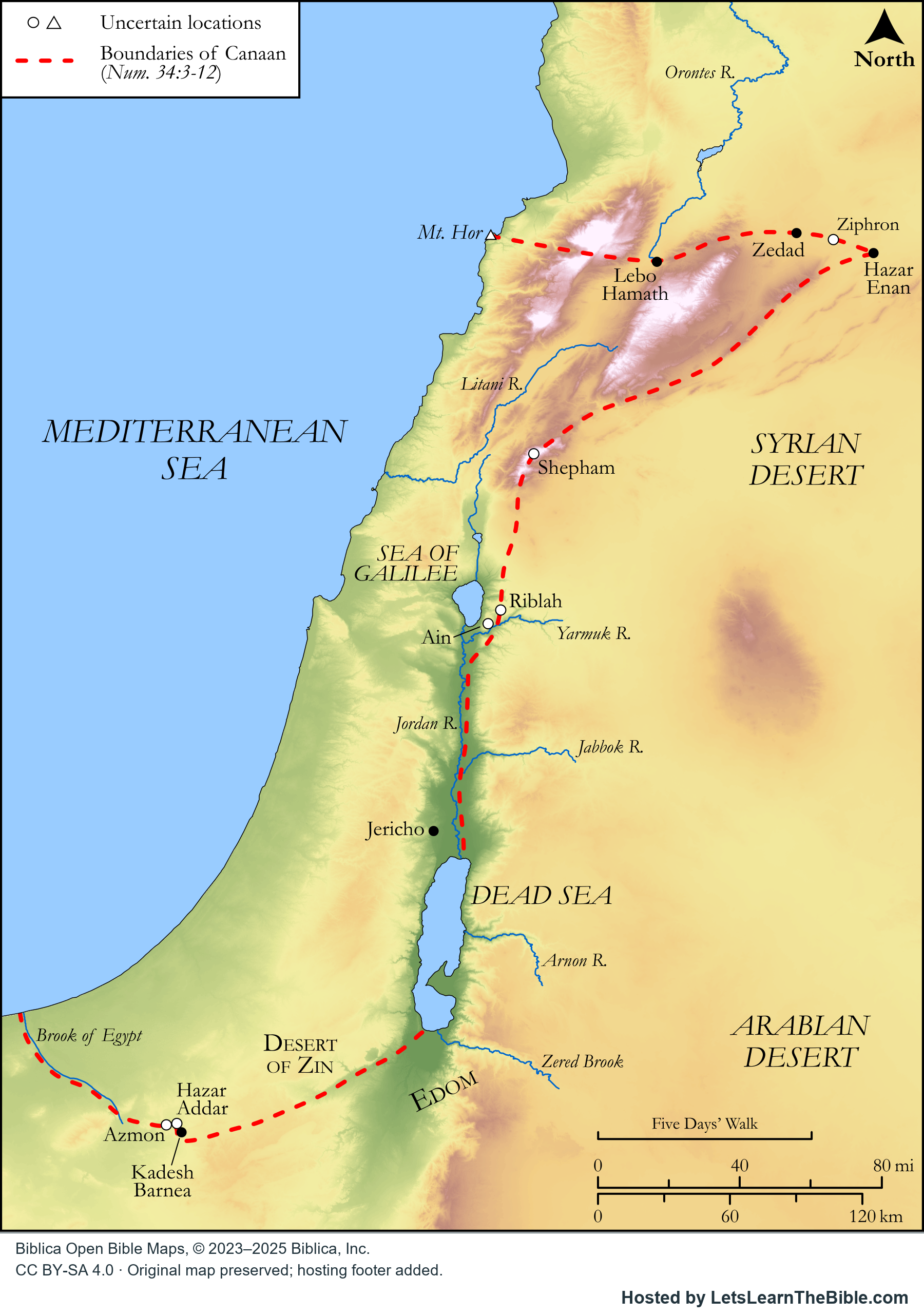
Use the Mediterranean on the west, the Jordan on the east and the Sea of Galilee and Dead Sea for orientation. The regional frame helps explain “the land” in the inheritance discussion. A passage naming a people in a mountain district supplies less information than a complete border survey. The table therefore gives named settings while leaving unestablished boundaries uncolored.
The Hittites
The name appears within the conquest setting in Deuteronomy 7 and Joshua 9 and 11. Joshua 1:4 also uses the expression “all the land of the Hittites” within its broad description extending toward Lebanon, the Euphrates and the western sea. These are contextual uses of the name, not a detailed historical explanation of its relation to every state called Hittite in other sources.
Identifying the local people in a given verse with an entire empire in Asia Minor would require evidence beyond these passages. The table keeps the geographical information the narrative actually provides. Neither Deuteronomy 7 nor the cited Joshua references attaches a year such as 1405 B.C. to that identification.
The Canaanites
“Canaan” names the land described in Numbers 34; “Canaanites” is also one of the peoples listed alongside others in Deuteronomy 7. The terms should be read in their sentences rather than assumed to have an identical scope everywhere. Joshua 11:3 names Canaanites on both east and west within the northern coalition, while Judges 1 follows particular Canaanite communities in towns such as Beth-shean, Dor, Megiddo and Gezer.
Judges 1:27–33 distinguishes communities not expelled, people placed under tribute, and Israelites dwelling among inhabitants. Those details are more precise than saying that one conquest removed every Canaanite from every allotted place.
The Girgashites
The secure starting point for this guide is their presence in Deuteronomy 7:1. The conquest and settlement texts compared here do not give enough information to place a separate Girgashite territory confidently east of the Sea of Galilee or in a specific western district. Those proposed locations would need an additional, assessed historical source. They are not drawn onto the regional map as established facts.
The Amorites: More Than Sihon's Kingdom
Numbers 21:21–32 describes Sihon, king of the Amorites, refusing passage, fighting at Jahaz and losing his kingdom to Israel under Moses. It locates Israel's resulting possession from the Arnon toward the Jabbok. Verse 26 says that Sihon had previously taken land from a king of Moab; it does not say that this particular conquest was from Ammon.
The Amorites remain prominent after Sihon's defeat. Joshua 10:3–6 calls the rulers of Jerusalem, Hebron, Jarmuth, Lachish and Eglon five Amorite kings and describes their attack on Gibeon. Joshua comes to Gibeon's aid and the chapter continues through the southern campaigns. Judges 1:34–35 later describes Amorites restricting Dan's settlement in the valley. The eastern victory is therefore not the last significant appearance of Amorites in the narrative.
Og's Bashan kingdom also belongs in the eastern comparison. Deuteronomy 3:8 describes the territory taken from the two Amorite kings, and Numbers 21:33–35 names Og's confrontation at Edrei. Deuteronomy 3:11 describes an iron bedstead nine cubits long and four cubits wide. Those are the bedstead's dimensions, not a measurement of Og's height; they should not be converted into a claim that the text specifies a thirteen-foot-tall king. For the eastern locations, use the Sihon and Og campaign map.
Perizzites, Hivites and Jebusites
Joshua 11:3 supplies a mountain setting for Perizzites and Jebusites and places Hivites under Hermon. Joshua 9 supplies another Hivite setting in the Gibeon episode. The people there pretend to have traveled from afar, Israel's leaders fail to ask the Lord's counsel, and a sworn agreement preserves their lives. Joshua assigns them labor rather than killing them (9:14–27). That episode should remain visible beside the chapter's opening account of peoples gathering to fight.
For Jerusalem, Judges 1 reports both Judah's capture and burning of the city (verse 8) and Benjamin's failure to expel its Jebusite inhabitants (verse 21). These are different claims about military action and continuing residence. The name Jerusalem is already used in Joshua 10; it is inaccurate to imply that it first comes into use only after a later conquest under David.
What Do the Destruction Commands Say?
Deuteronomy 7:2 commands Israel to destroy the named peoples, make no covenant with them and show no mercy. Verses 3–5 prohibit intermarriage, explain the danger of turning to other gods, and require destruction of the worship objects. The stated concern about worship does not make the command merely an instruction to destroy shrines while leaving the people out of account.
Deuteronomy 20:10–18 distinguishes distant cities from the cities of the peoples given as an inheritance. For distant cities, the passage first describes an offer of peace and service; if they fight, it describes killing the males and taking the women, children and goods. For the inheritance cities, verses 16–17 command that nothing breathing be kept alive. These are severe ancient war instructions, including the treatment of noncombatants.
Joshua's narrative also reports killing beyond soldiers alone. Jericho's account explicitly names men, women, young and old, while preserving Rahab and her household (Joshua 6:17–25). Ai's account counts both men and women among the dead (8:24–27). The Gibeonites' survival follows the oath in Joshua 9. Reading these accounts together preserves their destruction language and their particular surviving households and communities, rather than forcing every episode into one short formula.
Within Deuteronomy, the instructions are attributed to the Lord and tied to Israel's inheritance and covenant faithfulness. This guide explains that ancient textual setting. It does not turn the names into present-day racial categories, authorize violence against contemporary peoples, or derive a modern territorial ruling from them.
Which Neighbors and Outcomes Need Distinguishing?
| Compare | What changes the reading? |
|---|---|
| Named conquest peoples and protected neighbors | Deuteronomy 2 excludes Esau's possession in Seir, Moab's possession and Ammon's possession from Israel's seizure on this approach. Sihon and Og are treated differently. |
| Moses' wars and Joshua's wars | Joshua 12:1–6 recalls eastern victories under Moses; 12:7–24 lists western kings defeated under Joshua. |
| Campaign summary and continuing inhabitants | Joshua 11:23 summarizes taking the land and rest; 13:1–7 and 23:4–5 still speak of remaining land and nations. |
| Allotted inheritance and permanent occupation | Judges 1 describes towns not cleared and inhabitants subjected to tribute. Judges 2–3:6 connects the continuing peoples to Israel's obedience and worship. |
For a closer comparison of the three protected neighbors, see Edom, Moab, Ammon, Sihon and Og. For the narrative order of Joshua's campaigns, continue with the Promised Land wars. The inheritance itself is explained in the tribal allotment map.
Sources and Reading Limits
The names table and comparisons are this site's reading of Deuteronomy 2–3, 7 and 20; Numbers 21, 32 and 34; Joshua 1, 6–13 and 23; and Judges 1–3:6, checked in the King James Version text. Read the people lists, war instructions and later settlement passages together.
The map is a separately credited Biblica publication interpreting Numbers 34, rather than an independently surveyed ethnic map made by this site. No dictionary conjecture about Girgashite borders, imperial chronology or modern population ancestry is presented as verified by these passages. A useful reading exercise is to follow one name across the table's references and distinguish a people, a city, a ruler and an allotment before drawing conclusions about control of the whole land.