Israel and Judah's Captivities Map
When did the Kingdoms of Israel and Judah go into captivity? Why did God send them out of the land he gave them? Where did they settle after leaving their captors?
The northern kingdom was deported into the Assyrian sphere; people from Judah were later taken to Babylon. These were successive events involving different groups, while other people remained in the land. The Assyrian background map below provides regional context for the northern account. The destination table identifies the places named in both kingdoms' accounts without implying a reconstructed road.
The questions guiding this study are: Where were ancient Israel and Judah taken into captivity? When did this happen? Why did God allow this calamity to occur?
Assyria and the northern kingdom
Begin with Samaria, the northern kingdom's capital, and Jerusalem farther south. Then look northeast toward Assyria and the Habur River area. The map also labels Guzana and Media. These help orient the reader to the broad world of the deportation accounts; they do not settle every disputed place identification.
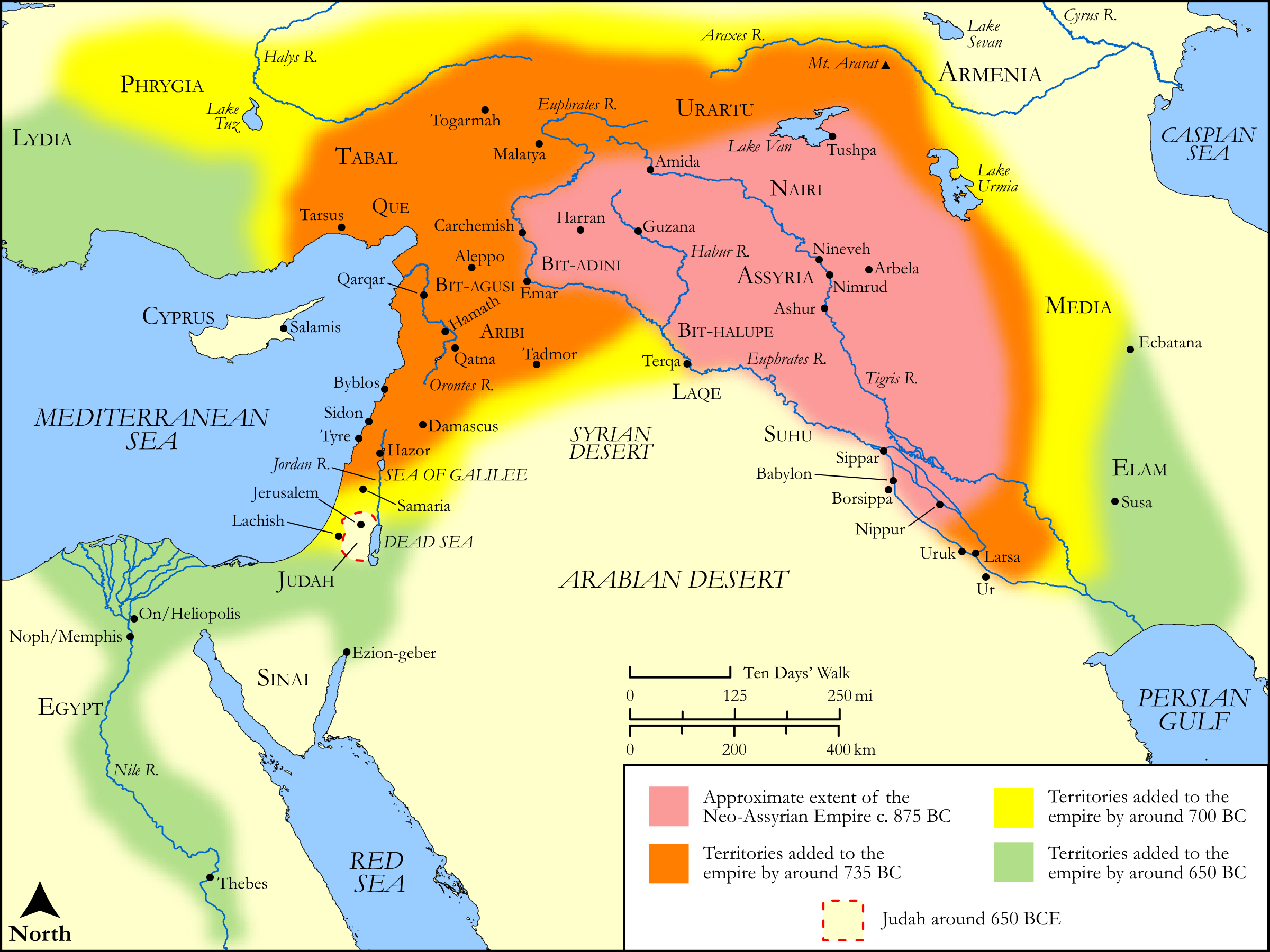

Second Kings 15:29 reports that Tiglath-pileser took people from named northern and eastern territories, including Gilead, Galilee and the land of Naphtali, to Assyria. It does not list Asher, Zebulun and Dan as three additional tribes in that verse. First Chronicles 5:26 separately describes the removal of the Reubenites, Gadites and half-tribe of Manasseh.
The later account of Hoshea describes tribute, an appeal to Egypt, imprisonment and a siege of Samaria. Second Kings 17:5–6 says the siege lasted three years and the city fell in Hoshea's ninth year. The destinations it names matter more for this map than an arrow implying that every northern Israelite followed one identical journey.
Who was taken where?
| Group or episode | Destination stated | Passage | What the evidence establishes |
|---|---|---|---|
| Northern and eastern territories during Pekah's reign | Assyria | 2 Kings 15:27–31 | A removal from named places, including Gilead, Galilee and Naphtali; no complete itinerary. |
| Reuben, Gad and half of Manasseh | Halah, Habor, Hara and the river Gozan | 1 Chronicles 5:18–26 | The account preserves this list of names. It does not give coordinates for every location. |
| Israel after Samaria's siege | Halah, Habor by the river of Gozan, and cities of the Medes | 2 Kings 17:1–6 | Several destinations within the Assyrian sphere, rather than one settlement for all deportees. |
| Jehoiachin and people removed with him | Babylon | 2 Kings 24:10–17 | The king, royal household, officials, fighting men and craftsmen are among those named; the account also says poorer people remained. |
| Zedekiah after Jerusalem's later fall | Riblah for judgment, then Babylon | 2 Kings 25:4–7 | A stated sequence for the captured king. It is not an itinerary for every person deported from Judah. |
| Further people from Jerusalem | Removed by the Babylonian commander; some poor people left as agricultural workers | 2 Kings 25:8–12 | Deportation and continued residence occurred together; the account does not describe an empty country. |
The similar Habor/Habur and Gozan/Guzana labels are useful reading aids, but a background map should not erase differences between the biblical lists. In particular, this article does not assign Halah and Hara arbitrary points or draw roads connecting every named place.
Judah and Babylon
Second Kings names Jerusalem, Riblah and Babylon in the accounts below. They identify places in distinct episodes; the text does not provide a complete road itinerary for all deportees.
Judah's experience cannot be reduced to one capture of Jerusalem. Second Kings 24 describes Jehoiachin's surrender and deportation, followed by Zedekiah's appointment. Chapter 25 describes a later siege, Zedekiah's capture, destruction in Jerusalem and further removals. Keeping these episodes separate also prevents different prophets' settings from being collapsed into one departure.
Ezekiel 1:1–3 places its opening vision among captives by the river Chebar and relates its date to Jehoiachin's captivity. Daniel 1:1–7 begins with a different regnal framework, referring to Jehoiakim and youths brought to the Babylonian court. Those introductions should not be turned into a claim that Daniel and Ezekiel were both taken in Jehoiachin's deportation.
When did the captivities happen?
The sequence is clear even where converting regnal years into calendar years requires further historical work. Northern deportations under Tiglath-pileser precede Samaria's fall in Hoshea's ninth year. Judah's later losses include Jehoiachin's deportation and the destruction under Zedekiah described in 2 Kings 24–25.
An external chronological reference is the Babylonian text commonly called the Jerusalem Chronicle, ABC 5. The Livius edition dates the capture of Jerusalem in its introduction to 597 BCE. Reverse lines 11–13 describe the campaign against the city of Judah, capture of its king, appointment of another king and tribute. Its seventh-year notice and the eighth-year notice in 2 Kings 24:12 use different regnal numbering; treating them as automatically identical wording would hide that issue.
This study therefore uses the biblical sequence and names the source for 597 BCE. The approximate years printed in the Assyrian map's legend belong to its background layers. They should not be read as independent dates for Samaria's fall or Jerusalem's later destruction.
Why do the biblical writers say this happened?
Second Kings 17:7–23 presents the northern kingdom's fall as a covenant judgment. Its explanation includes worship of other gods, rejection of warnings, and practices the narrator condemns. Second Chronicles 36:11–21 likewise portrays Judah's rulers and people as rejecting God's messengers until judgment comes. These are the biblical writers' theological explanations of these particular events.
The account also contains hope beyond judgment. Jeremiah's letter tells the exiles in Babylon to build houses, plant gardens and seek the city's welfare, while looking toward God's promised restoration (Jeremiah 29:1–14). These texts do not supply a rule for declaring that a modern displaced family or disaster victim deserves suffering.
Where did people live afterward?
Babylon: Jeremiah 29 addresses an existing exile community and envisages ordinary family and community life there. Captivity was not simply an uninterrupted march followed immediately by a return.
Judah: Some people remained. Jeremiah 40:1–12 describes Gedaliah at Mizpah, agricultural work and people gathering back into Judah. The northern story also has survivors: 2 Chronicles 30:1–11 describes Hezekiah's invitation reaching people in northern territories. Deportation language should not be made to mean that every individual had disappeared.
Ammon and Egypt: Jeremiah distinguishes the groups after Gedaliah's assassination. Ishmael and eight men escape toward Ammon (41:15). Johanan then gathers the rescued survivors; that group subsequently goes to Egypt, reaching Tahpanhes, despite Jeremiah's warning (41:16–18; 42:13–22; 43:1–7). Calling the Egypt group “Gedaliah's assassins” would confuse their identities.
Jerusalem and Judah again: Ezra 1 describes Cyrus's proclamation and preparations for a return. Ezra 2:1–2 identifies people coming from the captivity to Jerusalem and Judah, and Ezra 3 describes worship and rebuilding activity. These accounts establish a return community; they do not identify every later descendant of every deportee.
The passages examined here do not trace a documented chain from the captives to Saxons, Germans, Jutes or Goths. A similarity between later ethnic names and biblical names cannot fill that documentary gap. The separate migration study considers the evidence limits of those claims; the map on this page is confined to the ancient setting actually shown.
Sources and map credits
- Scripture checked in the King James Version: 2 Kings 15:27–31; 17:1–24; 24:1–20; 25:1–26; 1 Chronicles 5:18–26; 2 Chronicles 30:1–11 and 36:1–23; Ezekiel 1:1–3; Daniel 1:1–7; Jeremiah 29:1–14, 40:1–12, 41:1–18, 42:13–22 and 43:1–7; Ezra 1:1–11, 2:1–2 and 3:1–13. The explanations above distinguish the accounts rather than presenting a single reconstructed route.
- Livius: ABC 5, Jerusalem Chronicle, introduction and reverse lines 11–13. The calendar date is the edition's historical dating; the capture, king and tribute are described in its translation of the chronicle.
- Biblica Open Bible Maps OT007, original image at repository revision baa718b1ed1ae2d735d9deebf76159b588da8a47. See the resource license statement and publisher's additional information. The image retains its original content and credit, with no added route or ownership mark.
Earlier bibliography (not consulted for this revision)
Holy Bible, a Faithful Version
The Mysterious Numbers of the Hebrew Kings