Parthian Empire Map
The Parthian Empire, also called the Arsacid Empire, was an Iranian power that ruled much of Iran and Mesopotamia between the third century BC and the third century AD. It was a formidable rival of Rome, but the claim that its royal family descended from King David is not established by the historical sources used here. Its documented connection with Jewish history is clearer: Parthian forces intervened in Judean politics, and Acts names Parthians among the people present in Jerusalem at Pentecost.
Study questions: How is the Parthian Empire linked to King David? Why did the mighty Romans fear it? Use the map to distinguish the original region of Parthia, the wider empire and its western frontier.
Map of the Parthian Empire
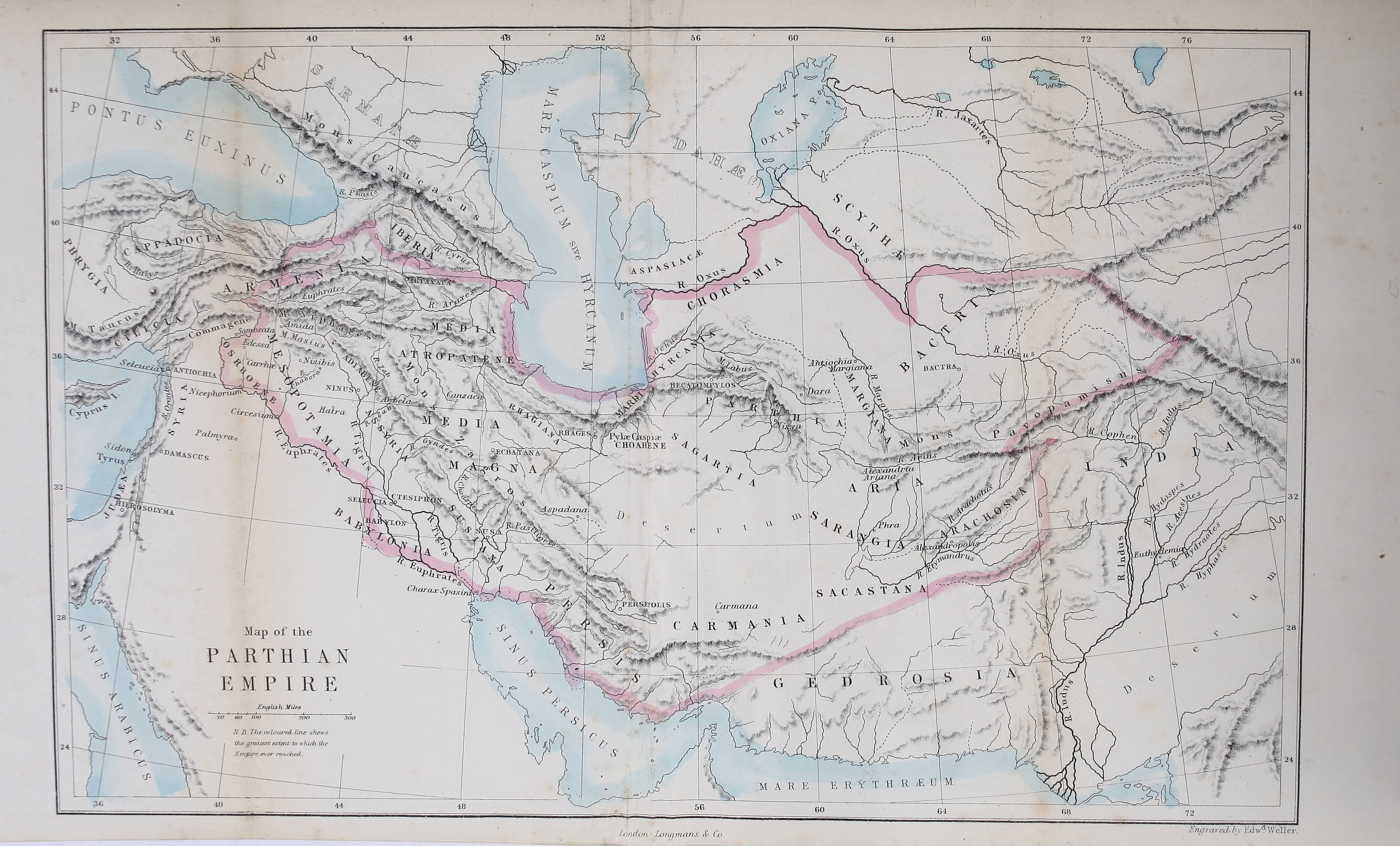
Begin beside the southeastern Caspian Sea, where the map places Parthia east of Hyrcania. That region gave the empire its name; it is only part of the much larger area outlined. Trace the Iranian plateau westward through Media to the Tigris valley. Ctesiphon and Seleucia lie close together there. Farther west, the Euphrates and Armenia bring the map into the zone where Parthian and Roman ambitions repeatedly collided.
The colored outline is especially easy to misread near Armenia and the eastern provinces. A maximum-extent compilation combines changes over time; it cannot establish who held a city in a particular battle year. For Carrhae or the intervention in Judea, use the written accounts and dates below rather than assigning all the map's outline to one king.
Find the places discussed below
| Place or region | Where to look on this map | Why it matters |
|---|---|---|
| Parthia and Hyrcania | East and southeast of the Caspian Sea, labeled Mare Caspium. | Orient the dynasty's northeastern beginnings before following its wider expansion. |
| Media and Ecbatana | South of the Caspian and west of Parthia, within the Iranian plateau. | They help connect the northeastern homeland with the empire's Mesopotamian centers. |
| Seleucia and Ctesiphon | Two nearby labels beside the Tigris, north of Babylon. | Ctesiphon became an important Arsacid royal center. The cities should not be confused with Jerusalem or with the original Parthian homeland. |
| Armenia | Between the Black Sea and Caspian, near the map's northwestern outline. | Its kingship and allegiance were recurring issues between Rome and Parthia. |
| Carrhae | Upper Mesopotamia, near Edessa, east of the Euphrates. | The setting of the Roman defeat in 53 BC. |
| Judea and Jerusalem | The eastern Mediterranean coast at the far left; Jerusalem appears as Hierosolyma. | The Parthian intervention in 40 BC helps explain Herod's flight and subsequent Roman-backed kingship. |
When did Parthian rule begin and end?
Klaus Schippmann's history of the Arsacid dynasty identifies the Parni as an Iranian tribe within the Dahae and describes Arsaces's movement into the northeastern Iranian world. About 247 BC is conventionally associated with his proclamation as king at Asaak and the beginning of the Arsacid era. It is not evidence that a fully formed transcontinental empire appeared in that year; the early chronology and the stages of conquest require qualification.
| Date | Turning point | How to read it |
|---|---|---|
| About 247 BC | Conventional beginning of the Arsacid era. | A dynastic starting point, not the date of all the territory on the map. |
| Second century BC | Expansion under Mithridates I brought Media and Babylonia into the Arsacid realm. | The dynasty's power moved beyond its northeastern base into established western centers. |
| 53 BC | Crassus's expedition ended in defeat at Carrhae. | A major Roman military disaster, not the end of Roman power. |
| 40 BC | Parthian forces intervened in Syria and Judea. | A particular campaign and political intervention, not permanent rule over the whole eastern Mediterranean. |
| AD 224 | Ardashir defeated the Arsacid king Artabanus. | The conventional end of the Parthian Empire and the transition to Sasanian rule. |
The conventional span of roughly 247 BC to AD 224 is about 470 years. A subtraction across BC and AD must allow for the absence of a year zero; uncertain founding dates also make a precise anniversary misleading. Comparing that entire dynastic span with just one campaign or one phase of another empire does not measure which state was strongest.
Why Rome took Parthia seriously
Parthia could defeat Roman armies and influence the political order east of the Mediterranean. At Carrhae in 53 BC, the army led by Crassus encountered forces commanded by Surena. Plutarch's Life of Crassus, especially chapters 23–31, describes mounted archers, heavily armored cavalry, an arrow supply supported by camels, and Roman difficulties in bringing the enemy to close combat. The account explains a tactical mismatch more usefully than saying that every Roman was afraid of Parthia.
Plutarch reports that about 20,000 Romans were killed and 10,000 captured in the campaign. He presents these as reported totals, not as a modern audited casualty return. Crassus survived the main battlefield disaster but died during the subsequent attempt at a meeting with the Parthians. Converting the traditional totals into exact percentages would imply more certainty about army strength, deaths and survivors than the evidence warrants.
Schippmann's history also emphasizes that the victory did not produce a decisive, lasting shift in the overall balance of power. Rome and Parthia continued to compete over the frontier and Armenia; neither the outcome of Carrhae nor the greatest-extent map establishes uninterrupted Parthian supremacy. Military success, the ability to hold provinces and the durability of diplomatic arrangements are different tests of power.
Parthia, Judea and Herod
Josephus, Antiquities of the Jews 14.13–16, supplies a direct connection with Jewish political history. He describes Parthian intervention on behalf of Antigonus, the capture of Hyrcanus and Phasael, and Herod's escape. These were rival local claimants operating within the wider Roman–Parthian contest. The episode does not make the Parthian royal house a branch of the house of David.
Herod subsequently reached Rome, where the Senate appointed him king; he still had to win control in Judea. Josephus's later account of the capture of Jerusalem distinguishes the Roman-backed conquest from the earlier appointment. Read together, these events explain why Parthian power mattered to the setting before Jesus's birth without treating Herod's flight as evidence that Parthia ruled Judea permanently.
Was the royal family descended from David?
No established Davidic genealogy for the Arsacid dynasty is supplied by these sources. Schippmann traces the dynasty's beginnings through Arsaces and the Iranian Parni. Josephus describes intervention in Judean affairs, not a Davidic ancestry for the Parthian kings. Similar-looking names, the presence of Jewish communities in a territory, and an alliance with a Judean ruler cannot by themselves establish royal descent.
The New Testament's explicit link is different. Acts 2:5–11 places Jews and devout people from many regions in Jerusalem and includes Parthians in its list. This is evidence for the passage's geographical and diaspora setting. It is not a genealogy of Arsaces or a statement that every inhabitant of the Parthian Empire belonged to Israel.
The claim that a Parthian capital was named after Isaac also lacks support here. Asaak, associated with the early proclamation of Arsaces, and Ctesiphon, a later royal center on the Tigris, are different places. Jens Kröger's study of Ctesiphon says that the origin and meaning of its name are unknown. A resemblance between English spellings cannot settle the etymology.
Sources and map credit
- Klaus Schippmann, “Arsacids ii. The Arsacid Dynasty,” Encyclopaedia Iranica: Iranian background, early chronology, expansion, Roman conflicts and the end of Arsacid rule.
- Jens Kröger, “Ctesiphon,” Encyclopaedia Iranica: location and the uncertainty about the name's origin.
- Plutarch, Life of Crassus 23–31, English translation hosted by the University of Chicago's LacusCurtius: an ancient narrative of the campaign, interpreted as a narrative source rather than an audited military dataset.
- Josephus, Antiquities 14.13–16, William Whiston translation hosted by the University of Chicago: the Parthian intervention, Herod's flight and Roman-backed kingship.
- Acts 2:1–11, KJV: the Pentecost setting and the list of places of origin.
- Map: George Rawlinson, The Sixth Great Oriental Monarchy (London, 1873), “Map of the Parthian Empire,” engraved by Edward Weller; Wellcome Collection work u79zs4hp, image b29352204_0108.jp2. The official catalogue and image manifest mark the digitized work as public domain. The historical map is reproduced unchanged and is not presented as a new original map or a contemporary archaeological reconstruction.
Research and editorial commentary: LetsLearnTheBible.com.