Alexander the Great's Empire Map
Alexander III of Macedon built an empire reaching from the eastern Mediterranean through the former Persian imperial heartlands to parts of the Indus region. His speed, battlefield leadership and ability to combine different forces explain his military reputation. Whether he was the “greatest military commander in history” remains a judgment, rather than an objectively settled title. His empire was vast, but it did not include the entire inhabited or “known” world.
Study question: What made Alexander the greatest military commander in history? How vast was his world empire?
Read the empire and campaign map
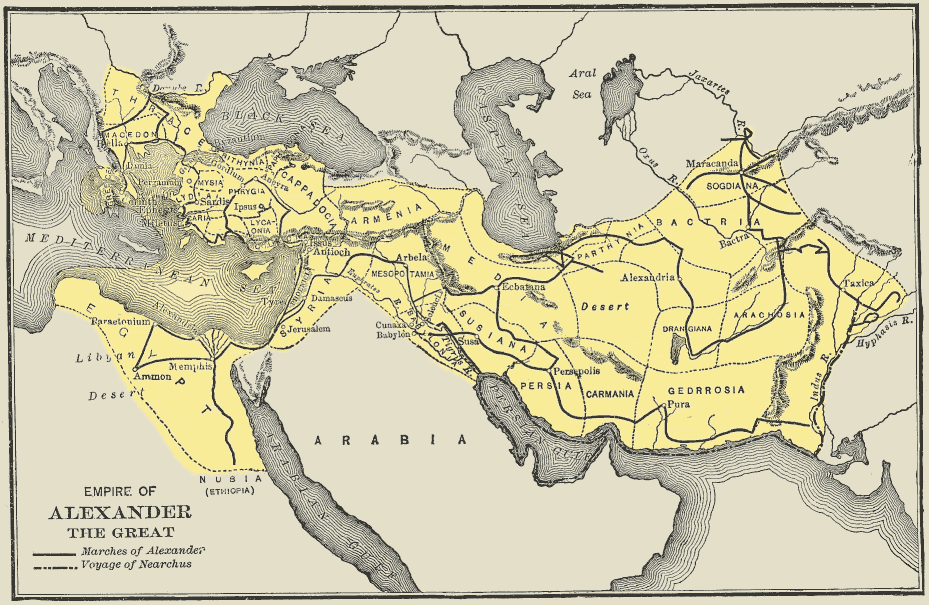

Begin at Macedon, follow the movement through Anatolia, then look south along the eastern Mediterranean to Egypt. Next trace Mesopotamia and the Iranian plateau toward Bactria and the Indus region. This geographical sequence explains the empire's extraordinary east–west reach without requiring an unsupported exact area total.
Notice that a march line can continue through difficult terrain without proving settled administration of every neighboring district. The coastward return route and the voyage are also different journeys. This 1913 map remains useful for orientation, but broad colored frontiers—particularly around Armenia and northern Anatolia—need more evidence than the image alone. Modern national borders should not be read into its ancient place names.
How far did his conquests reach?
Arrian's Anabasis traces the campaign from the Hellespont through the Persian dominions and into the Punjab. His narrative's eastern limit is especially instructive: at the Hyphasis River the soldiers refused to proceed farther. Alexander eventually accepted the return, an episode related in book V, chapters 28–29. Reaching the Indus system therefore does not mean conquering all of the Indian subcontinent.
The empire also did not absorb Rome, the whole Mediterranean or all of Asia. Its reach was extensive within the regions shown, but “most of the known world” obscures whose geographical knowledge is being assumed. A more useful answer names its regions and its limits, then separates military passage, local allied rule and sustained imperial control.
| Place or episode | Evidence in Arrian | What it helps explain | What it does not establish |
|---|---|---|---|
| Granicus | Anabasis I.15 describes cavalry fighting after a difficult river crossing and Alexander's personal danger. | Active command and the coordination of trained troops contributed to success. | One victory cannot prove that every gamble was sound or rank all commanders in history. |
| Tyre | II.24 relates attacks involving ships, harbor approaches and forces entering the city. | Adaptation and combined operations mattered beyond an open-field cavalry charge. | Military achievement does not erase the killing and enslavement in the same account. |
| Hyphasis | V.28–29 records the army's resistance and the decision to turn back. | Morale and endurance imposed limits even on a successful commander. | The eastern march did not conquer every land beyond the river. |
| Babylon and succession | VII.26 reports the final illness; the surviving Events after Alexander excerpt describes arrangements after his death. | The personal command structure left a difficult succession problem. | A final royal anecdote is not proof of an immediate partition into four stable kingdoms. |
What explains his military reputation?
In Arrian's portrayal, Alexander responds quickly, concentrates force and takes an active part in dangerous fighting. Granicus illustrates both the potential effect of personal leadership and its risk: Clitus intervenes when the king is threatened. Tyre illustrates a different skill, organizing a siege involving ships and troops rather than relying on one battlefield tactic.
Arrian's concluding assessment in VII.28 strongly praises Alexander's judgment, initiative and influence over his soldiers. That is an ancient historian's assessment, written centuries after the campaigns and drawing on earlier accounts. It provides evidence for Alexander's reputation, while remaining a perspective readers can evaluate. It is not a survey demonstrating that most modern historians agree on a single “greatest” commander.
Success also depended on soldiers, subordinate commanders, inherited military institutions and local circumstances. The refusal at the Hyphasis shows the limits of personal authority. Tyre's aftermath shows why evaluating effectiveness and evaluating the human cost of conquest are distinct tasks. An empire map can reveal reach while concealing much of that experience.
How old was he when he died?
Alexander died at Babylon in 323 BC. Arrian VII.28 attributes to Aristobulus an age of thirty-two years and eight months. He was therefore 32, rather than 33, at death under that account. Arrian VII.26 discusses the final illness and reports material attributed to the Royal Diary. The narrative does not establish a modern medical diagnosis, so “he died of alcoholism” should not be presented as a demonstrated cause.
Did four generals immediately inherit everything?
No. The surviving account of the initial settlement includes the proclamation of Alexander's half-brother Arrhidaeus as Philip and provision for Roxane's child if male; Alexander IV subsequently shared the royal title. Provincial commands were distributed among numerous figures. Nominal kingship and actual control by powerful commanders were already different things.
This evidence survives in Photius's excerpt of Arrian's lost Events after Alexander. It is a later epitome, not an eyewitness transcript. Its complex first settlement is nevertheless incompatible with a simple story in which four independent kings immediately replaced Alexander on the day he died. Later successor wars and changing kingdoms must be traced across time.
How does Daniel relate to this history?
Daniel 8:20–22 identifies the ram with Media and Persia and the goat with Grecia; the great horn is the first king, followed by four kingdoms. The passage does not use Alexander's personal name. Associating him with the first king and relating the four horns to successor kingdoms is an interpretation connecting the text to history.
Daniel 11:3–4 similarly describes a powerful king whose kingdom is divided and does not pass to his posterity. That language should not make the documented interval of Philip III and Alexander IV disappear. Readers can compare the interpretive correspondence while keeping the actual succession sequence visible. The Daniel comparison study considers those issues more fully.
Alexandria's later appearance in the New Testament is another distinct subject. Acts 18:24 identifies Apollos as Alexandrian, while Acts 27:6 and 28:11 mention Alexandrian ships. Those verses do not themselves establish the date of a church's foundation or a visit by Alexander to Jerusalem. For the latter tradition, read Josephus's account and its limitations.
Sources and map credit
- Arrian, The Anabasis of Alexander, E. J. Chinnock's 1884 translation: I.15; II.24; V.28–29; VII.26, 28. These are selected ancient narratives, not a modern medical investigation.
- Arrian, Events after Alexander, preserved in Photius, initial royal and provincial settlement, translated by J. H. Freese.
- Daniel 8; 11:1–4; Acts 18:24; 27:6; 28:11.
- Map: Botsford's 1913 historical map, unchanged; public-domain source record and full-size image linked beneath the figure.