Roman Empire Map at Its Greatest Extent: AD 117
Questions: What led to the Roman Empire reaching its peak of power? How did it affect early Christianity?
Rome's largest territorial extent is conventionally placed in AD 117, near the end of Trajan's reign. That map combines centuries of earlier conquest with his campaigns in Dacia and the east. It describes the widest reach of Roman power, rather than a moment when every frontier was secure or every conquered district was permanently incorporated. Christianity began within an earlier, smaller Roman world; its growth and its encounters with imperial authority should be examined separately from the empire's maximum area.
Map of the Roman Empire at its greatest extent
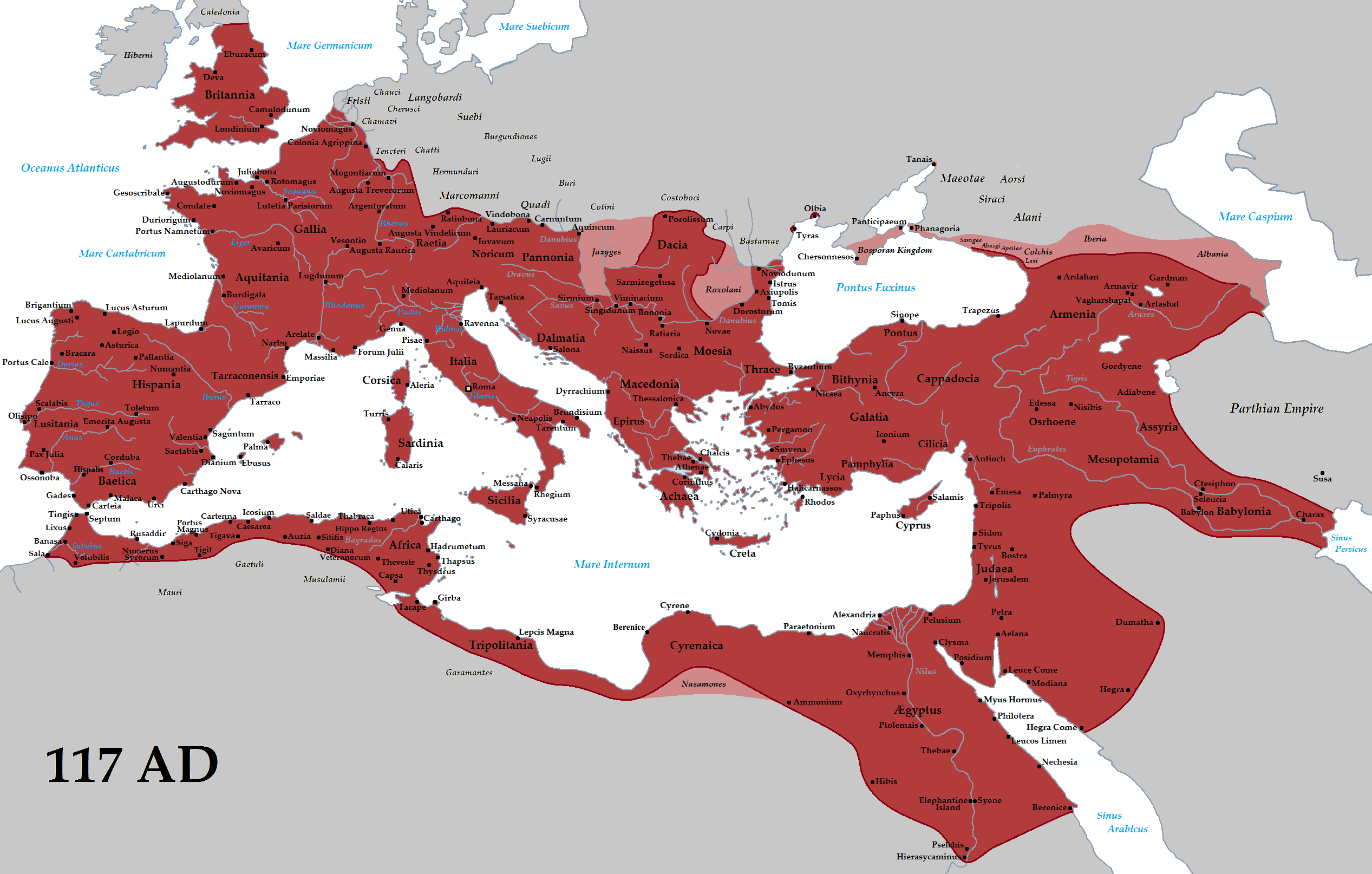

Locate Rome in Italy, then follow the Mediterranean coast toward Egypt and Judaea. Britain and Dacia extend the picture beyond the sea's northern shore; the eastern labels Armenia and Mesopotamia draw attention to Trajan's recent campaigns. These are historical reconstructions of changing authority, not surveyed boundaries or modern national borders. The red fill does not establish that every district had the same administration, level of occupation or prospect of remaining Roman.
What led to Rome's peak of power?
Trajan inherited an imperial structure built on the Republic's earlier expansion. Rome had already acquired Mediterranean territories before Augustus became its first emperor. Augustus' own account distinguishes adding Egypt to Roman rule from placing a chosen king over Armenia rather than making it a province (Res Gestae 27). Even an emperor's claim to control therefore needs to be read alongside the means by which that control was exercised.
| Stage | Contribution | Important distinction |
|---|---|---|
| Republican expansion | Rome established a Mediterranean base through conquest and political arrangements. | An overseas empire existed before government by emperors began. |
| Augustan settlement | Augustus consolidated personal rule while presenting it through republican offices and honors. | His account of restoring the republic is his political presentation, not proof that power returned to an equal competition among officeholders. |
| Trajan and Dacia | The Dacian wars ended in conquest in AD 106. | This conquest predates the conventional AD 117 maximum; it did not occur in 117. |
| Trajan's eastern campaigns | Campaigns against Armenia and Parthia extended Roman military power farther east. | Cassius Dio also reports revolts and lost garrisons. Military advance and durable government were different achievements. |
The map's size can thus be explained by accumulated conquests, the resources of existing provinces and further military campaigns. It cannot by itself measure prosperity, public consent, military security or comparative strength against every other ancient state. A ranking such as “the third most powerful empire” would need a defined measure and evidence beyond territorial shading.
Why the largest map was not a permanent settlement
Cassius Dio's account of Trajan's eastern war describes advances toward the Persian Gulf followed by revolts in the conquered districts (Roman History 68.28–30). His closing account emphasizes the fragility of those gains as Trajan became ill and left Hadrian with the army in Syria (68.33). The eastern edge of an AD 117 map should therefore be read with particular care.
The conventional label “Five Good Emperors” covers Nerva, Trajan, Hadrian, Antoninus Pius and Marcus Aurelius, AD 96–180. It is a later evaluative grouping, not a statement that every reign was free of war or that expansion continued at the same rate throughout it. For this page, the relevant point is narrower: the maximum shown belongs to Trajan, not to an unchanging two-century frontier.
How did Roman power affect early Christianity?
Acts gives concrete examples of Christians moving through this political world. In Acts 27:1–6, Paul travels toward Italy under a centurion's custody and changes to an Alexandrian ship. The Mediterranean connected communities, but the same journey also shows coercion: Paul travels as a prisoner after appealing to Caesar. The map supplies geographical orientation; it does not show his route, the ships or the reasons for the appeal.
Roman citizenship could matter in encounters with officials. At Philippi, Paul objects that he and Silas were beaten and imprisoned without condemnation despite being Roman citizens (Acts 16:19–40). In Jerusalem, his citizenship interrupts a planned examination by scourging (Acts 22:22–29). These passages describe particular interventions, not a general guarantee that Roman citizens or Christians were safe from mistreatment.
Nero, Trajan and the limits of a simple persecution timeline
Tacitus places Nero's punishment of Christians in the aftermath of Rome's fire in AD 64 (Annals 15.44). This is evidence for brutality in Rome under Nero. It should not be expanded into a demonstrated empire-wide edict beginning in AD 67, or used to locate every punishment in the Circus Maximus. Tacitus is a later Roman historian whose account must be distinguished from the New Testament narrative.
A different window appears in Pliny's correspondence with Trajan concerning Christians in Bithynia-Pontus, around AD 112 (Letters 10.96–97). Pliny describes interrogations and punishment; Trajan instructs him not to seek Christians out, while allowing punishment when accusations are proved and the accused persist. This is still coercive government action, but its instructions are more specific than a scheme of ten identical, empire-wide waves.
Territorial expansion and Christian experience therefore answer different questions. Rome provided an interconnected setting and powerful legal institutions. The surviving accounts show those institutions being used both to restrain some immediate abuses and to punish Christians. Neither the empire's geographic size nor its later reputation settles the details of an individual episode.
Sources
- Tataryn, Roman Empire Trajan 117AD, map, color identification, authorship and license.
- Augustus, Res Gestae 27, and 34, imperial claims about territories and the political settlement.
- Cassius Dio, Roman History 68.14, 17–20, 28–30, 33, Dacia and the eastern campaigns; a later literary account, not a modern boundary survey.
- Joshua J. Mark, “Roman Empire,” World History Encyclopedia, conventional maximum and reign dates; these do not validate every judgment in that overview.
- KJV: Acts 16:19–40; 22:22–29, citizenship and local officials; 25:10–12; 27:1–6, appeal and travel in custody.
- Tacitus, Annals 15.44, Nero and Christians after the fire; Pliny and Trajan, Letters 10.96–97, provincial proceedings and imperial reply.