Roman Empire in New Testament Times: Map and Emperors
Questions: Who ruled the Roman Empire in New Testament times? Who started the first state persecution of Christians?
Augustus, Tiberius and Claudius are named as emperors in Luke and Acts. Nero belongs to the later historical setting of Paul's ministry, although the New Testament does not name him. Nero also stands behind the first well-attested imperial persecution of Christians, in Rome after the fire of AD 64. To read this setting accurately, distinguish a named ruler, an emperor identified by chronology and a later tradition about an apostle.
Roman rule at the death of Augustus: AD 14
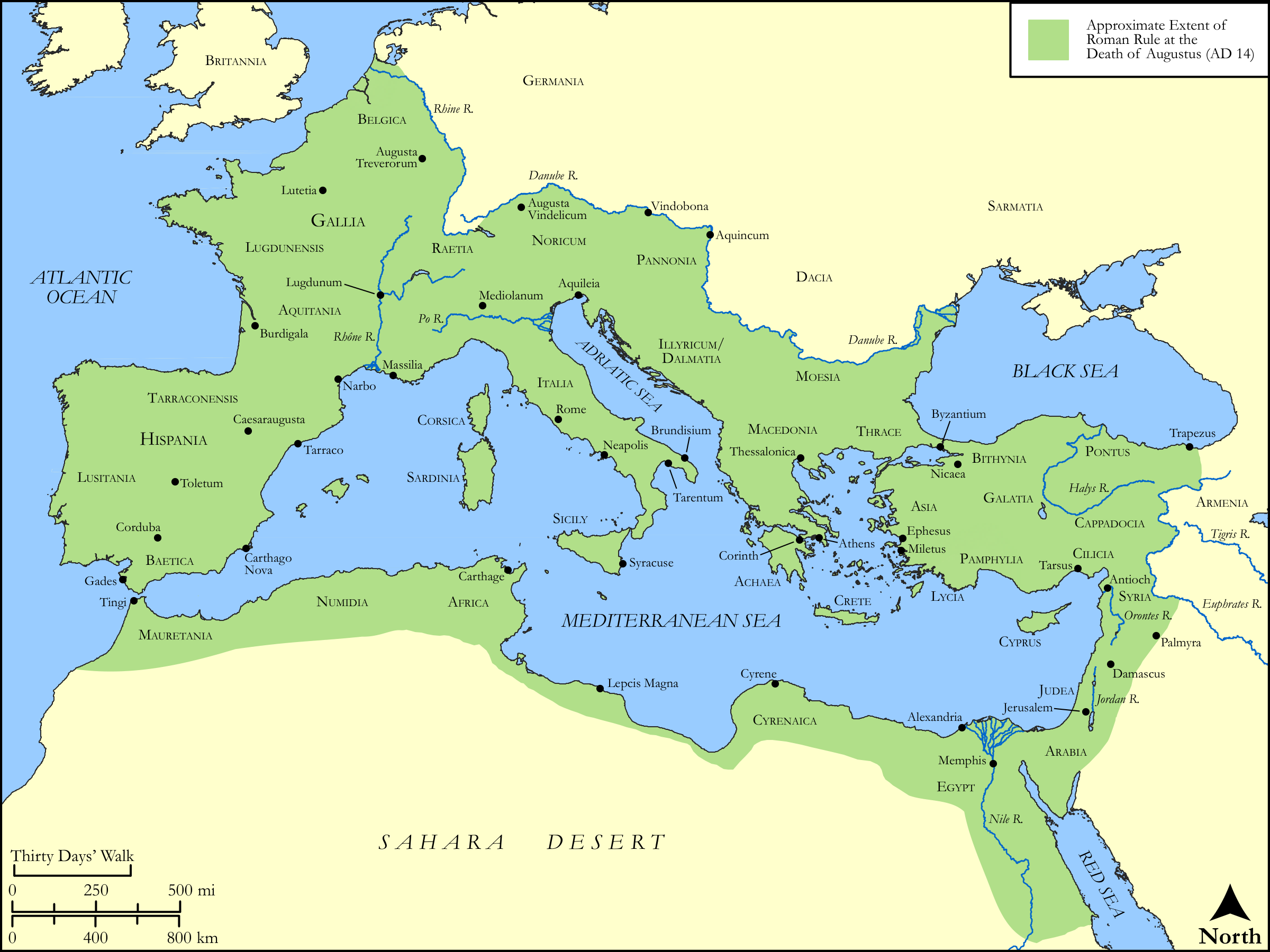
This is a baseline for the opening first-century setting. It is not a map of every year covered by the New Testament, and it is not Trajan's larger AD 117 empire. The green shading gives the approximate extent of Roman rule. It does not distinguish every legal arrangement within that sphere or supply a detailed province-by-province boundary key.
Find Judaea and Jerusalem on the eastern Mediterranean shore, Antioch farther north, and Rome in Italy. Corinth and Ephesus help orient the reader to places in Paul's ministry. The city dots identify places; they are not stops joined by a plotted missionary route. The map itself does not draw Paul's roads or sea journeys.
Who ruled during the first century?
| Emperor or transition | Reign | Connection and limit |
|---|---|---|
| Augustus | 27 BC–AD 14 | Named in Luke 2:1 at the beginning of the birth narrative. |
| Tiberius | AD 14–37 | Named in Luke 3:1 when John the Baptist's ministry is introduced. |
| Caligula | AD 37–41 | Part of the imperial succession; not named in the New Testament. |
| Claudius | AD 41–54 | Named in Acts 11:28 and 18:2. |
| Nero | AD 54–68 | Identified by the historical chronology of the later Pauline setting; not named by the text. |
| Galba, Otho and Vitellius; Vespasian's accession | Crisis of AD 68–69 | The “Year of Four Emperors” culminates in Vespasian's rule. This is historical background, not a succession narrated in Acts. |
| Vespasian; Titus; Domitian | AD 69–79; 79–81; 81–96 | The Flavian succession extends the first-century context. The New Testament does not give this emperor list. |
| Nerva; Trajan | AD 96–98; 98–117 | A bridge into the second century. Trajan's reign should not be taken as the date of every late New Testament writing. |
A table of rulers is a historical aid. Dating the composition of individual New Testament books is a separate question and cannot be settled simply by placing an emperor beside an apostle's name. Likewise, a reign's starting and ending years do not supply the exact year of every episode within it.
Which names are actually in the passages?
Augustus: Luke 2:1 names Caesar Augustus. Acts 27:1 instead calls Julius a centurion of “Augustus' band” in the KJV. That military designation does not put Paul's voyage in Augustus' reign or make Acts 27 the birth narrative's reference to the emperor.
Tiberius and Claudius: Luke 3:1 names Tiberius while also naming several regional rulers. Acts 11:28 places a famine in Claudius' days. Acts 18:1–3 explains Aquila and Priscilla's arrival from Italy by reference to Claudius' order that Jews depart from Rome. These are specific narrative notices, not merely names inferred from a later chronology.
Caesar: Paul's appeal is to Caesar in Acts 25:10–12. Philippians 4:22 sends greetings from believers of Caesar's household. Neither passage spells out “Nero.” In particular, a reference to the imperial household should not be rewritten as a statement that Nero himself was a Christian or that the greeting supplies an explicit emperor's name.
One emperor, many encounters with local authority
Luke 3:1 places an emperor, a governor and regional tetrarchs in the same sentence. Acts likewise distinguishes city magistrates, military officers and provincial governors. A single color on a large map should not erase these different offices or turn every local conflict into a direct imperial order.
At Philippi, Paul and Silas are beaten and imprisoned, then invoke their Roman citizenship when the magistrates try to send them away quietly (Acts 16:19–40). In Jerusalem, Paul's citizenship interrupts a threatened scourging (Acts 22:22–29). Soldiers later escort him to the governor Felix at Caesarea after a plot against his life (Acts 23:23–35). These accounts show both abuses and protections operating through Roman institutions.
Paul's appeal leads toward Italy, with a centurion supervising prisoners and arranging sea passage (Acts 25:10–12; 27:1–6). Acts closes with Paul in Rome, under guard but receiving visitors and teaching (28:16–31). It does not close with an account of Nero sentencing him to death.
Who began the first state persecution of Christians?
The qualified answer is Nero, in Rome after the fire of AD 64. Tacitus' Annals 15.44 describes Christians being made scapegoats and subjected to lethal punishments. That passage supports an imperial persecution at Rome. It does not establish a general law ordering the simultaneous persecution of all Christians in every province.
“First imperial persecution” also does not mean the first opposition or violence suffered by a Christian. Acts describes earlier confrontations in particular places. The question here concerns the Roman emperor's involvement, with the scale and location limited to the evidence.
Pliny's correspondence with Trajan in the early second century records a different administrative setting in Bithynia-Pontus. Trajan's reply instructs Pliny not to seek Christians out, but allows punishment after accusations and examination. Reading that exchange alongside Tacitus is more useful than assuming a fixed series of identical empire-wide campaigns.
What should be identified as later tradition?
Revelation 1:9 says John was on Patmos because of the word of God and the testimony of Jesus. It does not name Domitian or state AD 95. Those details belong to discussions of later testimony and the book's dating; they are not words supplied by this verse.
The New Testament passages used here likewise do not narrate Peter's and Paul's executions under Nero or give an exact joint martyrdom date. A reader can distinguish a church tradition from an explicit narrative statement without having to settle every disputed biographical question in order to use the map.
Sources
- Biblica, NT001 source record and its AD 14 map legend; collection license.
- KJV: Luke 2:1–7; 3:1–3; Acts 11:27–30; 18:1–3, named emperors in context.
- KJV: Acts 25:10–12; 26:30–32; 27:1–6; Philippians 4:21–23; Revelation 1:9, Caesar, the regiment and Patmos.
- KJV: Acts 16:19–40; 22:22–29 and 23:23–35; 28:16–31, officials, citizenship, custody and the narrative ending.
- Joshua J. Mark, “Roman Empire,” World History Encyclopedia, first-century and early second-century reign sequence.
- Tacitus, Annals 15.44, persecution at Rome after the fire; Pliny and Trajan, Letters 10.96–97, provincial correspondence.