Roman Empire under Constantine Map
Reader's questions: What made Roman Emperor Constantine great? How did he affect Christian history for generations?
Constantine's lasting significance rests on three connected changes: he emerged from civil war as sole emperor, gave Christianity imperial protection and patronage, and developed Constantinople as an imperial capital. “The Great” is a historical honorific, not a finding that all his actions were good. The map helps locate his empire; legal texts and competing narrative accounts explain his religious influence more accurately than the map alone can.
Roman Empire under Constantine: the map's date matters
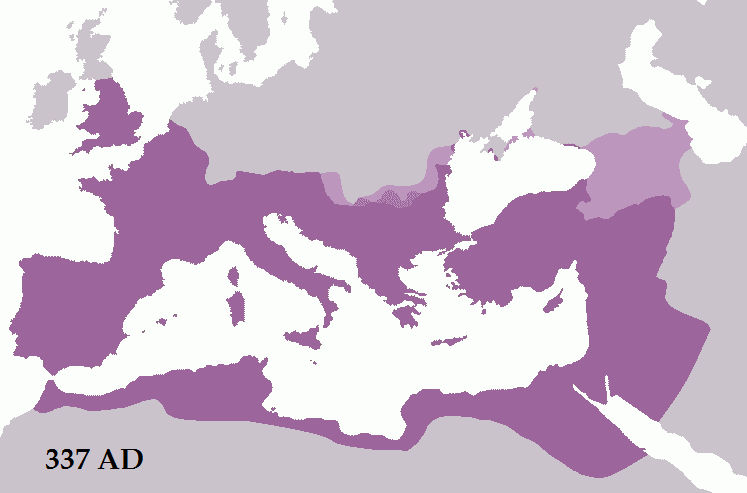

Follow the Mediterranean coastline to see how the empire joined territories in Europe, North Africa and western Asia. The picture is an overview, without provincial names, city labels or a campaign route. It does not depict Constantine's personal control in 306 or 312, when other rulers still held substantial parts of the Roman world.
| Map feature | Useful reading | What it cannot establish |
|---|---|---|
| Dark-purple territory | A broad picture of the empire across the Mediterranean. | The borders of every province or the army stationed at each location. |
| Shaded area in Dacia | The artist marks Constantine's gains north of the Danube separately. | Uniform or permanent incorporation of all the shaded land into Roman provincial government. |
| Light-purple areas | The file description identifies dependencies, including the Bosporan Kingdom and areas around the Caucasus. | That dependency and direct imperial rule were the same political relationship. |
| Date: 337 | A late-reign context for comparison with Constantine's earlier rise. | A territorial map for the New Testament era or for the later Byzantine Empire in 1025. |
For named provinces in the earlier apostolic setting, use the Roman provinces in New Testament maps. For a much later comparison centered on Constantinople, see the Byzantine Empire in 1025. These maps answer different chronological questions.
How did Constantine gain the whole empire?
Constantine's imperial career began in 306 within a political system that already divided authority among several rulers. His later achievement was to defeat rivals and reunite their territories under one emperor. It is misleading to imagine a single uncontested succession followed immediately by possession of everything on the 337 map.
His victory over Maxentius at the Milvian Bridge in 312 established his dominance in the west. Licinius remained a major ruler in the east; the religious agreement of 313 therefore involved both men. Their cooperation gave way to conflict. Constantine's final victory over Licinius in 324 made him sole ruler. Eusebius celebrates this reunion in Life of Constantine II.19, but his approving account also casts the defeated enemy in strongly religious terms. Political history should not simply adopt that rhetoric as a neutral assessment of the two men.
What can be said about the vision before battle?
The familiar story is often told as if all surviving accounts describe the same event in the same terms. They do not. Comparing the accounts is more useful than confidently placing a flaming cross in Gaul or claiming that a historian can directly verify the supernatural experience.
| Source | What the author reports | How to read the evidence |
|---|---|---|
| Lactantius, Deaths of the Persecutors 44 | Constantine is instructed in a dream to mark his soldiers' shields with a heavenly sign before the battle against Maxentius. | This account emphasizes a dream and the shields; it is not the same description as a public daytime cross. |
| Eusebius, Life of Constantine I.28–32 | A cross-like sign appears above the sun; a later dream explains it, and the account proceeds to the imperial standard. | Eusebius says Constantine related the incident to him long afterward. The author does not present himself as an eyewitness to the sight in the sky. |
Eusebius states in I.11 that his purpose is to select deeds illustrating the emperor's religious character. That helps explain the work's praise and selection of events. Neither text gives direct access to Constantine's private motives at every point in his life. The earlier article's claim that Sol Invictus was simply Baal, followed by a verdict that the conversion story was therefore suspicious, required evidence it did not provide. The surviving accounts can be studied without using that equation as a settled fact.
Did Constantine legalize Christianity?
He played a decisive role in its protection and advancement, but the legal sequence matters. Galerius's toleration edict of 311 had already permitted Christian assemblies again, subject to its stated conditions. In 313 Constantine and Licinius agreed on religious liberty and restoration of property taken from Christian communities. Lactantius preserves the published measures in chapter 48; the paired texts available through Fordham allow readers to compare 311 and 313.
The 313 agreement protected Christians and also described liberty for others to follow their religion. It was not a declaration that Christianity was the empire's compulsory religion. Nor had persecution been continuous and identical throughout the empire for a precise 246-year period. Different rulers, regions and episodes need to be distinguished.
The later law preserved as Theodosian Code XVI.1.2 gives a different kind of statement: it identifies an authorized Christian confession and treats dissenting groups as heretical. Reading it alongside the toleration texts shows why permission to practice, imperial favor and enforced religious orthodoxy should not be treated as one event accomplished by Constantine in 313.
Eusebius also reports laws against gladiatorial combat in IV.25. A report of a prohibition is evidence about a ruler's stated policy; by itself it cannot establish that every such spectacle ceased immediately throughout the empire. That distinction avoids turning a reform claim into an unsupported empire-wide result.
How did he influence the church?
Imperial support affected Christian institutions as well as legal safety. It supplied resources, public recognition and access to the emperor. At the Council of Nicaea in 325, Constantine convened bishops and pressed for agreement. Eusebius describes arrangements for their travel, the emperor's attendance and his appeals for unity in III.6 and III.10–14.
This was a substantial change in the relationship between churches and imperial power. The emperor could help bring bishops together and support decisions with political authority. The bishops' doctrinal deliberation, however, should not be replaced in the story by an emperor single-handedly inventing Christianity. Nor did the meeting resolve every subsequent Christian disagreement. Constantine's involvement made imperial intervention in disputes a practical issue for later generations.
Was Constantinople named only after his death?
No. Constantine developed Byzantium as a new imperial capital, dedicated in 330, and it was known as Constantinople while he lived. Eusebius III.48 explicitly speaks of the city bearing his name. Its Bosphorus position connected the Black Sea with the Aegean and placed an imperial center between important European and Asian regions. Those geographical connections explain more than a comparison of its hills with Rome's.
Constantine died in 337. Eusebius IV.61–64 describes his final illness and baptism near the end of his life. His favorable policies toward Christians therefore long preceded the baptism recorded in that account. Baptism's date alone does not settle every question about when his beliefs changed or how sincerely he held them.
What, then, made him “great”?
The strongest historical answer concerns consequences: military reunification, the elevation of Christianity's public position, and the development of a capital with a long future. These were major changes even though they did not happen simultaneously. The title should not erase the civil wars through which he rose or turn Eusebius's portrait of an exemplary emperor into an independent moral verdict.
For Christian history, Constantine marks a shift from vulnerability under persecuting rulers toward extensive imperial support. That support brought opportunities for churches and new questions about political power in religious affairs. The primary sources let readers ask both what changed and who is describing it, while the dated map keeps that discussion anchored in the correct Roman world.
Sources and reading notes
- Lactantius, On the Deaths of the Persecutors, chapters 44 and 48: the dream account and the religious settlement. This is a Christian account of persecution and its reversal.
- Eusebius, Life of Constantine I, chapters 11 and 27–32; II, especially 19–20; III, chapters 6, 10–14 and 48; IV, chapters 25 and 61–64. Its religious purpose and praise are part of the evidence to assess.
- Fordham University, the toleration texts of 311 and 313, and Theodosian Code XVI, especially XVI.1.2. Compare the translated legal texts; the latter page's introductory attribution of the 311 measure to Constantine is inaccurate.
- Donald L. Wasson, Constantine I, used for the outline dates of his rule, reunification, Nicaea and the dedication of the capital. Its broader claims about religion, spectacles and the emperor's family require separate evaluation against primary evidence.