When was Rome founded, who was its founder, and where did its name come from? The familiar answer is 21 April 753 BC, with Romulus as the founder. That is Rome's traditional foundation date and story. Understanding the tradition requires separating its civic anniversary, its competing narratives and the surviving objects used to represent it.
What does 753 BC tell us?
Rome's official introduction to the city presents 753 BC as the year of Romulus' kingship in the foundation legend. Plutarch, Life of Romulus 12, describes 21 April as the day celebrated as Rome's birthday and discusses attempts to calculate the founder's chronology. These references explain the traditional answer; they do not turn an anniversary into a contemporary record of a city's construction.
Livy makes the nature of his evidence clear in the preface to his History of Rome: he treats the stories before the city's foundation as traditions in which human and divine material have been combined, and declines to affirm or refute them. That warning belongs beside the stories themselves. A date attached to the legend is not enough to verify the twins' biographies or establish that all of Rome appeared at once.
Who were Romulus and Remus in the story?
In Livy 1.3–4, the twins belong to the royal story of Alba Longa, whose ancestry the narrative connects with Aeneas. Their mother is Rhea Silvia. The king orders the infants exposed, and they are left near the flooded Tiber. The account has a she-wolf nursing them before the shepherd Faustulus takes them to his household, where his wife raises them. Livy also records a different explanation of the wolf motif. These are reported ancient traditions, rather than details established by a surviving birth record.
After restoring their grandfather Numitor, the brothers plan a new city. Livy 1.6–7 places Romulus on the Palatine and Remus on the Aventine as they seek an omen about leadership. The dispute ends in Remus' death, but Livy preserves more than one version: in one he dies in the fighting, while the more familiar account has Romulus kill him after he jumps over the new wall. It is more accurate to acknowledge those alternatives than to present one smooth, certain biography.
Was Rome named after Romulus?
That is the explanation in Livy's foundation narrative: Romulus gains sole rule and the city takes its founder's name. It is a traditional explanation of the name, rather than a settled linguistic demonstration. At the start of his Life of Romulus, chapters 1–2, Plutarch reports that writers disagree about the city's name and founder, and supplies several competing stories. Even ancient readers were not being offered only one explanation.
The useful distinction is between “the Romans told this story about their beginning” and “this story proves the derivation of the word Rome.” The first can be supported by the texts. The second requires more than repeating the story.
Which are Rome's seven hills?
The traditional list is the Palatine, Aventine, Capitoline, Quirinal, Viminal, Esquiline and Caelian. Modern Italian names sometimes appear instead: Campidoglio is the Capitoline, while Celio is the Caelian. The Vatican Hill is not one of these seven. These names describe the conventional group associated with ancient Rome; they do not mean that the twins laid out seven complete districts in a single founding ceremony.
The city's own overview describes expansion from the Palatine across the seven hills. Livy's narrative likewise begins with Romulus fortifying the Palatine, rather than constructing the whole later city at once. When comparing the hills with the legend, keep the Palatine/Aventine rivalry in the augury story distinct from the full seven-hill list. Otherwise a later description of Rome's extent becomes an invented instruction given to its founders.
What can the she-wolf sculpture show?
Open the Capitoline Museums' photograph of the she-wolf and twins, then compare it with the museum's object record, inventory MC1181.
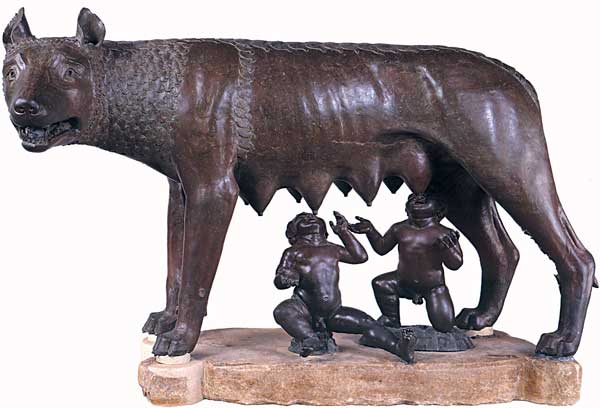
This is why the photograph and its catalogue should be used together. The image lets us inspect the composition, while the museum record supplies information about the object's later display and additions. Neither the photograph nor the fact that the wolf became a civic symbol establishes an exact founding day.
How should the rest of Romulus' story be read?
The same discipline applies to accounts crediting Romulus with political and military institutions. Plutarch 13 attributes a senate and military organization to him; his later chapters relate the abduction of the Sabine women and Romulus' identification with the god Quirinus. These are parts of the ancient explanation of Roman society and authority. Reporting them as traditions avoids presenting each institution's later form as a documented creation of one identifiable man.
For a reader asking when Rome began, the traditional date remains a useful answer when its status is stated. The date, the seven hills, the literary founder and the she-wolf image answer different questions: an anniversary, a geographical convention, a foundation narrative and a visual symbol. Keeping them distinct makes the familiar story more informative without giving it a certainty its own ancient narrators did not claim.