Neo-Babylonian Empire Map: Judah and the Exile
The Neo-Babylonian kingdom is conventionally dated from Nabopolassar's accession in 626 BC to the Persian conquest of Babylon in 539 BC. It is the later Babylonian power associated with Nebuchadnezzar II and Judah's exile, not the much earlier kingdom of Hammurabi. A useful map study must distinguish the city of Babylon, its home region of Babylonia, and the wider imperial sphere.
The map provides a broad spatial comparison. The table supplies the changing sequence: Egyptian pressure on Judah, Babylonian dominance, Jehoiachin's deportation, a later destruction under Zedekiah, and the eventual Persian takeover.
Read the map and its limits
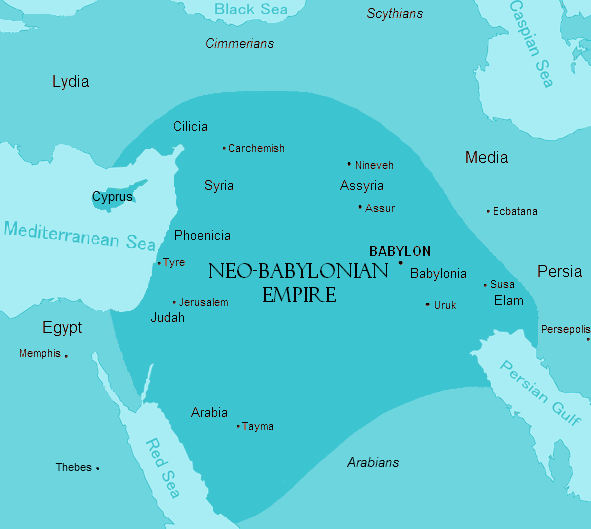

Locate Babylon and Jerusalem first. Carchemish lies far north of Jerusalem, near the passage between Mesopotamia and the western lands. Nineveh and Assur belong to the former Assyrian heartland; their appearance within the shading does not make them the capitals of the Babylonian kingdom. Egypt and Media are separately placed outside the principal shaded area.
Tayma belongs to a later part of this story: the Nabonidus Chronicle says the king was there while the prince and army remained in Akkad, meaning Babylonia in this edition. That notice is not a reason to project every Arabian claim on a generalized map backward into Nebuchadnezzar's campaign against Jehoiachin. The schematic is useful for orientation; its unlabeled frontier and broad Arabian shading should not carry detailed territorial conclusions.
Which Babylonian kingdom?
Hammurabi belongs to the eighteenth century BC, while Nebuchadnezzar II belongs to the early sixth. The Metropolitan Museum's history of Babylon traces these different periods and places the city on the Euphrates in southern Mesopotamia. A later revival of Babylonian power should not be described as the same short-lived state created by Hammurabi.
The ABC 3 edition dates Nabopolassar's accession to 626 BC and places the capture of Nineveh in 612 BC within a longer war involving Babylonians, Medes and remaining Assyrian forces. The empire therefore did not begin only when Nineveh fell. Its end in 539 BC was a transfer of political control; the Met's account makes clear that Babylon continued as a significant city afterward.
Babylonian envoys already appear during Hezekiah's reign in 2 Kings 20:12–19. The passage names Berodach-baladan as king of Babylon. This earlier encounter should not be inserted into Nabopolassar's later dynasty or used to claim that Nebuchadnezzar's empire was already ruling Judah then.
Follow Judah's changing situation
| Episode | What to follow on the map | Textual evidence | Chronological boundary |
|---|---|---|---|
| Necho and Josiah; then Jehoiakim | Egypt, Judah and the direction of Carchemish | 2 Kings 23:29–35 and 2 Chronicles 35:20–24 describe Josiah's death and Egyptian intervention. | These are not the same event as Babylon's capture of Jehoiachin. |
| Defeat of Egypt's army at Carchemish | Carchemish, far north of Judah | Jeremiah 46:2 names Necho's army and Nebuchadnezzar; ABC 5 describes the campaign. | The chronicle's edition places it in 605 BC. Defeating that army does not establish permanent control of Egypt. |
| Jehoiachin's surrender and removal | Jerusalem and Babylon | 2 Kings 24:10–17; ABC 5, reverse lines 11–13. | The edition dates the capture to 597 BC. It is distinct from the later burning of the temple. |
| Zedekiah's rebellion and Jerusalem's destruction | Jerusalem; the biblical account also names Riblah, which this schematic does not mark | 2 Kings 24:18–25:12. | Crossway's Judah chart dates the final fall to 586 BC. The biblical text itself supplies regnal years, not that modern year number. |
| Jehoiachin receives a royal allowance | Babylon, where the captive king remains | 2 Kings 25:27–30 names Evil-merodach and describes release from prison and provision. | A later change in the captive king's treatment; it does not say the exile community immediately returns. |
| Persian takeover and the return proclamation | Babylon and Jerusalem | ABC 7 describes the conquest; Ezra 1 gives Cyrus's proclamation concerning Jerusalem. | The 539 BC conquest and the process of return are related but not identical events. |
Daniel 1:1–7 opens with Jehoiakim and youths taken into the Babylonian court; Jeremiah 25:1 uses Jehoiakim's fourth year alongside Nebuchadnezzar's first. Those introductions should not be flattened into an assertion that every named exile departed in the same year. The table uses the chronicle's externally anchored 597 event while retaining the different biblical regnal notices.
Did Babylon conquer Egypt?
Second Kings 24:7 says Babylon took the territory formerly held by Egypt between the river of Egypt and the Euphrates. That is a statement about Egypt's possessions in the intervening region, rather than a statement that the Nile valley became a Babylonian province.
ABC 5's fourth-year notice describes a battle against Egypt with heavy losses on both sides and Nebuchadnezzar's return to Babylon. Its next-year notice describes rebuilding his chariot and horse forces. Neither this notice nor Jeremiah's description of the Egyptian defeat at Carchemish supports shading Egypt as an established part of the Neo-Babylonian Empire.
What does the Jerusalem Chronicle date?
In ABC 5, reverse lines 11–13, the king besieges the city of Judah, captures its king, installs another king and takes tribute. The edition relates this to Jehoiachin's capture in 597 BC. Second Kings 24:12 calls the event Nebuchadnezzar's eighth year; the chronicle uses his seventh. These are different regnal-numbering notices, not identical wording from interchangeable documents.
This surviving chronicle does not provide the later account of the temple's burning. For that episode the biblical narrative must be read in 2 Kings 25, while the calendar placement used here is explicitly attributed to Crossway's chronology. Keeping the evidence separate prevents the well-attested 597 capture from being used as if it independently documented every detail of the final destruction.
Belshazzar, Nabonidus and the end
Daniel 5 calls Belshazzar king and presents the writing on the wall as divine judgment. The Nabonidus Chronicle, ABC 7, names Nabonidus as king and repeatedly distinguishes him from the prince who remained in Akkad during his absence. This gives a more complex political setting than a list making Belshazzar the only ruler after Nebuchadnezzar. It does not itself establish a precise co-regency beginning in 553 BC.
ABC 7's seventeenth-year account distinguishes fighting at Opis, Sippar's capture, entry into Babylon, and Cyrus's subsequent arrival. Thus “Cyrus conquered Babylon in 539 BC” compresses a sequence, rather than describing every action as one battle inside the capital. Daniel's theological account and the Babylonian chronicle should each be identified by their own claims; this page does not solve the disputed identification of Daniel's Darius the Mede by renaming him Cyrus.
Life and hope among the exiles
Second Kings 25:12 says some poor agricultural workers remained in Judah. Jeremiah 29:1–14 addresses an exile community in Babylon, calling for homes, gardens, families and prayer for the city's peace while holding out hope of restoration. Empire-wide shading should not obscure those different lived situations.
Ezra 1 describes a proclamation and preparations for return, including temple vessels and support for those going to Jerusalem. It does not claim that every displaced person left Babylon at once. The end of one empire and the restoration of a community unfold at different scales.
Questions for a map study
- Find Carchemish and Jerusalem. Why should a victory at the former not automatically be called a capture of the latter?
- Compare 2 Kings 24 and 25. Record the king of Judah, the action and the stated regnal year before adding a modern calendar date.
- Read ABC 5's fourth-year and seventh-year notices. Which conclusion about Egypt or Jerusalem does each actually support?
- Compare Jeremiah 29 with Ezra 1. What changes for an exile household, and what is still left unstated?
Sources and map credit
- King James Version: 2 Kings 20:12–19; 2 Kings 23:29–37; 2 Kings 24; 2 Kings 25; 2 Chronicles 35:20–27; Jeremiah 25:1–14; Jeremiah 29:1–14; Jeremiah 46:1–12; Daniel 1:1–7; Daniel 5; Ezra 1.
- ABC 3, Fall of Nineveh Chronicle; ABC 5, Jerusalem Chronicle, obverse lines 1–13 and reverse lines 5–13; ABC 7, Nabonidus Chronicle, column ii's absence notices and column iii, lines 12–20. Ancient texts in the Livius editions, with translations and chronological commentary distinguished.
- Metropolitan Museum of Art: Babylon, for the city's location, different Babylonian periods and continued existence after 539 BC. Crossway, ESV Global Study Bible: Kings of Judah, for the explicitly attributed 586 BC placement of Zedekiah's final fall.
- Neo-Babylonian Empire.png, preserved Commons file page: creator ܥܝܪܐܩ, 17 March 2010, public-domain declaration. The creator's map does not specify one historical year or document every boundary. No site authorship claim, crop, recoloring or ownership watermark has been added.