Megiddo in Ancient Israel
Megiddo was a city whose remains form an archaeological mound beside the Jezreel Valley. The mound, the wider plain and the place called Armageddon in Revelation should be distinguished. Megiddo's strategic setting and memories of conflict help explain its significance, but they do not provide a surveyed location or a date for a future world war.
Where Is Megiddo, and What Does It Look Like?
The Israel Nature and Parks Authority locates Megiddo where the Iron Valley, or Wadi Ara, opens into the Jezreel Valley. This position controlled access to a major route between Egypt and Mesopotamia. The tell rises above its surroundings; it is a particular settlement mound, not a name for the whole expanse of fields.
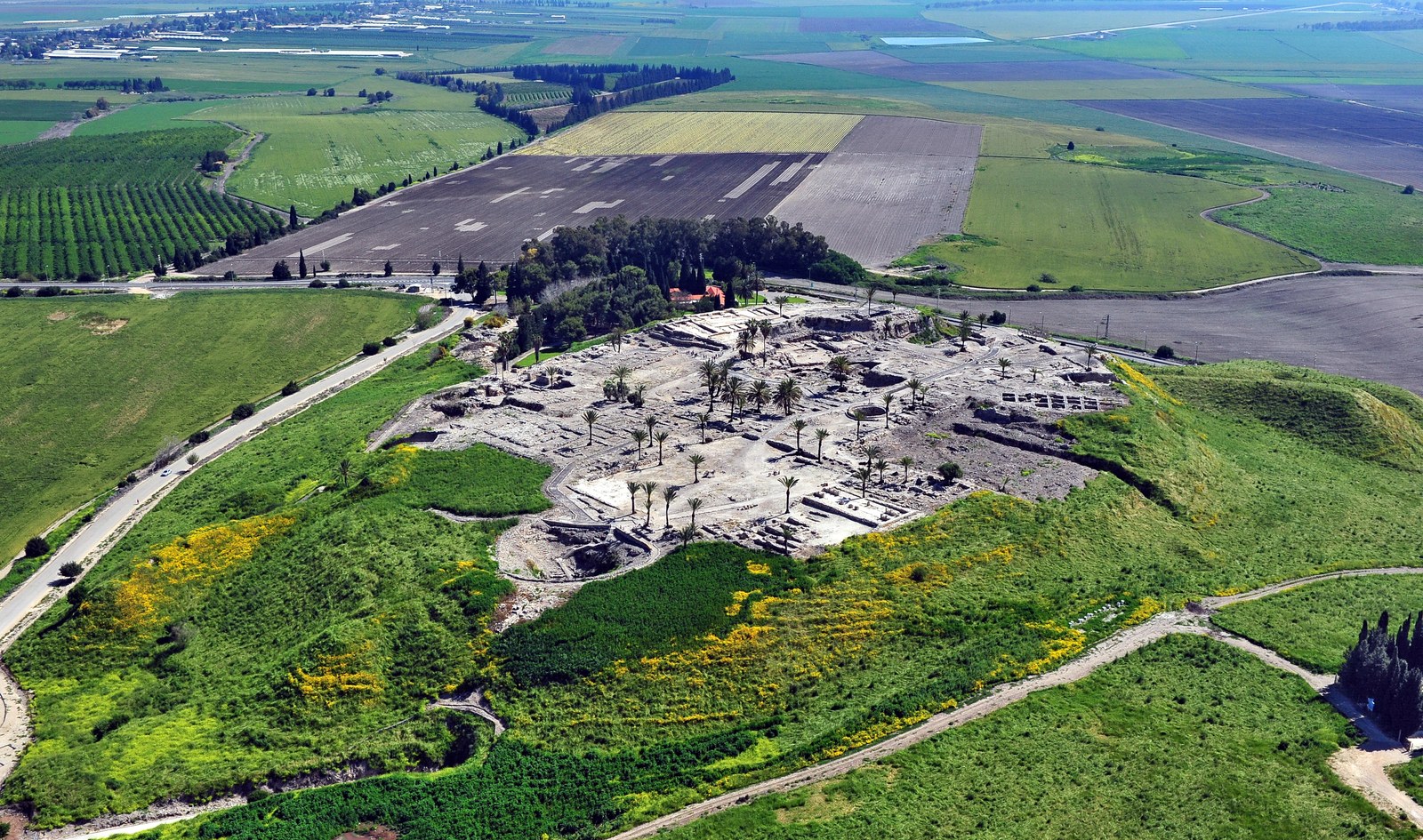

The photograph shows a modern archaeological landscape, with exposed remains, vegetation, roads and cultivated land. It is useful for understanding the relationship of mound and surrounding low ground. It is not a reconstruction of Solomon's city, a photograph of Josiah's battle or evidence of where future armies must stand.
| Expression | Setting | Reading distinction |
|---|---|---|
| Megiddo the city | Joshua 12:21; 17:11–13; 1 Kings 9:15 | A royal city, a town associated with Manasseh and a place named in Solomon's building program. |
| Waters of Megiddo | Judges 5:19–21 | The song names fighting at Taanach and the river Kishon; it does not confine the battle to the city's mound. |
| Valley of Megiddo / Megiddon | 2 Chronicles 35:22; Zechariah 12:11 | The surrounding lowland is associated with Josiah's encounter and a comparison of great mourning. |
| Armageddon | Revelation 16:16 | A named place of gathering in the vision. A proposed Megiddo connection requires explanation; the text supplies no modern coordinate. |
What Role Did Megiddo Play in Ancient Israel?
Joshua 12:7–24 includes Megiddo's king among the defeated kings. Joshua 17:11 assigns Megiddo and its towns to Manasseh within the account of its inheritance, but verses 12–13 also say the Canaanite inhabitants remained and were later subjected to tribute. Judges 1:27–28 repeats this distinction between subjection and complete expulsion.
Consequently, “Joshua defeated its king,” “Manasseh received it” and “all its inhabitants were driven out” are different claims. The first two appear in the accounts; the third is expressly qualified. The guide to Israel's possession and dominion compares Megiddo with other examples.
First Kings 4:7–12 includes Taanach and Megiddo in the district of Baana, one of Solomon's provisioning officers. First Kings 9:15 names Megiddo with Hazor and Gezer in the account of Solomon's levy and building works. These notices concern government and construction, not only warfare.
Second Kings 9:27 records another royal death: Ahaziah, wounded after Jehu ordered him struck near Ibleam, fled to Megiddo and died there. This is a separate event from Josiah's confrontation with Necho. Similar geography should not cause the kings and episodes to be combined.
What Can Be Said about the Excavations?
The national park's guide describes remains from successive periods, including palaces, fortifications, structures commonly called stables and a water system. It also records disagreement over the dating of major buildings. The biblical statement that Solomon built Megiddo should be distinguished from an archaeological claim that a particular exposed structure has been securely assigned to him.
That distinction matters when viewing the aerial photograph. Walls visible together today need not have stood together in one ancient period. The photograph identifies a real excavated site; identifying the age and function of individual remains requires the excavation record. This guide therefore does not label every visible wall “Solomon's fortress” or claim an exact total of cities stacked beneath it.
How Do Kings and Chronicles Describe Josiah's Death?
Second Kings 23:25–30 praises Josiah's turning to God but says judgment on Judah was not thereby removed. It then reports Necho's expedition toward the Euphrates, Josiah's opposing him, Josiah's death at Megiddo and his servants bringing him dead to Jerusalem.
Second Chronicles 35:20–27 gives a fuller and differently paced account. Necho sends a warning; Josiah disguises himself and fights in the valley; archers wound him; his servants transfer him to another chariot and bring him to Jerusalem, where the account reports his death and burial. The chapter emphasizes his refusal to heed Necho's words and the subsequent mourning.
The shared core is Josiah's fatal encounter with Necho near Megiddo and his burial in Jerusalem. Kings places the death at Megiddo; Chronicles narrates wounding there followed by removal to Jerusalem and death. Readers should acknowledge that difference in presentation rather than quote the two as an identical travel-and-medical chronology.
Zechariah 12:11 compares mourning in Jerusalem with mourning at Hadadrimmon in the valley of Megiddon. Its immediate subject is lamentation in Jerusalem. The comparison should not be converted into a detailed description of every army movement at Megiddo.
Do Thutmose III, Josiah and Allenby Belong to One Battle?
No. The park guide describes Thutmose III's fifteenth-century BCE campaign against a Canaanite coalition and the Egyptian annals' account of it. That is a different event from Josiah's encounter with Necho many centuries later. The annals of Thutmose cannot be cited as a contemporary description of Josiah's death.
The same guide records Allenby's 1918 campaign against Ottoman forces. This modern military episode adds to the area's history; it does not establish that a biblical prophecy was fulfilled there. Neither the older Egyptian campaign nor the 1918 battle identifies Thutmose as the Pharaoh confronted by Moses.
Will This Be the Battlefield of Mankind's Last World War?
Revelation 16:12–16 describes the Euphrates drying, deceptive spirits going out to the world's kings and their gathering for the battle of God's great day. Verse 16 names the gathering place Armageddon. The interruption in verse 15 calls the hearer to watchfulness; the passage's purpose is not exhausted by finding a point on a map.
A connection between Armageddon and Megiddo is discussed in the name and derivation guide. Even when that connection is accepted, a historical association with battle does not determine the exact geographical extent of Revelation's scene. The text does not explicitly say “every part of the final battle occurs in the fields visible in this photograph.”
Revelation 19:11–21 describes the rider, beast and assembled kings, but does not repeat the name Armageddon. Revelation 20:7–10 describes another gathering after the thousand years in that chapter's sequence, with Gog and Magog and the beloved city. Calling Megiddo simply “the site of the last war in the Bible” conceals these distinctions. A particular end-time chronology requires an argument across those scenes; neither archaeology nor a modern battle anniversary supplies its date.
Sources and a Reading Exercise
Scripture checked in the KJV text: Joshua 12:7–24; 17:7–13; Judges 1:27–28; 5:19–23; 1 Kings 4:7–12; 9:15–19; 2 Kings 9:27–28; 23:25–30; 2 Chronicles 35:20–27; Zechariah 12:9–14; Revelation 16; 19:11–21; 20:7–10. The comparisons are editorial analysis of those accounts.
The Israel Nature and Parks Authority's English Megiddo guide, edited by Tsvika Tsuk and written by Inbal Samet, supplies the geographic, excavation and separate-campaign background. Its touring plan is useful for locating named remains. Its own prophetic interpretation is not archaeological proof of a future battle. The photograph's primary source and license appear directly in its caption.
Read Joshua 17:11–13, 1 Kings 9:15 and Revelation 16:12–16. For each, identify whether the text describes a town, its inhabitants, a building program or a visionary gathering. Then use the photograph to distinguish what can actually be seen from what must be learned from texts and excavation evidence.