A queen with more than a famous face
Plutarch emphasizes Cleopatra's conversation and command of languages rather than treating beauty as a sufficient explanation of her influence. In Life of Antony 27, he says that she could answer many visitors without an interpreter and contrasts this with earlier Egyptian kings' neglect of the local language. That is testimony to how an ancient writer portrayed her education; it does not establish that no earlier ruler could speak Egyptian.
Caesar: an alliance and a relationship
Cleopatra's relationship with Julius Caesar preceded her later visit to Rome. Plutarch's Life of Caesar 48–49 places their meeting in Egypt, where she was contesting power with her brother. He tells the celebrated story of her entering Caesar's quarters concealed in a bedding sack. Caesar subsequently left her on the Egyptian throne. The story illustrates both her precarious position and the importance of Roman military backing; its theatrical detail comes through a later literary account.
Suetonius, Julius Caesar 52, explicitly reports their affair and her visit to Rome. He also preserves disagreement over Caesarion's paternity: Antony claimed Caesar acknowledged the child, while Caesar's associate Oppius argued otherwise. Calling Caesarion Caesar's unquestionably proven or only known son would conceal the dispute in the evidence.
Antony and the loss of independence
Her later partnership with Mark Antony joined a personal relationship to a struggle over territory and Roman power. Plutarch, Antony 54, describes Antony publicly assigning royal titles and territories to Cleopatra and their children at Alexandria. This made the partnership politically explosive in Rome, beyond its romantic appeal to later audiences.
Octavian defeated Antony's side at Actium in 31 B.C. Plutarch's chapters 65–66 describe the naval battle and Cleopatra's departure, followed by Antony. The defeat did not immediately end the war: Octavian's subsequent capture of Alexandria brought the final collapse in 30 B.C. Suetonius, Augustus 17, connects the victory at Actium with that later siege.
Why did she die, and was it a snake?
Plutarch says Antony fatally wounded himself after receiving a false report of Cleopatra's death. Cleopatra survived him but became Octavian's captive. His account connects her final decision with the prospect of being taken away and displayed in a Roman triumph, as well as her grief for Antony (76–77, 84–86). These are reported circumstances and motives, not direct access to her thoughts.
The famous snake story is uncertain. Plutarch records competing versions involving an asp or concealed poison and admits that the method was unknown. A snake in a later picture therefore tells us about the story's afterlife; it does not settle how she died.
View Michelangelo's Cleopatra in the Casa Buonarroti collection · Open the museum's drawing image
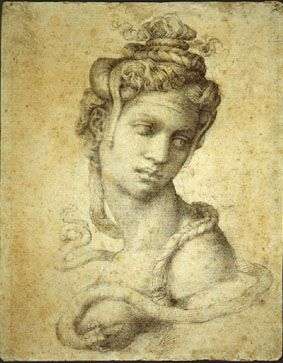
The distinction matters on a Bible study site: Cleopatra belongs to the political background before the New Testament period, while this Renaissance drawing belongs to a much later interpretation of her life. Neither should be used to supply a precise date for Jesus' birth or an eyewitness picture of the Egyptian queen.