Persian Empire Map: Cyrus, Darius and the Biblical Kings
The Achaemenid Persian Empire grew under Cyrus II, usually called Cyrus the Great, and his successors. Its beginnings are conventionally associated with his defeat of the Median king around 550 BC, rather than with the first year of his own reign. By the time of Darius I, Persian power linked Egypt and Anatolia with Mesopotamia, the Iranian plateau and lands toward the Indus. Its importance rests on that reach and its organization; calling it the “greatest” ancient power requires a criterion that a map alone cannot supply.
Study question: When did the Persian (Achaemenid) Empire begin? What made them the greatest ancient world power?
Read the map by reign
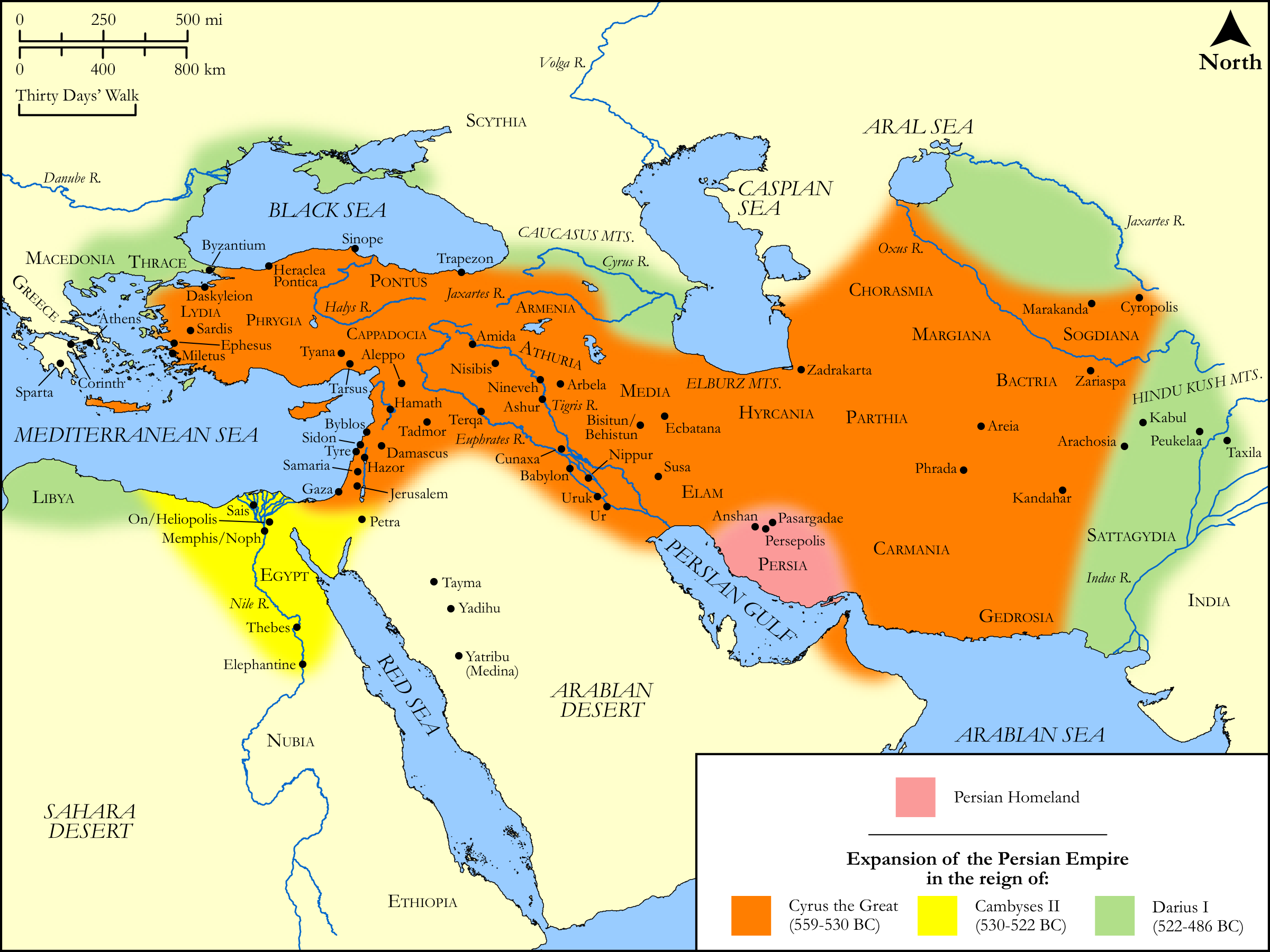

Start with the homeland near the Persian Gulf, then trace the different colors west toward Babylon and Egypt and east toward the Indus. Egypt belongs to a later layer than much of Cyrus's expansion. A reader studying Cyrus's decree should therefore avoid treating all the map's combined colors as his personal conquests.
Find Babylon on the Euphrates, Susa farther east and Persepolis in the Persian homeland. These were distinct royal centers. A large empire could use several centers and inherited administrative systems; one capital marker does not mean every decree originated there. The map gives geographical orientation, while a particular action still needs a text and a ruler.
When did the empire begin?
Cyrus was a Persian ruler before his empire became an international power. The Encyclopaedia Iranica account of Cyrus distinguishes his own kingship from his overthrow of Astyages and the absorption of Median power. It explains why about 550 BC is the conventional turning point, while also discussing uncertainty within the preceding years. It would be misleading to describe 559 BC, the first reign date on the map, as an uncontested founding day for the whole empire.
The conquest of Babylon in 539 BC brought Cyrus control of another major kingdom. The empire subsequently changed under later kings: the map attributes Egypt's addition to Cambyses and another layer of expansion to Darius. “Achaemenid” identifies the dynasty; “Persian” identifies its ruling center and tradition. “Medo-Persian” in biblical discussion need not mean that two equal states jointly administered every territory shown.
What sustained Persian power?
Conquest gave Persian rulers access to established cities, resources and regional officials. Holding those lands required administration as well as an army. The Iranica study of Darius I describes provincial government, tribute assessments and a chancery operating through several centers. It also discusses the use of Aramaic alongside other administrative languages. Such arrangements helped orders and resources move across a culturally varied realm.
These mechanisms explain more than a superlative does. Military reach, revenue, communication and cooperation from local institutions could reinforce one another. They did not prevent rebellion or make every subject community content. Ezra 6:6–12, for example, depicts an imperial order that protects temple work while demanding prayer for the king and threatening penalties for obstruction. Support for local worship and assertion of royal authority coexist in that account.
Neither the map nor the biblical passages establish a precise proportion of the world's population under Persian rule. This article therefore does not convert the colored area into an exact land total or repeat a claim that Persia governed 44 percent of all humanity. “One of antiquity's major empires” is supported by its documented reach; a universal ranking needs a defined measure and separate demographic evidence.
Identify the biblical kings carefully
| Name or title | Passage and action | Identification and limit |
|---|---|---|
| Cyrus | Ezra 1:1–4 records permission to build the Jerusalem temple and support its returning community. | The setting is Cyrus II's Persian rule after Babylon's conquest. His accession and the later conquest are separate events. |
| Darius in Ezra | Ezra 6:1–15 describes an archive search, confirmation of the building order and completion in his sixth year. | The historical setting is normally placed under Darius I. The text gives a regnal year, not a modern BC date in its own wording. |
| Darius the Mede | Daniel 5:30–31; 6:28; 9:1 identify a Median ruler and call him a son of Ahasuerus. | His historical identity is disputed. He must not be silently substituted for Darius I or the later Persian king Darius II. |
| Ahasuerus in Esther | Esther 1:1–4 places the court at Shushan and describes rule from India to Ethiopia over 127 provinces. | Esther's ruler is commonly associated with Xerxes. This does not identify Daniel's separately mentioned Ahasuerus as the same person. |
| Artaxerxes in Nehemiah | Nehemiah 2:1–8 records a twentieth-year request, letters and timber for Jerusalem's work. | Keep this rebuilding episode distinct from Cyrus's temple authorization and Darius's later confirmation. |
The Iranica article titled “Darius the Mede” surveys the identification problem; its proposals are not interchangeable with an established royal list. Meanwhile, the USCCB introduction to Esther connects the story's Ahasuerus with Xerxes while treating the work's literary character critically. Readers should distinguish that scholarly interpretation from the narrative's own statements. Esther's 127 provinces also should not automatically be equated with one particular external list of satrapies.
Cyrus, Babylon and Jerusalem
The Getty's presentation of the Cyrus Cylinder dates the object after the conquest of Babylon in 539 BC. It describes a royal inscription presenting Cyrus as a restorer of Babylonian religious order and displaced communities. That is valuable evidence for how his Babylonian kingship was represented. The cylinder does not itself name Jerusalem or reproduce Ezra's decree.
Ezra 1 makes the specific Jerusalem claim: Cyrus authorizes the house of the Lord and calls for assistance with the project. Ezra 6 later places the recovered memorandum at Achmetha and distinguishes Cyrus's original order from Darius's enforcement. Reading the inscription and Ezra together can illuminate imperial practices, but neither document should be quoted as though it contains the other's specific wording.
How did Achaemenid rule end?
Alexander's campaigns overthrew the Achaemenid monarchy in the fourth century BC. Arrian's Anabasis III.22 looks back on Darius's lost territories, death and royal burial. The succeeding Alexander map study follows the campaigns and examines what happened after Alexander's own death. A dynasty's overthrow and the subsequent transfer of provincial authority were related events, rather than a single change on every part of the map at once.
Sources and map credit
- Ezra 1:1–4; 6:1–15; Esther 1:1–4; Nehemiah 2:1–8; Daniel 5:30–31; 6:28; 9:1; 10:1. References distinguish a passage's explicit claim from later identification.
- Encyclopaedia Iranica: “Cyrus III: Cyrus II the Great”, “Darius I the Great”, and “Darius the Mede”. The website's numbered URLs do not themselves identify the king.
- Getty, The Cyrus Cylinder and Ancient Persia; USCCB, introduction to Esther.
- Map: Biblica OT009, reproduced unchanged with source and CC BY-SA 4.0 attribution beneath the image.