Neo-Assyrian Empire Map: Israel and Judah
The Neo-Assyrian Empire expanded from northern Mesopotamia across much of the ancient Near East during the ninth–seventh centuries BC. For a reader of Kings, its importance lies in several different relationships: tribute from Israel, an appeal for help from Judah, the capture of Samaria, and a later threat against Jerusalem. Those events should not be compressed into one conquest of “Israel.”
The map below shows stages of expansion. Read its dates before using its colors, then compare the northern kingdom of Israel with the southern kingdom of Judah in the evidence table.
Read the Assyrian map's time layers
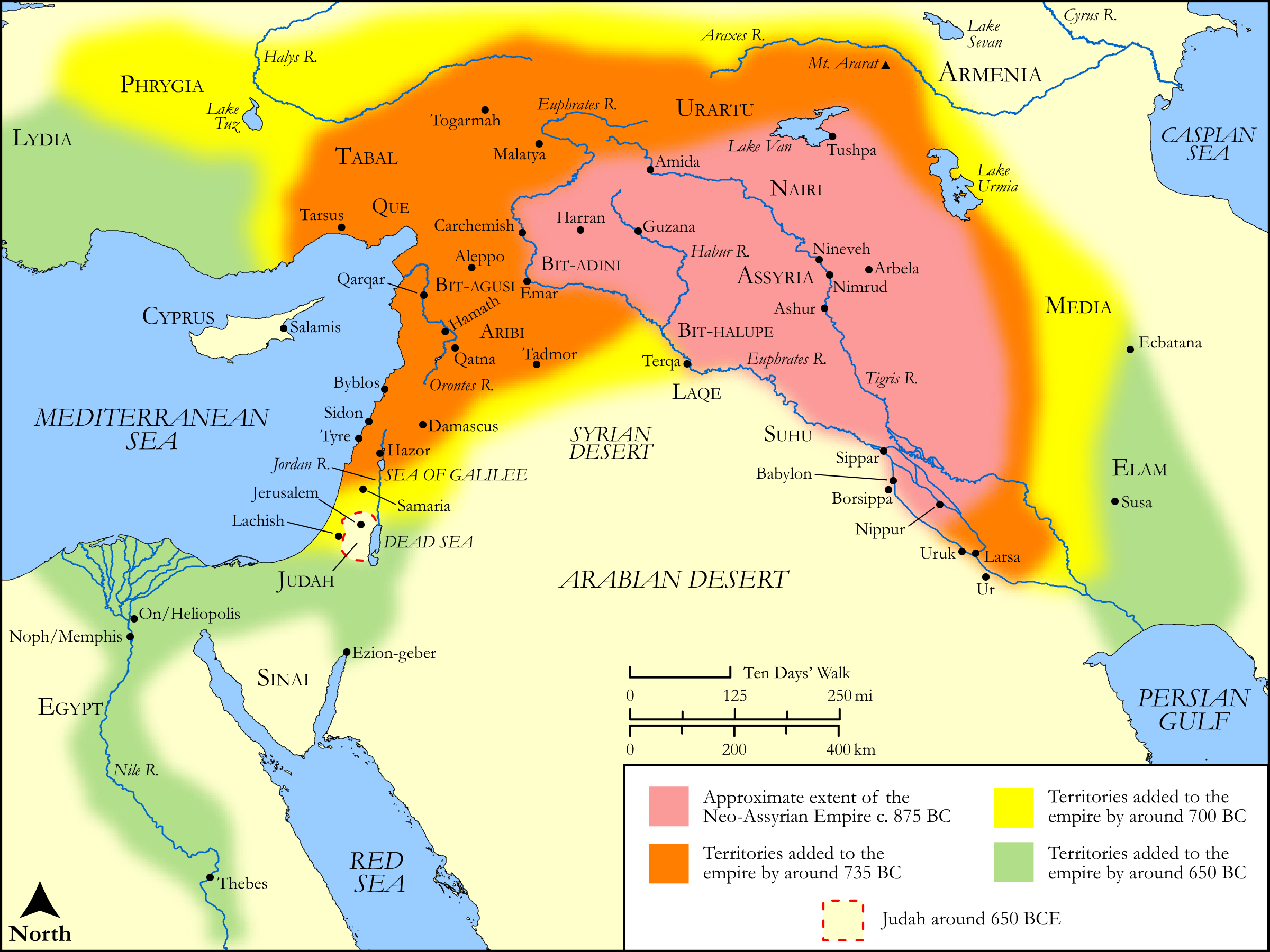

Find Ashur, Nimrud and Nineveh along the Tigris system. These are different places within Assyria's heartland, not three names for the same capital. Next find Samaria, Jerusalem and Lachish near the Mediterranean side of the map. Babylon lies much farther southeast, on the Euphrates. That separation helps explain why the biblical expressions “king of Assyria” and “king of Babylon” should not be treated as interchangeable.
Notice Egypt's appearance in a later expansion color. That color must not be carried backward into the setting of every earlier king. Nor does a color that includes Judah erase the distinction between tribute, siege, deportation and a city's actual capture. The table records those actions separately.
When did this empire begin?
Assyria existed long before the phase normally called Neo-Assyrian. The Metropolitan Museum's historical account begins with Ashur and distinguishes Middle Assyrian expansion from the later imperial period. Its discussion of the Neo-Assyrian phase focuses on the ninth–seventh centuries BC, including Ashurnasirpal II's building at Nimrud. Calling 884 BC the beginning of Assyria itself would hide that earlier history.
The museum also describes royal centers changing across reigns: Sargon II built at Khorsabad and Sennacherib chose Nineveh. A map showing Nineveh therefore does not prove that it was every Assyrian king's capital. “Assyrian empire” names a long political history; a particular campaign requires a ruler and an episode.
Compare Israel's and Judah's experiences
| Episode | Kingdom and ruler | Action described | Evidence and limit |
|---|---|---|---|
| Pul and Menahem | Northern Israel, based at Samaria | Menahem pays silver and raises it from wealthy men. | 2 Kings 15:19–20 says the payment secures support for his kingdom. It is not a report of Samaria's destruction. |
| Tiglath-pileser during Pekah's reign | Northern Israel | Named towns and regions are taken, and people are carried to Assyria. | 2 Kings 15:29 identifies Galilee, Gilead and other places. It does not give every deportee's road. |
| Ahaz appeals to Tiglath-pileser | Judah, threatened by Rezin and Pekah | Ahaz sends treasure and asks for rescue; Damascus is captured. | 2 Kings 16:5–9. An appeal to Assyria for help is a different relationship from Assyria capturing Jerusalem. |
| Hoshea and Samaria | Northern Israel | Tribute is withheld, Hoshea is imprisoned, and a three-year siege ends in Samaria's capture. | 2 Kings 17:1–6. The destinations named afterward belong to this account, rather than to Judah's later Babylonian exile. |
| Hezekiah and Sennacherib | Judah | Fortified cities fall; Hezekiah sends tribute to Lachish; officials threaten Jerusalem. | 2 Kings 18:13–37. The story then continues in chapter 19; stopping at the tribute payment misses its outcome. |
These accounts show why a single label such as “conquered Israel” is inadequate. A payment can strengthen a ruler while placing him under foreign pressure. A successful attack on one city does not establish the capture of another. Deportation can occur in one part of a kingdom before its capital finally falls.
What can be said about Samaria's fall?
Second Kings 17:3 names Shalmaneser when Hoshea becomes tributary. Verses 5–6 then describe the siege and capture using the title “king of Assyria,” without naming the captor in verse 6. Second Kings 18:9 likewise names Shalmaneser at the siege's beginning. These details should remain visible when the biblical account is compared with royal inscriptions or a modern chronological chart.
The passages checked here do not justify declaring an exact modern year of 723 BC and dismissing all claims involving Sargon II. Resolving the sequence around an Assyrian succession requires evidence beyond the label in a territorial map. The text does establish the capture in Hoshea's ninth year and named destinations for deportees. The captivity study examines those destination lists separately.
Second Kings 17:7–23 supplies the narrator's explanation in terms of covenant disobedience and rejected warnings. That is the passage's theological interpretation. The map helps locate the kingdoms; it neither proves nor replaces that explanation.
Why distinguish Lachish from Jerusalem?
Lachish and Jerusalem are separate marked sites. Second Kings 18:14 places Sennacherib at Lachish when Hezekiah offers payment. The subsequent confrontation takes place at Jerusalem, and its speeches address the people who can hear from the wall. A city marker allows the reader to keep those scenes apart instead of picturing one undifferentiated siege.
Chapter 19 presents Hezekiah's prayer, Isaiah's answer, the Lord's promise to defend the city, the death of 185,000 in the Assyrian camp, and Sennacherib's return to Nineveh. Those are claims of the biblical narrative. Its ending must not be described merely as Hezekiah purchasing peace, and a modern map cannot independently verify the narrative's supernatural explanation or casualty total.
The story also cannot be used to say that no Judean cities suffered. Chapter 18 already reports the loss of fortified towns. Holding Jerusalem's deliverance and the wider devastation together is essential to reading the sequence accurately.
Did everything end in 612 BC?
The translated Fall of Nineveh Chronicle, ABC 3 describes Babylonian and Median action against Assyria. Its account places Nineveh's capture in 612 BC and continues with events involving Harran and a remaining Assyrian king. Nineveh's fall was decisive, but “the capital fell” and “all resistance immediately stopped” are different claims.
The edition follows the later struggle into 609 BC. It also records the Medes taking Ashur before Nineveh's fall. A coalition with successive campaigns gives a more accurate ending than saying that Babylonians alone suddenly erased the entire empire on one day.
Reading the evidence together
- Read the map's earliest and latest legend entries. Which colors would be inappropriate for an episode occurring between them?
- Compare 2 Kings 15:19–20 with 16:7–9. Who requests or purchases assistance, and what is the stated political purpose?
- Read 18:13–19:37 as a sequence. Which cities are captured, which city is threatened, and what outcome does the narrator attribute to God?
- For a proposed historical reconstruction, record the biblical passage, inscription or chronicle, and modern dating separately. Where does one source stop answering the question?
Sources and map credit
- King James Version: 2 Kings 15:19–31; 2 Kings 16; 2 Kings 17:1–24; 2 Kings 18; 2 Kings 19.
- Metropolitan Museum of Art, Assyria, 1365–609 BC, Middle Assyrian and Neo-Assyrian sections. This museum overview supplies the earlier history and changing royal centers; the chronicle below gives a more differentiated account of the final campaigns.
- Livius: ABC 3, Fall of Nineveh Chronicle, translated notices for Nabopolassar's twelfth, fourteenth, sixteenth and seventeenth years, with the edition's chronology and discussion. The article does not treat a royal chronicle as a neutral transcript of every participant's experience.
- Biblica Open Bible Maps OT007, revision baa718b1ed1ae2d735d9deebf76159b588da8a47. Resource license statement; publisher's additional information. The map remains unchanged, with no reconstructed route or added ownership watermark.