Reader question: What symbols, in Christian art, are used to represent the four gospel writers? Does such imagery come from the Bible?
The familiar Christian art convention identifies Matthew with a human figure, Mark with a lion, Luke with an ox, and John with an eagle. Matthew's figure is also described as an angel in art guides. These symbols help a viewer recognize the four Evangelists, the traditional names attached to the four Gospels. Their imagery draws on biblical throne visions, but those visions do not name the Gospel writers or assign an animal to each book.
The distinction matters when looking at a manuscript, mosaic or painting: a traditional artistic identification answers a different question from “What does this biblical passage explicitly say?” Early Christian interpreters also disagreed about the assignments. The familiar arrangement is therefore a useful guide to art, rather than the only combination Christians have ever proposed.
Which Symbol Represents Each Evangelist?
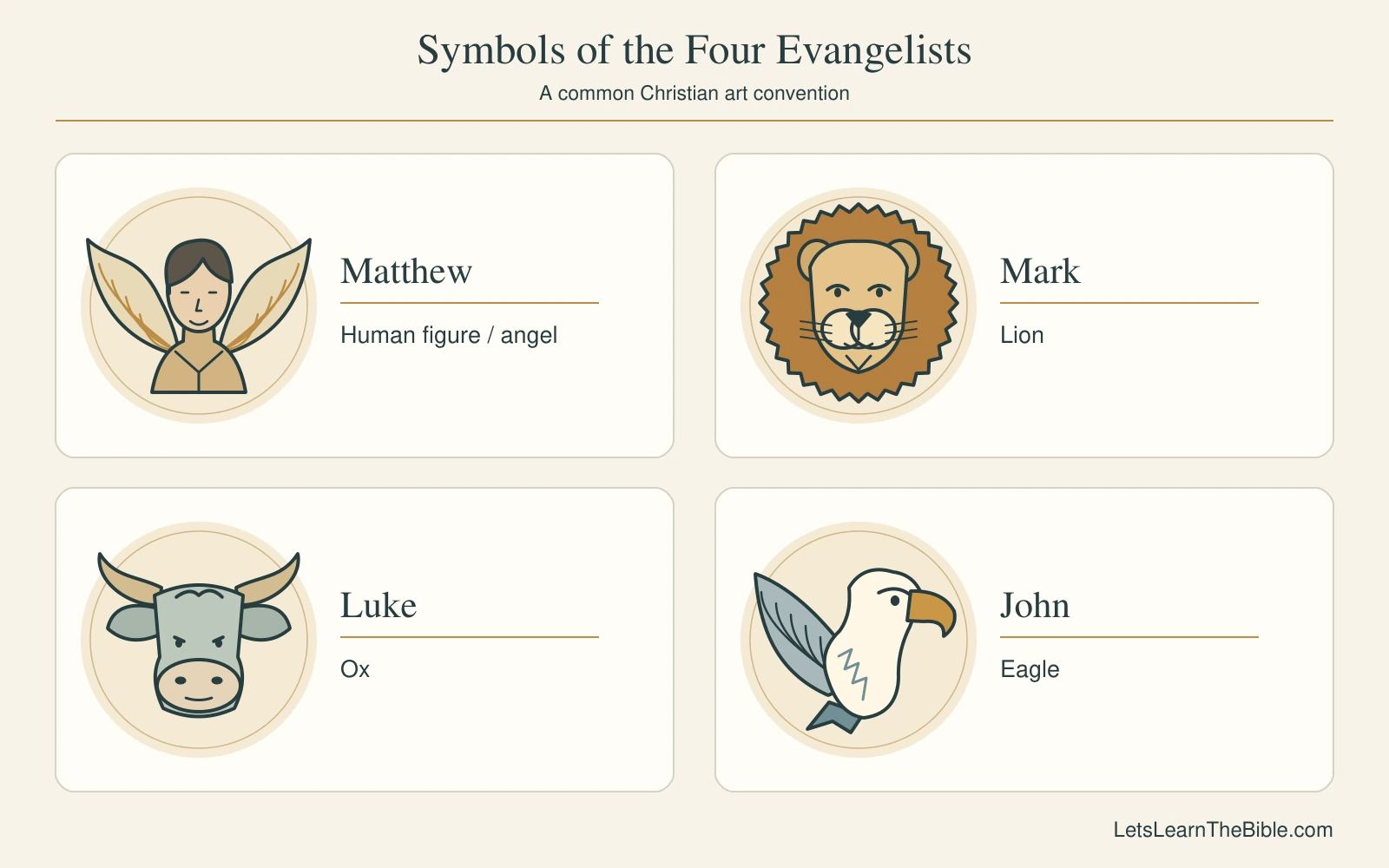
| Evangelist | Usual symbol | How to use the identification |
|---|---|---|
| Matthew | A human figure, also called an angel in art guides | A human or angelic figure accompanying an Evangelist can indicate Matthew in this arrangement. |
| Mark | Lion | Look for the lion beside the writer or standing in for him. |
| Luke | Ox | The bovine figure identifies Luke in this arrangement; early texts below also use the word calf. |
| John | Eagle | The eagle can accompany the writer or represent him by itself. |
The National Gallery's glossary gives these four attributes, using “Angel” for Matthew, and notes that the symbols sometimes stand in for the Evangelists. Charles Souvay's Catholic Encyclopedia article “Evangelist” gives man, lion, ox and eagle as the arrangement that prevailed in the Latin Church. Together these sources explain both the familiar set and the variation in the name given to Matthew's figure.
Calling Matthew's artistic attribute an angel does not mean that Matthew is a heavenly being in the biblical narrative. The attribute identifies the Evangelist within a visual convention. Likewise, a lion or eagle elsewhere in a painting need not represent a Gospel writer: the surrounding scene and the work's own identification still matter.
What Do the Biblical Visions Actually Describe?
Ezekiel 1 begins among the exiles by the river Chebar and reports a vision of God. Four living creatures appear, each with four faces and four wings (1:5–6). Verse 10 describes the faces of a man, lion, ox and eagle. These are four faces belonging to each creature, rather than four separately named Evangelists. The chapter moves through creatures, wheels and a throne to the appearance of the likeness of the Lord's glory (1:26–28).
Ezekiel 10 explicitly connects the creatures with the earlier vision and identifies them as cherubim (10:15, 20–22). It describes coals, wheels and the movement of the divine glory from the temple. Its face list in verse 14 says cherub, man, lion and eagle; it should not be silently replaced by the wording of 1:10. Reading both chapters preserves the connection Ezekiel makes without flattening every descriptive detail.
Revelation 4 places four living creatures around the heavenly throne. In the KJV they are called “beasts,” but their role here is worship. Verse 7 describes the first as like a lion, the second like a calf, the third with a human face, and the fourth like a flying eagle. Each has six wings, and they proclaim God's holiness (4:8). The chapter concludes with praise of God as Creator (4:9–11).
| Passage | Faces or likenesses | Context and limit |
|---|---|---|
| Ezekiel 1 | Each creature has four faces: man, lion, ox and eagle; each has four wings. | A vision culminating in divine glory. No Gospel writer is named. |
| Ezekiel 10 | Each has four faces; verse 14 lists cherub, man, lion and eagle. | The creatures are identified with the cherubim and the earlier vision; the glory departs from the threshold. |
| Revelation 4 | Four distinct likenesses: lion, calf, human face and flying eagle; each creature has six wings. | Worship at the throne. No assignment to Matthew, Mark, Luke or John is stated. |
Both visions supplied imagery for later Christian interpretation. Neither says that its order of creatures supplies the order in which the Gospels were written. Nor does Revelation 4 explicitly call its creatures the Gospel authors. Those identifications belong to the history of interpretation.
Did Early Christian Writers Use the Same Assignments?
No. The association of the four creatures with the Gospels is already attested in second-century Christian interpretation, as the Catholic Encyclopedia notes. Two primary texts make the disagreement over assignments clear: Irenaeus's Against Heresies 3.11.8 and Augustine's Harmony of the Gospels, Book 1, chapter 6, paragraph 9. Their explanations concern the character of Christ and the Gospels, rather than a claim that the visionary passages print the authors' names.
| Source or convention | Matthew | Mark | Luke | John |
|---|---|---|---|---|
| Irenaeus, Against Heresies 3.11.8 | Man | Eagle | Calf | Lion |
| Augustine, Harmony 1.6.9 | Lion | Man | Calf | Eagle |
| Familiar later Latin artistic convention | Man | Lion | Ox | Eagle |
Irenaeus argues for a fourfold Gospel united by one Spirit. He connects the lion with royal power, the calf with sacrifice and priesthood, the human face with Christ's human advent, and the eagle with the Spirit. His discussion then associates John with Christ's glorious generation from the Father, Luke with Zacharias the priest, Matthew with human generation, and Mark with the prophetic Spirit and the Gospel's winged aspect. That yields a different Mark–John pairing from the familiar art convention.
Augustine explicitly prefers lion–Matthew, man–Mark, calf–Luke and eagle–John. He explains that Matthew emphasizes Christ's kingly character, Luke the priestly, and Mark Christ's human deeds. John, in his description, soars above earthly concerns toward divine truth. Augustine also criticizes a competing approach for concentrating on the books' beginnings instead of their full design. His words show interpreters making and defending different judgments.
The later familiar arrangement should therefore be identified by its tradition, not attributed indiscriminately to every early writer. The Catholic Encyclopedia traces its use in Latin Christian writing and art; the National Gallery confirms its usefulness for recognizing attributes in paintings. These sources do not make it a biblical command or prove an exact date when all artists adopted it.
What Can Readers Check in the Gospels Themselves?
Matthew 1 opens with Jesus' genealogy and birth. Mark 1 opens with the Gospel announcement, prophetic words about preparing the way, and John baptizing in the wilderness. After its introductory address to Theophilus, Luke 1 introduces Zacharias, a priest serving in the temple. John 1 opens with the Word who was with God and was God. Those textual features help readers follow the comparisons made by later interpreters.
The features do not compel one complete symbol scheme. Irenaeus and Augustine use overlapping material and reach different assignments. A reader can understand their reasoning while keeping the Gospel text, the commentator's interpretation and the artist's convention distinct.
The familiar printed sequence Matthew, Mark, Luke and John is also not a dated record of their composition. Symbolic arrangements cannot establish exact writing years or demonstrate that one Gospel was completed before another. Questions of authorship and dating require their own evidence; see the guide to named writers and traditional attributions.
How Can I Use the Symbols When Looking at Art?
- Start with the whole scene. A Gospel writer with an accompanying animal is different from a biblical vision showing creatures at God's throne.
- Use the familiar table as a first identification. Human figure or angel, lion, ox and eagle commonly point to Matthew, Mark, Luke and John respectively.
- Check labels and the work's catalog entry. The convention alone cannot settle every unfamiliar image, especially when symbols appear without the writers.
- Keep the explanation attached to its source. “Augustine associates Matthew with the lion” is more accurate than claiming all Christian writers use the same system.
The symbols are useful precisely because a visual attribute can identify a person without a full written name. Their usefulness does not depend on treating the authors as literal animals or turning every lion, ox or eagle into a Gospel reference. For the biblical beings themselves, compare cherubim and living creatures in their own passages. For a different use of animal imagery, see animals as symbols of kingdoms.
Sources and Related Reading
- Biblical contexts: Ezekiel 1 and 10; Revelation 4. Gospel openings compared: Matthew 1; Mark 1:1–13; Luke 1:1–25; John 1:1–11. Biblical wording identified as KJV follows the King James Version.
- Irenaeus, Against Heresies, Book 3, chapter 11, especially paragraph 8: the fourfold Gospel and his symbol assignments.
- Augustine, Harmony of the Gospels, Book 1, chapter 6, paragraph 9: his preferred assignments and criticism of another arrangement.
- Charles Souvay, “Evangelist,” Catholic Encyclopedia, volume 5 (1909): the Latin Church's familiar arrangement and its use in Christian art.
- National Gallery, “Evangelists”: the four artistic attributes, including the term angel for Matthew.
- Compare the lengths and narrative scope of the Gospels.
This guide compares specified texts and a common convention for identifying art. It does not offer a complete history of every regional symbol system, an attribution for every unlabeled image, or exact dates for the composition of the Gospels.