Miracles in the Old Testament
The Old Testament describes many events as signs, wonders, acts of healing, provision, judgment, or deliverance. This page is a selected guide to those accounts, not a claim to list every event that any reader might classify as a miracle. The Bible does not give one formal definition or a complete numbered catalogue.
The selections below follow the narrative and references in the King James Version (KJV). Their categories are reading aids: one account can fit more than one category, and the text’s own description matters more than a modern label.
What Kinds of Events Appear?
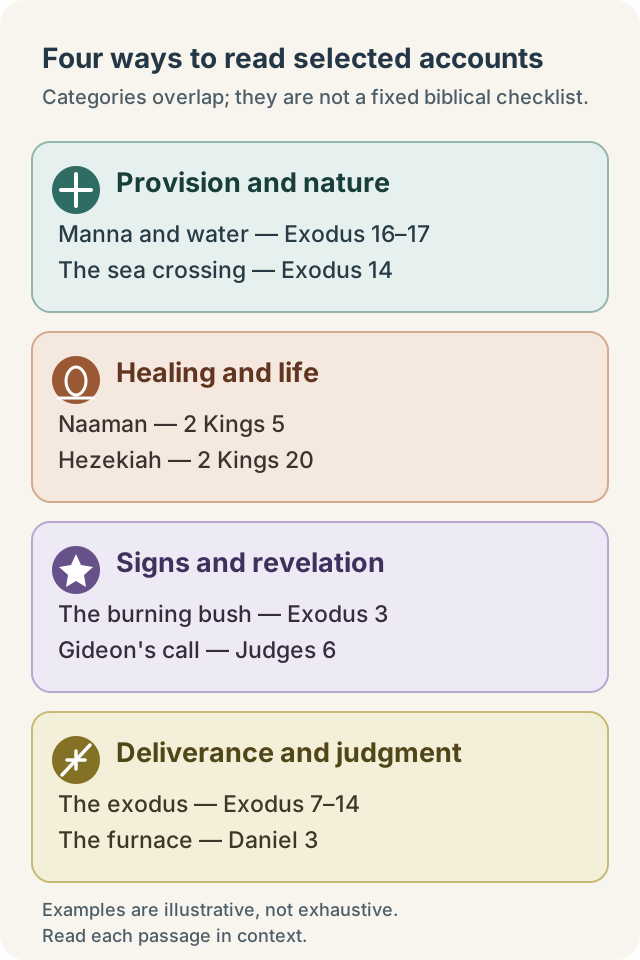
Accounts often meet people in concrete settings: hunger in the wilderness, sickness, political danger, conflict, or a question about God’s presence. A sign may accompany a commission; a healing may restore someone to family or community; a provision story may explain how a group survives. These narrative purposes help readers ask more than simply, “What unusual thing happened?”
Selected Accounts by Book
| Book or setting | Passage | What the account describes | A useful context question |
|---|---|---|---|
| Genesis: Abraham's covenant | Genesis 15:7–21 | A smoking furnace and burning lamp appear as the covenant scene concludes; the burning lamp passes between the divided pieces. | How does the sign function within the promise made to Abram? |
| Genesis: Isaac's birth | Genesis 17:15–21; 18:9–15; 21:1–7 | Sarah gives birth to Isaac after the promise, despite her age. | How does the narrative connect the child's birth with the covenant promise? |
| Exodus: Moses' commission | Exodus 3:1–12; 4:1–9 | The bush burns without being consumed; signs are given in response to Moses' questions about his commission. | What do the signs answer, and what task does Moses still receive? |
| Exodus: Egypt and the sea | Exodus 7–14 | The narrative recounts the plagues, the departure from Egypt, and Israel's passage through the sea. | How do the signs relate to Pharaoh's refusal, release, and the people's escape? |
| Exodus: wilderness provision | Exodus 16; 17:1–7 | Manna is provided, and water comes from the rock at Horeb. | How do the stories address hunger, thirst, and the people's conflict with Moses? |
| Numbers: Aaron's rod | Numbers 17:1–13 | Aaron's rod buds, blossoms, and produces almonds in the dispute about priestly service. | What disagreement does the sign answer in the surrounding chapters? |
| Numbers: Balaam's journey | Numbers 22:21–35 | Balaam's donkey sees the angel before Balaam does and speaks to him. | How does the episode expose Balaam's limited perception? |
| Joshua: crossing the Jordan | Joshua 3:7–17; 4:14–24 | The river's flow is stopped while the people cross, and memorial stones recall the event. | Why does the text connect the crossing with public remembrance? |
| Joshua: sun and moon language | Joshua 10:6–15 | The battle account includes Joshua's words to the sun and moon and reports that the day did not hasten to its end. | How does the passage describe divine aid in the battle, and how have readers understood its poetic and cosmic language? |
| Judges: Gideon's fleece | Judges 6:11–24; 6:36–40 | Fire consumes Gideon's offering; later, the fleece and ground provide the requested signs. | How does Gideon's hesitation fit the call and reassurance in the whole scene? |
| 1 Kings: Elijah at Carmel | 1 Kings 18:17–40 | Fire consumes the offering during Elijah's confrontation with the prophets of Baal. | What question about worship does Elijah pose before the sign? |
| 2 Kings: Naaman | 2 Kings 5:1–19 | Naaman is healed after following Elisha's instruction to wash in the Jordan. | How do status, expectation, and obedience shape Naaman's response? |
| Daniel: the furnace | Daniel 3:8–30 | Shadrach, Meshach, and Abednego survive the furnace in the king's account. | What choice do the three men make before they know how the outcome will unfold? |
| Jonah: the sea and the fish | Jonah 1–2 | A storm, the sea's calm, and Jonah's preservation inside a great fish frame his flight and prayer. | How does the narrative contrast Jonah's actions with God's mercy? |
The table does not include every healing, prophetic sign, dream, rescue, or judgment narrative. It also does not imply that the passages all use the same Hebrew word or that every unusual event has the same literary function.
How to Read These Accounts
Start with the whole passage. Identify who speaks, who acts, the stated problem, and what changes afterward. Then notice the words the passage itself uses: a sign can confirm a message, a wonder can draw attention, and a healing can form part of a larger account of restoration or conflict. These terms overlap in English, but they should not be treated as a technical checklist supplied by the Bible.
Separate the narrated event from conclusions added later. For example, Joshua 10 reports the sun and moon standing still and links the event with Israel’s battle. The passage does not provide a modern astronomical mechanism. Readers have interpreted its language in different ways; an explanation should say when it is moving from the text’s wording to a proposed interpretation.
Likewise, the lists in Exodus and Kings should be read in their narrative sequence, not reduced to a detached list of spectacle. The exodus account connects signs with oppression, Pharaoh’s response, Israel’s departure, and remembrance. Elijah’s sign at Carmel is part of a dispute about worship. Context helps explain why a story is included.
Common Questions
Does the Old Testament give a complete list of miracles?
No. It contains many accounts that later readers group under “miracles,” but it does not provide a single exhaustive index or one definition that settles every classification. This page presents selected examples and labels its selection as such.
How many Old Testament miracles are there?
There is no single count independent of the rules used. A count changes depending on whether it includes creation, dreams, prophetic signs, acts of judgment, answered prayers, and events narrated without a specific miracle label. A responsible count would state its criteria and scope.
Does Joshua 10 prove that the earth stopped rotating?
Joshua 10:12–14 uses the language of the sun and moon standing still and describes an unusually long day in the battle narrative. The passage does not use modern astronomical terms or describe a physical mechanism. It is safer to distinguish what the text says from explanations readers propose.
Are all unusual events described as miracles?
Not necessarily. Readers may disagree about the category, especially when a narrative does not itself label an event a sign or wonder. The passage’s wording and purpose should guide the discussion.
Sources and Method
We selected representative passages across the Old Testament and checked each reference against the KJV text. The links open the cited context; they are not a claim that this page exhausts the subject. The table’s categories and questions are an editorial guide written for this page. No third-party artwork is used in the original diagram.
- Digital KJV corpus - local verse text used to cross-check the cited accounts.
- Bible Gateway: Exodus 7–14, KJV — the signs in Egypt, the departure, and passage through the sea.
- Bible Gateway: Joshua 10:6–15, KJV — the battle account and sun-and-moon language.
- Bible Gateway: 1 Kings 18:17–40, KJV — Elijah at Carmel.
- Bible Gateway: Daniel 3:8–30, KJV — the furnace narrative.
Content revised October 29, 2026. Send factual corrections or source questions through our contact page.