How Long Did Egypt's Plagues Last?
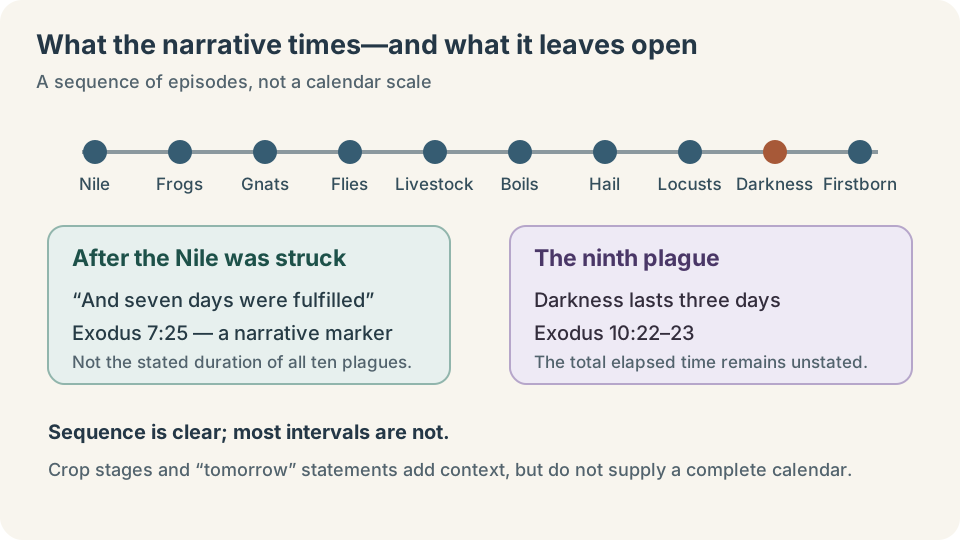
Exodus does not state how long all ten plagues lasted in total. It does give two clear time markers: seven days are mentioned after the Nile is struck (Exodus 7:25), and the darkness of the ninth plague lasts three days (Exodus 10:22–23). Other details help establish sequence and agricultural setting, but they do not add up to a reliable total number of days or months.
That distinction matters because later chronologies sometimes assign dates or intervals that Exodus itself does not give. A proposed chronology may be discussed as an interpretation, but it should not be presented as a date supplied by the narrative.
What Time Markers Are Explicit?
| Text | What it says | What the detail supports | What it does not establish |
|---|---|---|---|
| Exodus 7:14–25 | After the Nile is struck, verse 25 says seven days were fulfilled. | A seven-day interval or marker follows the striking of the river in the narrative. | It does not state that every later plague lasted seven days, or that the entire series took a known number of days. |
| Exodus 10:21–29 | Thick darkness covers Egypt for three days; the Israelites have light where they dwell. | The ninth plague's duration is given as three days. | It does not state how much time passed between the other plagues or between the darkness and the final plague. |
| Exodus 9:13–35 | The hail damages the flax and barley, while the wheat and the crop the KJV calls “rie” are not yet grown. | The narrative gives a crop-stage clue for the setting of the hail. | Without a secure calendar date and local crop calendar, this does not yield a month or a total duration for the plagues. |
| Exodus 8:8–15 | Pharaoh asks for the frogs to be removed “to morrow”; they die and are gathered after Moses cries to the LORD. | The story identifies a requested time for the response and describes what follows. | It does not give the duration of the whole frog episode in a way that can be added to a complete chronology. |
Sequence and Limited Clues
Exodus 7–12 arranges the events in a narrative sequence: water becomes blood, frogs appear, then come gnats or lice depending on translation, flies, livestock disease, boils, hail, locusts, darkness, and the death of the firstborn. The first nine are described across Exodus 7–10; the final judgment and Passover instructions continue through Exodus 11–12. The order is clear even where elapsed time is not.
The story uses short transition phrases at several points. Moses meets Pharaoh “in the morning” before some judgments (Exodus 7:15; 8:20; 9:13). Pharaoh asks for relief “to morrow” during the frog episode (8:10), and the locust warning names “to morrow” (10:4). These phrases locate particular conversations or threats. They do not supply an interval for every event in the series.
The crop note at Exodus 9:31–32 can help readers picture the season described by the hail report. It cannot on its own identify a precise month. Crop timing can vary by place, weather, and historical period, and Exodus does not provide a year or a complete agricultural calendar for the scene.
Why Can't We Calculate the Total?
To add the episodes into a total, we would need reliable start and end times for each plague and the intervals between them. Exodus does not give those details for most episodes. The narrative may move quickly from one confrontation to another, but a compact account is not a stopwatch or a full day-by-day diary.
Some interpreters combine a proposed Exodus date with crop seasons, feast dates, or assumptions about the spacing of events. That can create a historical reconstruction, but its result depends on those assumptions. The text itself neither says that the plagues occupied a fixed number of weeks nor supplies the dates needed to calculate a total.
The careful answer is therefore limited but useful: the Nile episode is followed by a seven-day marker, the darkness lasts three days, and the total duration of the ten plagues is not specified. The silence on a total is not evidence that the events happened in one day, one month, or any other definite span.
Common Questions
Did the plagues last six months?
Exodus does not give a six-month total. Such a figure depends on a reconstructed chronology and assumptions about when the series began and how much time passed between events. It should be labeled as a proposal, not as a statement in Exodus.
Did all ten plagues happen in a few weeks?
The text does not provide enough elapsed-time data to establish that. It gives the event sequence and a few timing clues, including the seven-day marker after the Nile was struck and the three days of darkness. The total remains unstated.
Does “seven days” mean the Nile remained blood for exactly seven days?
Exodus 7:25 says seven days were fulfilled after the LORD had smitten the river. It marks the interval in the narrative; it does not explicitly say in those words that the water’s condition ended exactly then. Readers should avoid making the verse more precise than its wording.
How long did the darkness last?
Exodus 10:22–23 says the darkness lasted three days and notes that the Israelites had light in their dwellings.
Sources and Method
The time markers and crop detail were checked in the KJV passages linked below. This page distinguishes an explicit duration from a chronological inference and does not use a commentary’s proposed calendar as if it were stated in Exodus.
- Digital KJV corpus - local verse text used to cross-check the cited accounts.
- Bible Gateway: Exodus 7–12, KJV — the narrative sequence and surrounding context.
- Bible Gateway: Exodus 7:14–25, KJV — the seven-day statement.
- Bible Gateway: Exodus 9:13–35, KJV — the hail and crop-stage detail.
- Bible Gateway: Exodus 10:21–29, KJV — the three days of darkness.
Content revised October 29, 2026. Send factual corrections or source questions through our contact page.