Story Flow of the Bible
The Bible’s broad story moves from creation and humanity’s estrangement from God, through the history of Israel, to Jesus, the early church, and the hope of a renewed creation. This guide is a thematic overview with key books and turning points. It is not a precise year-by-year chronology, and it does not force every book into one simple timeline.
Readers sometimes meet the Bible first as a table of contents. Its books are arranged in literary and canonical groupings; that order does not always match the sequence of every event. The prophets, poetry, wisdom books, and overlapping Gospel accounts make the story richer than a straight list of dates.
The Story in Six Movements
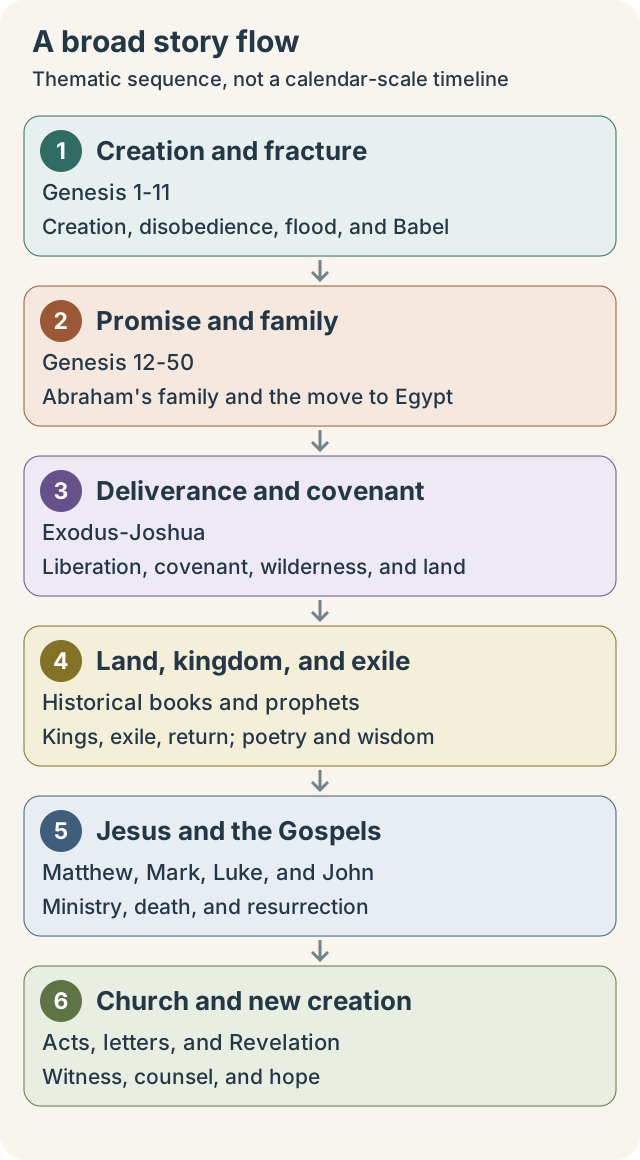
| Movement | Books and passages | People and events | Story question |
|---|---|---|---|
| Creation and fracture | Genesis 1–11 | Creation, human disobedience, violence, the flood narrative, and Babel. | What is humanity's relationship to God and to one another? |
| Promise and family | Genesis 12–50 | Abraham and Sarah, Isaac and Rebekah, Jacob and his family, and Joseph in Egypt. | How does the promise to Abraham continue through conflict, migration, and family life? |
| Deliverance and covenant | Exodus–Deuteronomy; Joshua | Moses, the exodus from Egypt, covenant at Sinai, wilderness years, and entry into the land. | How is a people formed, and what responsibilities accompany covenant? |
| Land, kingdom, and exile | Judges; Samuel; Kings; Chronicles; many prophets | Israel's judges and kings, Jerusalem's temple, divided kingdoms, prophetic warnings, exile, and return. | How do power, justice, worship, and covenant shape national life? |
| Jesus and the Gospels | Matthew; Mark; Luke; John | Jesus' ministry, teaching, death, resurrection, and the claims made about his identity. | How do the Gospel writers present Jesus in relation to Israel's Scriptures and God's reign? |
| Church and new creation | Acts; the New Testament letters; Revelation | The early church, Paul's journeys and letters, counsel to Christian communities, and visions of final renewal. | How do the communities respond to Jesus, and what hope shapes the ending? |
How Do the Books Fit the Story?
Genesis through Deuteronomy gives the foundational account of creation, ancestors, exodus, covenant, and wilderness. Joshua through Kings follows Israel in the land and its monarchies. Chronicles retells much of that history with its own emphasis. The Psalms and wisdom books collect prayer, poetry, reflection, and instruction; they are not simply the next dated events after Kings.
The prophetic books address particular communities and historical crises, but their placement in the Bible is not a complete chronological index. To place a prophet beside a king or an exile, readers need to look at the book’s own setting notes and compare the historical passages. The return from exile appears in books such as Ezra and Nehemiah, while later biblical writings also look forward to restoration.
The four Gospels tell the story of Jesus from related but distinct perspectives. They share people and events, yet arrange and emphasize material differently. Acts continues with the early church; letters address particular communities and questions, and Revelation uses apocalyptic visions. These literary differences should not be flattened into one continuous travel log.
What Can a Bible Timeline Show?
A timeline can help readers see sequence and broad historical relationships. It becomes less reliable when it assigns exact dates where the biblical text does not, treats a debated chronology as certain, or hides differences between parallel accounts. Dates for early biblical events and many later events depend on interpretive assumptions and external historical evidence.
The same care applies to character-based timelines. Adam, Noah, Abraham, Moses, David, Daniel, and Paul can serve as memorable landmarks, but the Bible’s story is not only a biography of famous individuals. It includes families, communities, laws, worship, poetry, conflict, and hope. A useful overview should show those connections instead of making the whole narrative depend on a few names.
For a closer look at two connected New Testament questions, see the guide to Jesus’ genealogies and the mapped sequence of Paul’s second missionary journey. For the Exodus signs, read the companion overview of selected Old Testament miracle accounts and the discussion of how long the plagues lasted.
Common Questions
What is the Bible’s main story?
This page summarizes it as creation, human fracture, God’s dealings with Israel, Jesus, the early church, and the hope of renewed creation. Christians differ in how they interpret particular passages, but this broad sequence follows major themes and transitions across the biblical books.
Is the Bible arranged in chronological order?
No. Its books are grouped by literary and canonical traditions. Poetry, wisdom, prophecy, and parallel Gospel accounts do not all form one date-by-date sequence. Readers should distinguish book order from event order.
Can I assign a specific year to every biblical event?
No single timeline does that without assumptions. Some periods have stronger historical anchors than others; early dates, synchronisms, and the interpretation of particular texts remain debated. A chart should identify which dates are explicit, estimated, or disputed.
Where does the story end?
Revelation closes with visions of judgment, renewed creation, and life with God. Its imagery is apocalyptic and symbolic in form; interpretations of particular images differ, so a summary should not turn every symbol into a literal timeline detail.
Sources and Method
This overview is based on reading the Bible’s book-level sequence and the passages named in the table in the KJV. The six movements are an editorial framework for orientation, not labels printed in the biblical text. They summarize recurring narrative turns while leaving room for differences among books and interpretive traditions.
- Digital KJV corpus - local verse text used to cross-check the cited accounts.
- Bible Gateway: Genesis 1–11, KJV — creation and early humanity.
- Bible Gateway: Exodus 1–20, KJV — Moses, the exodus, and the covenant at Sinai.
- Bible Gateway: 2 Kings 17 and 25, KJV — the fall of Samaria and Jerusalem.
- Bible Gateway: Luke 1–4, KJV — the opening of Luke's Gospel narrative.
- Bible Gateway: Acts 1–2, KJV — the beginning of Acts' account of the early church.
- Bible Gateway: Revelation 21–22, KJV — the final visions of renewal.
Content revised October 29, 2026. Send factual corrections or source questions through our contact page.