Paul's Second Missionary Journey
Acts 15:36–18:22 records Paul’s second missionary journey as a sequence of visits, teaching, opposition, and returns. The route begins after Paul and Barnabas separate, continues with Silas through Syria and Cilicia, crosses into Macedonia after the vision at Troas, and ends when Paul returns by way of Ephesus, Caesarea, and Antioch.
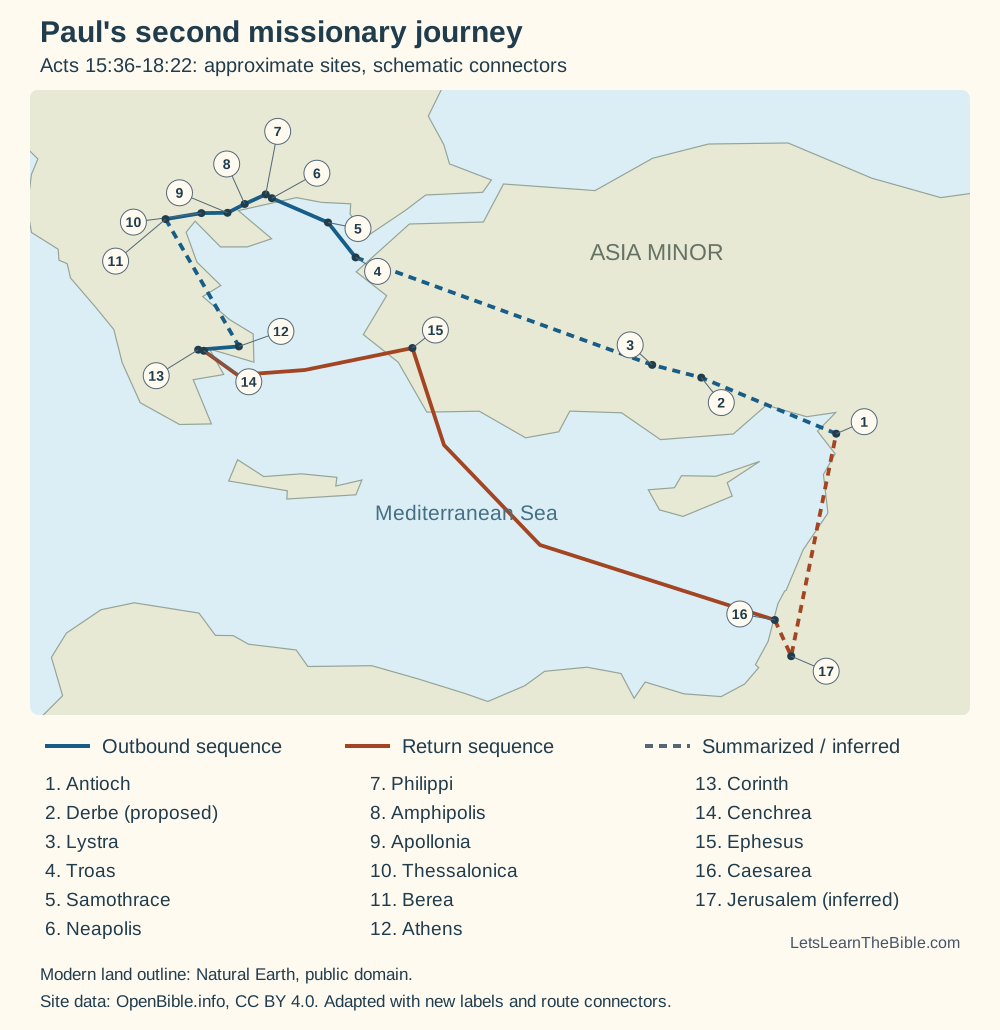
Acts supplies a sequence of places and events, rather than a complete travel diary. The map uses approximate site locations on a modern coastline, with schematic connectors. Neither the lines nor the coastline reconstruct every ancient road, harbor, or sailing course.
What Was Paul's Second Missionary Journey?
Acts begins the journey with Paul’s proposal to revisit the believers in the cities where he and Barnabas had preached (Acts 15:36). Barnabas took John Mark and sailed to Cyprus. Paul chose Silas and went through Syria and Cilicia, strengthening the churches (Acts 15:39–41).
That opening matters because the second journey is not a single uninterrupted line drawn from one modern border to another. It grows out of a pastoral purpose: revisit existing communities, deliver the decision made by the apostles and elders in Jerusalem, and then preach in new places as the Spirit directs.
Which Places Does Acts Name?
| Place or region | Acts reference | What the text records |
|---|---|---|
| Antioch, Syria; Syria and Cilicia | Acts 15:36–41 | Paul and Silas depart after the separation from Barnabas and strengthen the churches. |
| Derbe and Lystra | Acts 16:1–5 | Paul comes to Derbe and Lystra, where Timothy is introduced, and takes him along, and delivers the Jerusalem decrees. |
| Phrygia and Galatia | Acts 16:6 | The group travels through these regions; the Holy Spirit forbids preaching in Asia at that point. |
| Mysia, Bithynia, Troas | Acts 16:7–10 | They are prevented from entering Bithynia, reach Troas, and receive the Macedonian vision. |
| Samothrace and Neapolis | Acts 16:11 | Luke describes the sea crossing and arrival at Neapolis. |
| Philippi | Acts 16:12–40 | Lydia believes and is baptized; Paul and Silas are beaten and imprisoned; the jailer believes after the earthquake. |
| Amphipolis and Apollonia | Acts 17:1 | They pass through these cities on the way to Thessalonica. |
| Thessalonica | Acts 17:1–9 | Paul reasons in the synagogue for three Sabbaths; opposition leads the believers to send him onward. |
| Berea | Acts 17:10–15 | The Bereans examine the Scriptures daily; pressure from Thessalonica forces Paul to leave for Athens. |
| Athens | Acts 17:16–34 | Paul speaks in the synagogue, marketplace, and Areopagus; some listeners believe. |
| Corinth | Acts 18:1–17 | Paul works with Priscilla and Aquila, teaches for a year and six months, and faces a hearing before Gallio. |
| Cenchrea, Ephesus, Caesarea and Antioch | Acts 18:18–22 | Paul leaves Corinth, sails by way of Ephesus, lands at Caesarea, goes up to greet the church, and returns to Antioch. A Jerusalem visit is commonly inferred from “gone up”; verse 22 does not name the city. |
The table separates what Acts names from later attempts to calculate a route. A connector on a map can make the journey look simple, while the narrative includes sea crossings, detours, enforced departures, and places where the group was forbidden to preach.
Why Is Troas a Turning Point?
At Troas, Paul sees a vision of a man of Macedonia asking for help. Acts 16:10 changes from “they” to “we,” which has commonly been taken as a sign that Luke joined the group at this point. The text itself says that the group immediately concluded that God had called them to preach in Macedonia.
The first named Macedonian stops are Samothrace, Neapolis, and Philippi. Philippi is described as a colony and becomes the setting for Lydia’s baptism, the conflict over a slave girl’s exploitation, the imprisonment of Paul and Silas, and the jailer’s response. These episodes show why a route map should be read with the narrative rather than treated as a list of sightseeing locations.
What Happened in the Main Cities?
Philippi: a household receives the message
Lydia, a seller of purple from Thyatira, hears Paul by the riverside and is baptized with her household (Acts 16:13–15). Later, the earthquake in the prison leads the jailer to ask what he must do to be saved (Acts 16:25–34). Acts presents both encounters as responses to the message, while also showing the social and legal pressure surrounding the new community.
Thessalonica and Berea: reception and examination
In Thessalonica, Paul reasons from the Scriptures for three Sabbaths. Some believe, but opposition forms a mob around Jason’s house. In Berea, the hearers are praised for receiving the word eagerly and examining the Scriptures daily (Acts 17:10–12). “Noble” in this context describes their response to teaching; it does not authorize readers to turn the verse into a claim about a city’s permanent character.
Athens: the Areopagus speech
Acts 17:16–34 records Paul’s conversation with Athenians, including his reference to an altar dedicated “TO THE UNKNOWN GOD.” The passage reports a speech and its responses. It does not require a modern map to identify the exact spot where every sentence was spoken.
Corinth: an extended stay
Paul stays in Corinth, works with Priscilla and Aquila, and teaches for a year and six months (Acts 18:1–11). When the Jews bring him before Gallio, the proconsul declines to judge their dispute as a matter of words and names (Acts 18:12–17). Acts gives a longer stay here than at most earlier stops, but it does not state that Corinth was the only place where Paul established a lasting church.
How Did the Journey End?
Paul leaves Corinth with Priscilla and Aquila. Acts 18:18 connects a haircut and a vow with Cenchrea, before the stop at Ephesus. He leaves the couple at Ephesus, speaks in the synagogue, and declines an extended stay while promising to return if God wills (18:19–21).
The KJV includes a statement about keeping a coming feast in Jerusalem at 18:21; the ESV passage checked here does not include that clause. The wording should therefore be identified by version rather than used to fix an otherwise unstated festival date.
Paul then lands at Caesarea, goes up to greet the church, and goes down to Antioch (18:22). Jerusalem is the usual inference for the unnamed church visit; it is marked with a dashed connector on the map. The text does not describe every road taken between these points.
For this guide, the return to Antioch at 18:22 closes the second journey. Verse 23, after a stay there, begins a new departure through Galatia and Phrygia and is commonly treated as the opening of the third journey. Those later visits are not included in the map’s second-journey route.
The passage does not give a complete modern date range for these events. Proposed chronologies often use Acts, Paul’s letters, and external historical anchors differently. This guide keeps the sequence that Acts states and does not present a disputed year or season as certain.
Common Questions
Did Paul and Barnabas take this journey together?
No. Acts 15:39–40 says that Barnabas took Mark and sailed to Cyprus, while Paul chose Silas and departed through Syria and Cilicia. Both groups continued ministry, but Acts’ route in chapters 16–18 follows Paul and his companions.
Did Paul plan to preach in Macedonia from the beginning?
Acts first says he revisited the churches in Syria and Cilicia and then traveled through several regions. The Macedonian direction becomes clear after the vision at Troas (Acts 16:6–10). The narrative therefore supports a route shaped along the way, not a plan that Acts states in advance.
Was Timothy Paul’s “best friend”?
Acts says Timothy was well reported of by the brethren and that Paul wanted him to travel with him (Acts 16:1–3). Paul later calls him a beloved and faithful child in the Lord (1 Corinthians 4:17). “Best friend” is a devotional description, not a title given by Acts; this guide uses the relationships and descriptions the texts actually provide.
Is every line on the diagram a documented road?
No. Connectors show sequence and broad travel direction. In particular, the route through Phrygia and Galatia is summarized, and the text does not specify how Paul reached Athens from Berea. Dashed connectors mark those uncertainties and the inferred Jerusalem visit.
Sources and Method
The route and events were checked against Acts 15:35–18:23 in a digital KJV corpus and a KJV/ESV parallel display. References in the table support the narrative sequence; map coordinates come from OpenBible.info and are approximate. For Derbe, the dataset lists several proposed sites; this map uses Kerti Hüyük without treating that choice as certain. The coastline is modern and generalized. The new drawing combines these licensed geographic inputs with our own labels and route connectors.
- Digital KJV corpus — verse text used for the route cross-check.
- Bible Gateway: Acts 15:36–18:23, KJV and ESV — narrative context and the difference at 18:21.
- OpenBible.info Bible Geocoding, Acts KML dataset — approximate site coordinates, adapted under CC BY 4.0.
- Natural Earth — generalized land outlines; its public-domain terms allow adaptation.
Content revised October 29, 2026. Send factual corrections or source questions through our contact page.