Jesus' Genealogies in Matthew and Luke
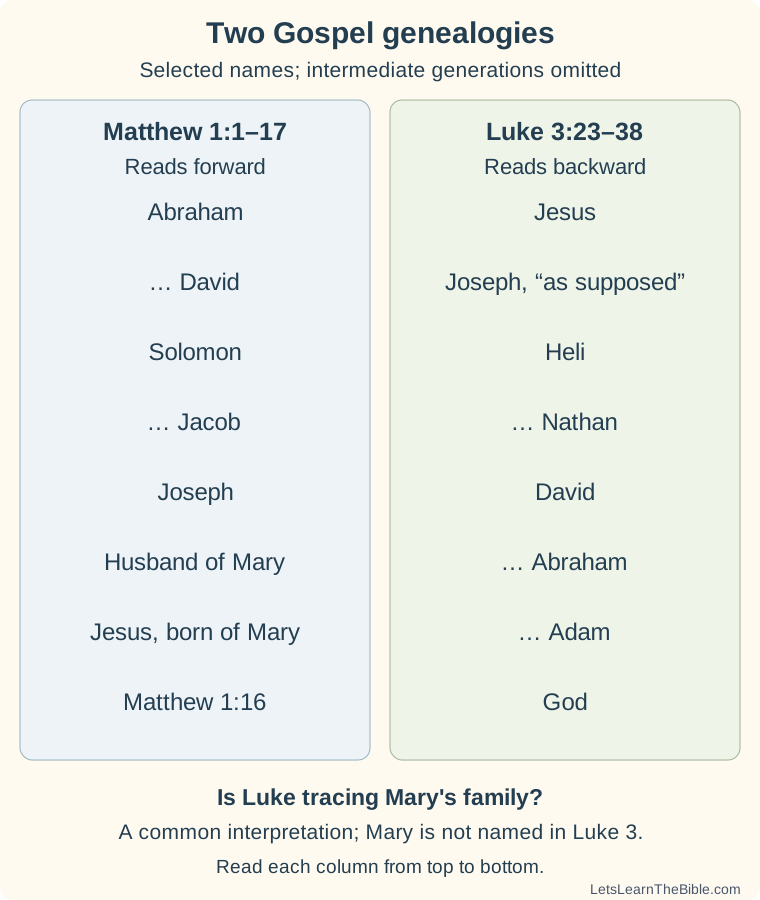
The Bible gives two genealogies of Jesus, in Matthew 1:1–17 and Luke 3:23–38. Matthew begins with Abraham and moves forward to Joseph, the husband of Mary. Luke begins with Jesus and moves backward through Joseph, “as was supposed,” to Heli and then to Adam.
Many Christian interpreters identify Luke’s line as Mary’s family and Matthew’s as Joseph’s legal or royal line. That is a longstanding interpretation, but Luke 3 does not name Mary in the genealogy. A careful comparison should show both the wording of the text and the reasons people propose this harmonization.
How Do Matthew 1 and Luke 3 Differ?
| Feature | Matthew 1:1–17 | Luke 3:23–38 |
|---|---|---|
| Direction | Begins with Abraham and moves forward to Jesus. | Begins with Jesus and moves backward to Adam and God. |
| Davidic branch named | David through Solomon. | David through Nathan. |
| Joseph wording | “Joseph the husband of Mary, of whom was born Jesus” (Matthew 1:16). | Jesus was “as was supposed” the son of Joseph, “which was the son of Heli” (Luke 3:23). |
| Stated purpose in the passage | Matthew's opening identifies Jesus as son of David and son of Abraham; verse 17 groups the generations in three sets of fourteen. | Luke's list reaches Adam and God, fitting the Gospel's wider presentation of Jesus' place in humanity. |
| Does the list name Mary? | Yes, Mary is named in verse 16. | No; Luke 3 names Joseph and Heli. Calling it Mary's line is an interpretation. |
Matthew’s list is not a complete register of every king or generation between Abraham and Jesus. Matthew itself presents a shaped arrangement of three groups of fourteen (Matthew 1:17). Omissions in a theological genealogy do not automatically mean the writer intended a modern civil record.
Why Is Luke Commonly Called Mary's Genealogy?
The common interpretation begins with the apparent difference between Joseph’s fathers. Matthew 1:16 calls Joseph the son of Jacob. Luke 3:23 places Joseph beside Heli. If the two lists are both genealogies connected with Joseph, interpreters must explain why the names differ.
One proposal is that Luke gives Mary’s family line while placing Joseph’s name in the legal form expected in a male-centered genealogy. On this reading, Heli is Mary’s father and Joseph is his son-in-law. The phrase “as was supposed” is taken as a signal that Joseph was not Jesus’ biological father, while Mary is the physical parent named in Luke’s birth narrative.
Benson and Jamieson-Fausset-Brown, among the commentaries collected on Bible Hub, explain this maternal-line proposal. Other commentators, including Meyer on Luke 3:36, object to reading “son-in-law” into the chain. Alternatives connect both lists with Joseph through different natural or legal relationships. The existence of proposals does not make any one of them an explicit statement by Luke: the list names Joseph and Heli, and does not name Mary.
Luke 1:26–35 supplies the birth context: Mary is a virgin betrothed to Joseph; the angel says the child will be conceived through the Holy Spirit and will be called the Son of God. Those verses support the distinction between Jesus’ divine conception and Joseph’s legal role. They do not, by themselves, label every name in Luke 3 as Mary’s ancestors.
How Do Nathan, Solomon, and David Fit Together?
Matthew 1:6 goes from David to Solomon. Luke 3:31 goes from David to Nathan. Both Solomon and Nathan are named as sons of David in the Old Testament’s genealogical material (2 Samuel 5:14; 1 Chronicles 3:5). The two Gospel lists therefore present different branches associated with David.
This difference is the reason many Christians describe Matthew as the royal or legal line and Luke as the family line through Mary. It is a proposed harmonization that needs to be identified as such. The text directly establishes that Jesus is connected with Davidic expectation in the Gospel narratives; it does not give a sentence saying, “Matthew is Joseph’s legal line and Luke is Mary’s biological line.”
What About Cainan in Luke 3:36?
The KJV wording of Luke 3:35–36 includes Cainan between Sala and Arphaxad. Genesis 11:12 in the KJV says that Arphaxad begat Salah without naming Cainan in that position. This is a textual-history question, not a reason to label Luke’s genealogy an obvious mistake.
The Brenton English Septuagint display checked here includes Cainan after Arphaxad in Genesis 11:12–13, while the KJV Genesis passage does not. This comparison shows that the name is present in a Greek Old Testament tradition as well as Luke. It does not establish which document Luke directly copied, or settle the history of every manuscript reading. Commentaries on Luke 3:36 discuss competing explanations; the difference should be stated before proposing a solution.
Luke 3 also includes a Cainan in the line from Adam to Noah. Repeated names and variant forms make exact name counts less useful than identifying the textual tradition being used. This guide therefore does not repeat the old page’s claim that Luke “copied an error” as if that were a settled historical conclusion.
What Do the Genealogies Establish?
The two lists place Jesus within the story of Israel and the wider human family. Matthew opens with Abraham and David, then connects Jesus with the royal history of Judah and with Joseph, the husband of Mary. Luke reaches back to Adam and God, highlighting a horizon wider than one nation’s royal line.
The birth narratives provide the theological center. Jesus is born of Mary, conceived by the Holy Spirit, and identified as the Son of God (Luke 1:31–35; Matthew 1:18–25). The genealogies then answer related historical and narrative questions: how Jesus is situated within Davidic expectation, how Joseph is related to him in the public/legal story, and how the Messiah’s story reaches back through Israel to humanity.
They do not authorize every later chart that assigns an apostle, tribe, or spiritual virtue to a specific ancestor. A chart may be useful when it labels its assumptions, cites its verses, and distinguishes names directly stated from names supplied by harmonization.
Common Questions
Does Luke explicitly say that his genealogy is Mary’s?
No. Luke 3:23 names Jesus, Joseph, and Heli, then continues backward. Identifying Heli as Mary’s father and Luke’s list as Mary’s lineage is a common interpretation based on the comparison with Matthew and the birth narratives.
Which genealogy is Jesus’ legal line?
Many interpreters call Matthew’s list the legal or royal line because it runs through Solomon and Joseph, whom Matthew identifies as Mary’s husband. The label is an interpretive summary, not a heading supplied by Matthew.
Why do Matthew and Luke name different fathers for Joseph?
Matthew names Jacob; Luke names Heli. The common harmonization treats one as Joseph’s biological father and the other as his father-in-law through Mary. Other explanations have been proposed. The difference should be acknowledged rather than hidden by rewriting Luke’s wording.
Does the genealogy prove Mary’s ancestry with complete certainty?
Romans 1:3 explicitly speaks of Jesus as descended from David. Identifying every name in Luke 3 as part of Mary’s maternal family tree is a further interpretation; Luke does not name her in that list.
Is Cainan an error in the Bible?
The checked KJV and Septuagint Genesis displays differ at this point, and Luke includes Cainan. Those facts raise a textual-history question; they do not establish that Luke simply made a copying mistake.
Sources and Method
We compared Matthew 1:1–25, Luke 1:26–35, Luke 3:23–38, 2 Samuel 5:14, 1 Chronicles 3:5, Romans 1:3, and Genesis 11:10–13 in the digital KJV corpus. The checked USCCB note on Luke 3:23–38 supports the discussion of Luke’s reach to Adam and God; the discussion of maternal-line interpretation uses the specifically named commentaries below. We compared the displayed Brenton Genesis text for the Cainan question. The diagram is newly authored and uses no third-party artwork.
- Digital KJV corpus — verse text used for the comparison.
- USCCB: Luke 3, note on 3:23–38 — Luke's reach to Adam and God.
- Bible Hub: commentaries on Luke 3:23 — Benson and Jamieson-Fausset-Brown explain the maternal-line reading as an interpretation.
- Bible Hub: commentaries on Luke 3:36 — Meyer discusses the differing lists and rejects the proposed “son-in-law” reading.
- Brenton Septuagint Translation: Genesis 11 — the displayed Cainan sequence at verses 12–13.
- Bible Gateway: Matthew 1 and Luke 3 — parallel reading of the KJV passages.
Content revised October 29, 2026. Send factual corrections or source questions through our contact page.