Paul's Cities: Maps and a Place-by-Place Evidence Index
A map of places linked with Paul needs more than a set of identical dots. Damascus, Corinth and Rome have explicit arrival accounts. Chios and Cnidus are offshore references. Hierapolis is connected with Epaphras’s work, while Spain and Nicopolis occur as intended destinations. Treating every name as a city where Paul preached would change the evidence.
Use the maps to see where the named places lie, then use the alphabetical index to check what the passage actually says. The index brings the former small-map list and the larger-map page’s useful passage notes together. It retains their 59 named entries, including islands, a region and a road label; 59 is the size of this selected lookup list, not a count of cities Paul visited or a claim to list every place associated with him.
Choose a Map for the Part of the Journey You Need
The three maps below provide complementary views. They are existing site study diagrams, with different scopes and keys. Their numbers restart on each diagram; they are not one continuous numbered journey. Open a full-size image for a larger view, or use the linked guide for its detailed passage key.
| Question | Map or guide | What it covers |
|---|---|---|
| Where are the earlier places? | Early-travel guide | Read the named early travels separately; Arabia is a region, not a supplied city coordinate. |
| Where did the Cyprus and inland journey go? | First-journey guide | Antioch, Cyprus, Perga and the inland cities in Acts 13–14, with the return sequence. |
| How are Troas, Macedonia and Greece connected? | Second-journey map below | Selected sites in Acts 15:36–18:22, including the return by Ephesus and Caesarea. |
| Where are the Aegean islands and return ports? | Return-leg map below | Philippi to Jerusalem in Acts 20:6–21:17; it does not map the whole third journey. |
| Where are Malta and the Italian places? | Rome-journey map below | Acts 27–28 place references, with an Italy detail and no invented storm track. |
| What about Spain or Nicopolis? | Later-travel evidence map | Reference geography rather than a proven continuous fifth itinerary; consult its separate passage key and limitations. |
Asia Minor, Macedonia and Greece
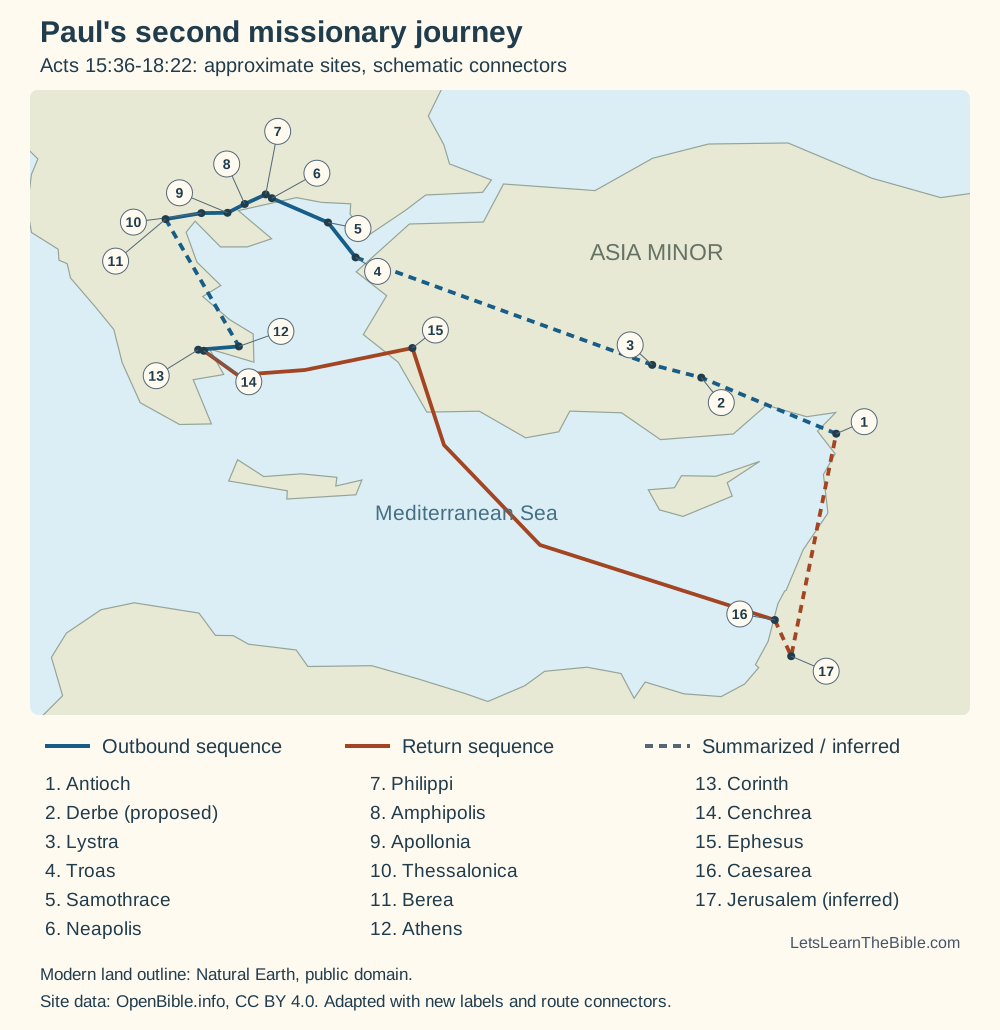
The lines help locate the sequence; they do not certify ancient roads or sailing tracks. In particular, Acts 18:22 says Paul lands at Caesarea, goes up to greet the church and goes down to Antioch. Identifying that upward visit as Jerusalem is an inference, unlike the explicitly named arrivals in Acts 9:26 and 21:17.
The Aegean Return toward Jerusalem
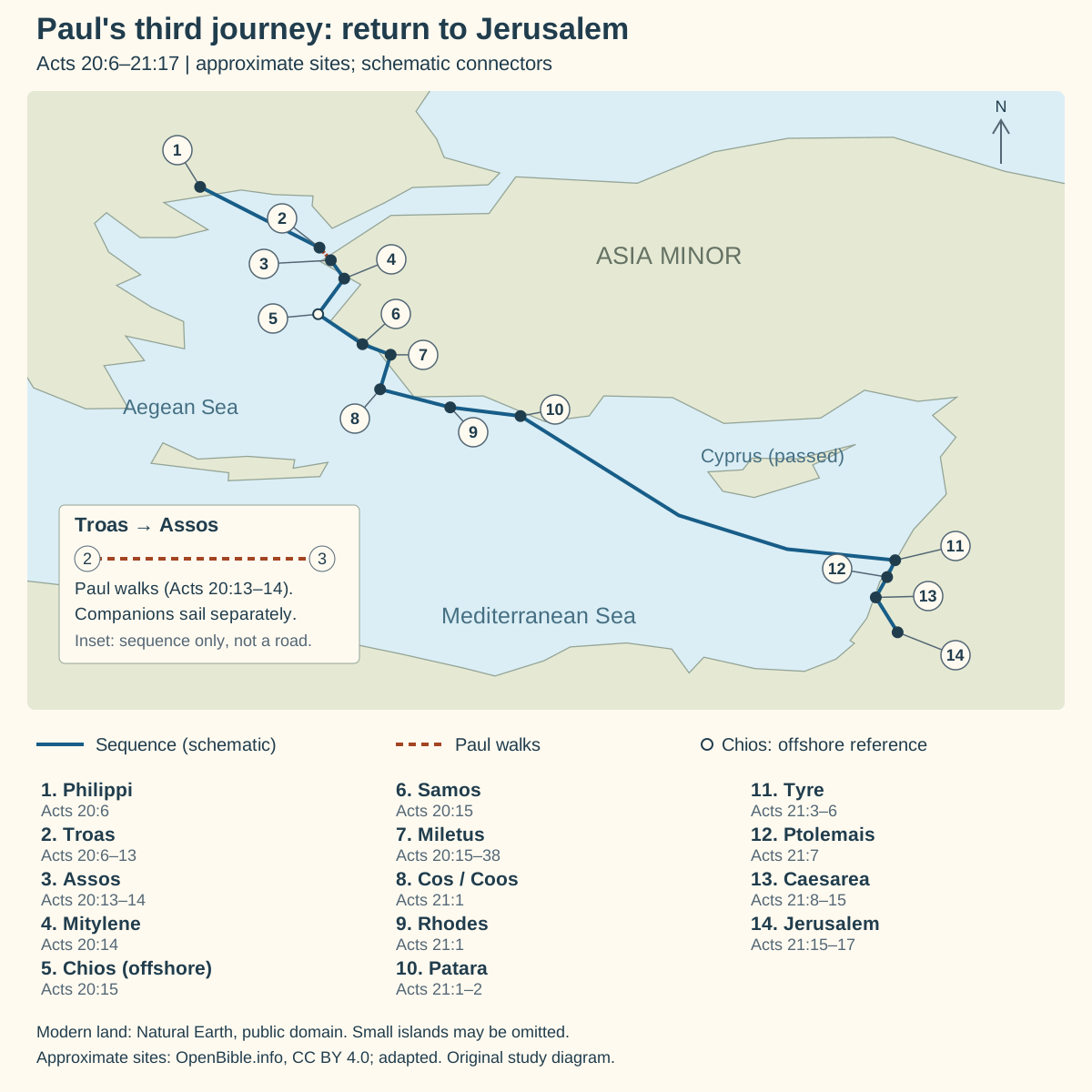
Keep the verbs attached to the names. Acts 20:15 says the ship comes opposite Chios and arrives at Samos; the KJV also includes tarrying at Trogyllium. Acts 21:1 names Coos, Rhodes and Patara as stages reached, and the next verse describes finding another ship. By contrast, 21:3 expressly describes Cyprus being left on the left before the landing at Tyre. These statements do not all amount to the same kind of visit.
The Voyage and Approach to Rome
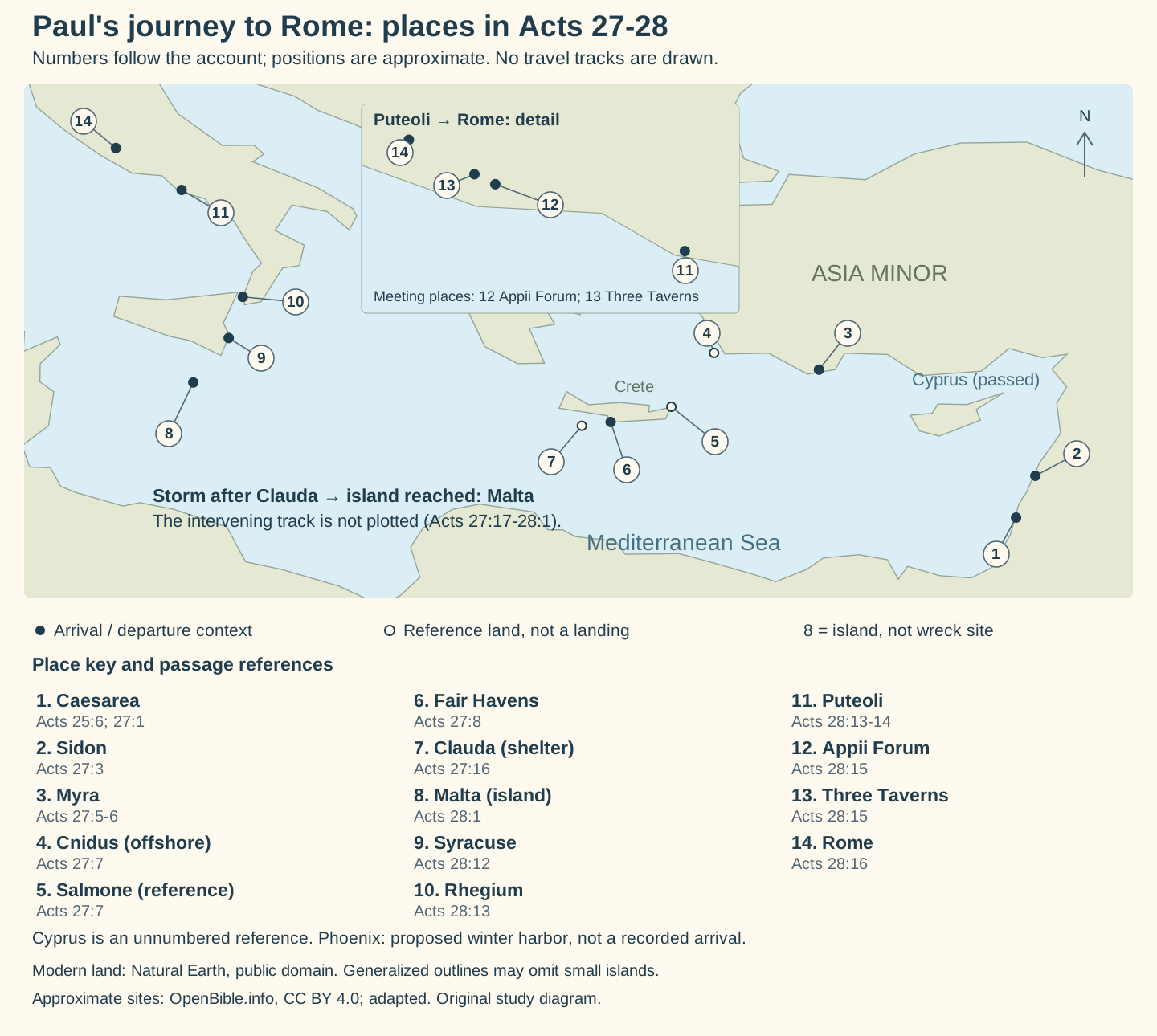
Paul’s arrival in Rome is explicit in Acts 28:16. It differs from his earlier expressed hope to visit the Roman believers on the way to Spain. The voyage also names places that are not arrivals: Lasea is near Fair Havens, Cnidus and Salmone orient the sailing, and the ship runs under Clauda. A coastal reference does not establish a disembarkation or a preaching stay.
How to Read the Alphabetical Place Index
The evidence column distinguishes a visit or arrival, passage through a place, a geographical reference, association with another worker, and an intended destination. These descriptions are not spiritual rankings: a brief stop can be explicitly attested, while an important community may lack a recorded visit by Paul in the cited text.
Use your browser’s find function for a name, including the KJV forms Coos, Melita, Samothracia and Miletum mentioned below. The alphabetical sections retain the old list’s lookup function while adding the larger page’s useful explanations. City, island, harbor, region and road label are kept recognizable. This is not an index of all Roman provinces, a timetable for every visit, or a census of churches founded by Paul.
A–C: Amphipolis through Cyprus
| Place | Evidence type | Passage | What is established |
|---|---|---|---|
| Amphipolis | Passage through | Acts 17:1 | Paul and Silas pass through on the way to Thessalonica; this verse does not describe a preaching stay. |
| Antioch (Pisidia) | Visit and ministry | Acts 13:14–16, 42–52; 14:21–23 | The first journey includes teaching, opposition and a return to strengthen disciples. Later references to travel through regions do not individually name this city. |
| Antioch (Syria) | Visit and ministry | Acts 11:25–26; 13:1–4; 14:26–28; 18:22–23 | Barnabas brings Saul here; the church sends the missionaries and receives their report. Keep it distinct from Pisidian Antioch. |
| Antipatris | Custody transfer | Acts 23:23–33 | Soldiers bring Paul here by night before the horsemen continue with him to Caesarea; the destination is not established by 23:13 alone. |
| Apollonia | Passage through | Acts 17:1 | Named with Amphipolis as a place passed through before Thessalonica, without a narrated ministry there. |
| Appian Way | Road label, not a named Acts stop | Acts 28:13–16 | The passage names Puteoli, Appii Forum, Three Taverns and Rome. It does not use the name Appian Way; this inherited index label adds no separate biblical arrival. |
| Appii Forum | Road meeting | Acts 28:14–16 | Believers coming from Rome meet Paul's party here; the encounter belongs to his approach to Rome. |
| Arabia | Regional travel recalled | Galatians 1:17 | Paul recalls going into Arabia and returning to Damascus. He names no Arabian city, route or length of stay in this verse. |
| Assos | Arrival and change of transport | Acts 20:13–14 | Paul meets the ship here after arranging to travel on foot while his companions sail. |
| Athens | Visit | Acts 17:14–16; 18:1 | Paul is brought to Athens, waits there, and later leaves for Corinth. |
| Attalia | Departure port | Acts 14:24–26 | After preaching in Perga, Paul and Barnabas go down to Attalia and sail back to Antioch. |
| Berea | Visit and ministry | Acts 17:10–15 | Paul and Silas enter the synagogue; the response and ensuing pressure precede Paul's departure toward Athens. |
| Caesarea | Visits and custody | Acts 9:30; 18:22; 21:8; 23:31–35 | Named as a departure point toward Tarsus, a landing, Philip's home setting and the destination of Paul's military escort. |
| Cenchrea | Departure setting | Acts 18:18–19 | The departure toward Syria and onward arrival at Ephesus are linked with Cenchrea. A named travel setting does not supply a separate church-founding account. |
| Chios | Offshore reference | Acts 20:15 | The ship comes opposite Chios. The verse does not say Paul lands on the island. |
| Clauda | Sheltered sailing reference | Acts 27:16–17 | The ship runs under the island during the storm and the crew secures the boat; no landing by Paul is stated. |
| Cnidus | Offshore reference | Acts 27:7 | The ship comes opposite Cnidus with difficulty; the account does not report a landing there. |
| Coos / Cos | Voyage stage | Acts 21:1–2 | The party comes to Coos, then Rhodes and Patara. These are named stages, without an account of preaching or an instruction to treat all three as mere distant landmarks. |
| Corinth | Visit and ministry | Acts 18:1–18 | Paul arrives from Athens, works and teaches, stays a year and six months, and later departs. |
| Cyprus | Visited island; later passed | Acts 13:4–6; 21:3; 27:4 | The first journey includes Salamis and Paphos. Later voyages pass Cyprus; those references do not establish additional island visits. |
D–M: Damascus through Myra
| Place | Evidence type | Passage | What is established |
|---|---|---|---|
| Damascus | Visit and ministry | Acts 9:1–25; Galatians 1:17 | Acts describes Saul being brought into the city and preaching there; Galatians recalls a return after Arabia. |
| Derbe | Visit and ministry | Acts 14:20–21; 16:1 | Paul and Barnabas preach and teach in Derbe, and Acts later names Paul's arrival there again. |
| Ephesus | Visits and ministry | Acts 18:19–21; 19:1–10; 20:16–17 | Acts records an initial synagogue visit and later extended teaching. On the return voyage Paul sails past and calls its elders to Miletus; those are different actions. |
| Fair Havens (Crete) | Harbor arrival | Acts 27:7–12 | The ship reaches Fair Havens near Lasea. Phoenix is the proposed winter harbor, not an arrival reported in this passage. |
| Hierapolis | Associated with another worker | Colossians 4:12–13 | The letter speaks of Epaphras's concern for people here and in Laodicea. That statement does not establish a personal visit by Paul. |
| Iconium | Visit and ministry | Acts 13:51; 14:1–7, 21–23 | Paul and Barnabas come here, teach and leave after a threatened attack; they return to strengthen disciples. |
| Jerusalem | Visits | Acts 9:26–30; 12:25; 21:15–17 | These passages explicitly name Jerusalem. In contrast, the upward visit in Acts 18:22 is not named Jerusalem in that verse and is marked as inferred on the second-journey map. |
| Laodicea | Community addressed or discussed | Colossians 2:1–5; 4:12–16 | Paul expresses concern and gives instructions involving its believers. These references are not a narrated arrival; concern and shared correspondence should not be turned into a travel log. |
| Lasea | Nearby city reference | Acts 27:8 | Lasea is near Fair Havens. The passage does not say Paul entered Lasea. |
| Lystra | Visits and ministry | Acts 14:6–21; 16:1–3 | Acts narrates the healing, attempted divine honors, stoning and return, and later introduces Timothy in this setting. |
| Malta / Melita | Island arrival and stay | Acts 28:1–11 | After the wreck, the survivors learn the island's name; Paul meets its inhabitants and later departs. The passage does not pinpoint the wreck beach. |
| Miletus | Visit and meeting | Acts 20:15–38; 2 Timothy 4:20 | Acts places the meeting with Ephesian elders here. Second Timothy separately recalls leaving Trophimus at Miletum, without supplying a complete later itinerary. |
| Mitylene | Voyage arrival | Acts 20:14–15 | After taking Paul aboard at Assos, the party comes to Mitylene and continues by sea. |
| Myra | Arrival and ship change | Acts 27:5–6 | The party comes to Myra in Lycia, where the centurion transfers the prisoners to an Alexandrian ship bound for Italy. |
N–T: Neapolis through Tyre
| Place | Evidence type | Passage | What is established |
|---|---|---|---|
| Neapolis | Voyage arrival | Acts 16:11–12 | The crossing from Troas reaches Neapolis after Samothrace; the party then continues to Philippi. |
| Nicopolis | Intended winter destination | Titus 3:12–15 | The instruction asks Titus to come because the writer has decided to winter there. It is a plan, not a report that the winter stay has occurred; this index does not choose among identifications of Nicopolis. |
| Paphos (Cyprus) | Visit and ministry | Acts 13:6–13 | The island journey reaches Paphos, where Elymas and Sergius Paulus appear in the narrative; the party then sails for Perga. |
| Patara | Voyage arrival and ship change | Acts 21:1–3 | After Coos and Rhodes, the party reaches Patara and finds a ship sailing toward Phoenicia. |
| Perga | Arrival and later preaching | Acts 13:13–14; 14:24–25 | The first arrival includes John Mark's departure; the return leg explicitly includes preaching in Perga before Attalia. |
| Philippi | Visit and later departure | Acts 16:11–15; 20:6 | Acts names the arrival and stay, and later a departure by sea after the days of unleavened bread. |
| Ptolemais | Arrival and short stay | Acts 21:7–8 | The party comes from Tyre, greets believers and stays one day before Caesarea. |
| Puteoli | Arrival and stay | Acts 28:13–14 | The party reaches Puteoli, finds believers and stays seven days before continuing toward Rome. |
| Rhegium | Voyage arrival | Acts 28:13 | The account names arrival after Syracuse and departure toward Puteoli after one day. |
| Rhodes | Voyage stage | Acts 21:1 | Rhodes is named between Coos and Patara. No separate ministry or duration is given. |
| Rome | Arrival and residence | Acts 28:14–31 | Acts explicitly brings Paul to Rome under guard and closes with two years in his rented dwelling. Arrival is established without treating his earlier wish to come as an earlier completed visit. |
| Salamis (Cyprus) | Visit and ministry | Acts 13:4–6 | The missionaries arrive and preach in the synagogues before traveling through the island toward Paphos. |
| Salmone | Coastal reference | Acts 27:7–8 | The ship sails under Crete opposite Salmone before Fair Havens. It is a geographical reference, not a narrated city visit. |
| Samos | Voyage arrival | Acts 20:15 | The KJV says the party arrives at Samos. Keep that wording distinct from coming opposite Chios. |
| Samothracia / Samothrace | Sea-crossing stage | Acts 16:11 | Named between Troas and Neapolis. The verse supplies the voyage sequence, not a ministry account on the island. |
| Seleucia | Departure port | Acts 13:4–5 | Barnabas and Saul go down to Seleucia and sail to Cyprus. |
| Sidon | Arrival and contact with friends | Acts 27:3–4 | The ship touches at Sidon and Julius permits Paul to go to his friends before the voyage continues. |
| Spain | Intended journey | Romans 15:22–29 | Paul hopes to travel through Rome to Spain after delivering the collection. These future-facing sentences do not establish that he completed the journey. |
| Syracuse (Sicily) | Landing and stay | Acts 28:12–13 | The party lands at Syracuse and remains three days before continuing to Rhegium. |
| Tarsus | Destination and residence context | Acts 9:30; 11:25–26 | Paul is sent to Tarsus; Barnabas later goes there to find him and brings him to Antioch. |
| Thessalonica | Visit and ministry | Acts 17:1–10 | Paul reaches the city, reasons in the synagogue and leaves for Berea after opposition. |
| Three Taverns | Road meeting | Acts 28:14–16 | Believers come from Rome to meet Paul's party here, as at Appii Forum; no separate preaching stay is described. |
| Troas | Visits and departure setting | Acts 16:8–11; 20:5–13; 2 Timothy 4:13 | Acts records the vision before Macedonia and a later stay and departure. The cloak left with Carpus is a separate letter reference, not a date for a reconstructed final journey. |
| Trogyllium | KJV voyage stop | Acts 20:15 | The KJV includes tarrying at Trogyllium. The return map does not plot it; the English-version wording is retained here without a new manuscript or site-identification claim. |
| Tyre | Arrival and stay | Acts 21:3–7 | The ship lands to unload cargo; the travelers find disciples, remain seven days and continue to Ptolemais. |
Spain, Nicopolis and the Limits of Counting Visits
Romans 15:22–29 places Paul’s hope to travel to Spain after the collection for Jerusalem and a visit to Rome. Titus 3:12 asks Titus to come to Nicopolis because the writer has determined to winter there. Neither statement, by itself, reports that the intended stay has taken place. This index therefore includes both names with their future-facing status rather than deleting them or silently counting them as completed visits.
That distinction does not settle every later historical tradition. This page has not independently examined later reports of a Spanish mission or claims about Britain. The cited passages supply a plan for Spain, not a completed Spanish or British itinerary. The linked later-travel guide handles the wider evidence separately.
Similarly, Colossians 4:13 describes Epaphras’s zeal for Hierapolis and Laodicea. A place connected with a coworker’s labor belongs in a study index, but it does not become Paul’s personal destination merely because it occurs in a Pauline letter. Colossians 2:1–5 expresses concern for believers and people who have not seen his face; it is not an arrival scene.
Do repeated journeys tell us which city received the most visits? Only after deciding what counts as a visit, how to handle regional summaries, and whether a letter’s reference belongs to a distinct trip. Acts 14 explicitly narrates a return through Lystra, Iconium and Antioch. Acts 18:23 instead summarizes travel through Galatia and Phrygia without naming each city. The latter should not be turned into a confirmed third arrival in every earlier city. For the same reason, this guide does not assign an exact lifetime journey total.
Sources and Map Credits
The place notes are independent paraphrases checked in the retained digital King James Version corpus. Actual bounded readings were Acts 9:1–31; 11:19–30; 12:25; 13:1–16 and 42–52; chapter 14; 15:36–41; 16:1–15; 17:1–16; 18:1–23; 19:1–10; chapters 20 and 27–28; 21:1–17; 23:12–35; Galatians 1:11–24; Romans 15:14–33; Titus 3:12–15; Colossians 2:1–5 and 4:12–18; 1 Corinthians 16:5–9; 1 Timothy 1:1–4; and 2 Timothy 4:9–22. This is a bounded place check, not a new reading of every chapter or a manuscript, chronology or ancient-road survey.
The three embedded maps are existing diagrams made for this site. Land outlines use Natural Earth public-domain data; approximate site data are adapted from OpenBible.info under CC BY 4.0, with site selection, labels and diagram keys. Their existing credits and the linked guides’ fuller explanations are retained. Reuse here does not create a new coordinate survey or redraw a map. Modern generalized coastlines may omit small islands and do not reconstruct ancient shores.
No former all-cities artwork is reused. The geographical coverage is supplied by the separate maps, not a newly claimed master map with a pin for every index entry. Some names, especially an unnamed Arabian city or an unidentified Nicopolis, cannot responsibly be supplied with a precise point from the passages checked here. Report a factual correction through Contact.