Paul's Early Travels: Damascus, Arabia, Tarsus and Antioch
Before the departure from Antioch in Acts 13, Saul’s story connects Damascus, Arabia, Jerusalem, Caesarea, Tarsus and Antioch. These places do not form one continuous route described in a single passage. Acts follows his encounter, preaching, danger and work with Barnabas; Galatians supplies the Arabia journey, return to Damascus and later regional movements.
Use the place guide for orientation and the sequence table to follow the notices. A place name can be certain even where the road between places, the length of a stay or its calendar year remains unknown. Here “before the first missionary journey” means before the sending and departure narrated in Acts 13:1–4; it does not mean Saul had done no preaching or traveling earlier.
Locate the Places before Connecting Them
Damascus, Jerusalem, coastal Caesarea, Tarsus and Antioch in Syria are the five city references in this guide. Arabia and the regions of Syria and Cilicia are broader geographical notices. They should not be turned into additional city dots merely to complete a line on a map. In particular, Galatians 1:17 gives no named destination within Arabia.
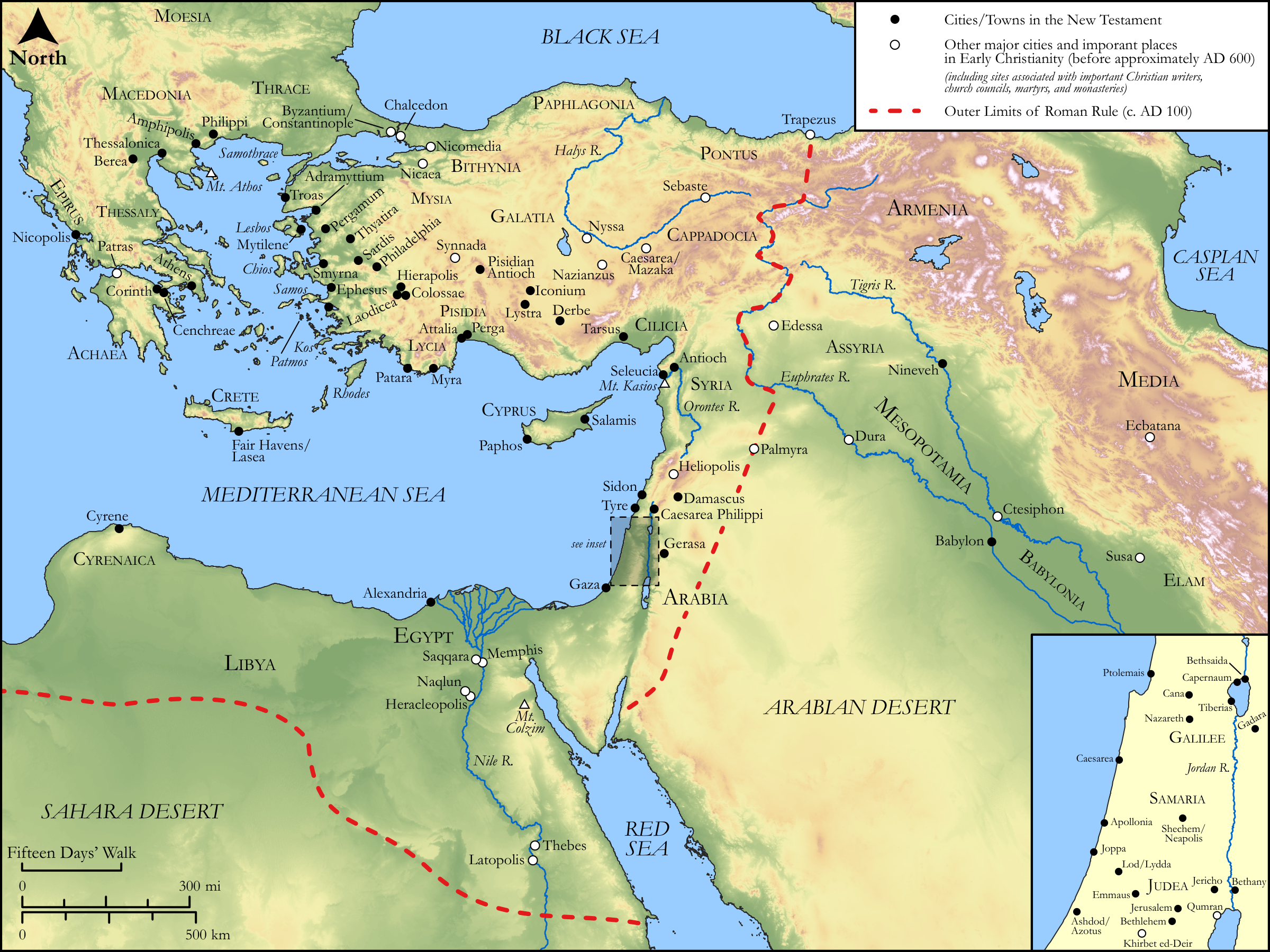
Use this as a place locator, not an early journey route map. On the main map, find Damascus, Tarsus in Cilicia, and Antioch beside Syria and the Orontes River. That Antioch is the Syrian congregation in Acts 11–13, distinct from the separately labeled Pisidian Antioch. In the lower-right inset, find Jerusalem and coastal Caesarea (Caesarea Maritima). Do not substitute Caesarea Philippi, north of the inset area on the main map, or Caesarea/Mazaca in Cappadocia. The Caesarea name guide and Antioch name guide explain these distinctions.
The publisher’s map covers a much broader period than Saul’s early movements. Its red dashed line marks the outer limits of Roman rule around AD 100; it is not Paul’s route. Hollow circles include other early Christian places before approximately AD 600. Neither date gives the time of Saul’s journey or a date for the events in the table. The broad label Arabia does not identify where Paul went in Galatians 1:17; no specific Arabian stop is inferred here.
The table below supplies the movement order separately from geographical orientation. It includes returns to the same place and explicitly marks where accounts are being compared. A single line cannot show those evidential differences by itself.
What Movements Do Acts and Galatians State?
| Stage | Passage and movement | How to read it |
|---|---|---|
| 1. Journey to Damascus | Acts 9:1–9: Saul seeks authority against followers of the Way, approaches Damascus and is led into the city without sight. | The destination and arrival are stated. Intermediate towns and the exact road are not. |
| 2. Damascus disciples and preaching | Acts 9:10–22: Ananias visits Saul; Saul is baptized, stays with the disciples and proclaims Jesus. | An existing community receives him; he does not arrive as its founder. |
| 3. Arabia and return to Damascus | Galatians 1:15–18: Paul goes to Arabia, returns to Damascus, then visits Jerusalem after three years. | Paul gives this order. He does not assign the whole interval to Arabia or name a destination there. |
| 4. Escape and Jerusalem | Acts 9:23–28: after many days, disciples lower Saul in a basket; at Jerusalem, Barnabas introduces him. Galatians 1:18–19 gives fifteen days with Peter and a meeting with James. | Placing the escape after the Arabian return combines the two accounts; Galatians does not narrate the escape. |
| 5. Caesarea and Tarsus | Acts 9:29–30: after a threat at Jerusalem, brethren bring Saul to Caesarea and send him to Tarsus. | The two destinations are named. The text gives no route survey or four-year Tarsus residence. |
| 6. Syria and Cilicia | Galatians 1:21: Paul says he later came into these regions. | A regional notice is not a list of every town visited or a complete itinerary within Tarsus. |
| 7. Tarsus to Antioch | Acts 11:25–26: Barnabas seeks Saul at Tarsus and brings him to Antioch; together they teach with the church for a whole year. | That year concerns the Antioch work, not the length of the preceding Tarsus interval. |
| 8. Relief for Judea | Acts 11:27–30: Antioch's disciples send relief by Barnabas and Saul. KJV Acts 12:25 describes their return from Jerusalem with John Mark. | Judea is the stated relief destination in chapter 11; a precise transport route and list of recipients are not given. |
| 9. The next journey begins | Acts 13:1–5: the Spirit directs the setting apart of Barnabas and Saul; they leave Antioch for Seleucia and sail to Cyprus. | This departure marks the boundary of this guide. The first-journey guide follows the subsequent stops. |
Galatians Supplies a Sequence, Not an Arabian Road
Acts 9 moves from Saul’s early preaching to a plot “after that many days were fulfilled” and his escape. It does not describe Arabia. Galatians 1:17 explicitly supplies Arabia and the return to Damascus before the Jerusalem visit. A combined early itinerary should show which writer contributes each notice rather than attribute all of it to Acts.
Galatians 1:11–17 concerns the source of Paul’s gospel and his calling. He says he received the gospel through revelation of Jesus Christ and did not first go to the earlier apostles in Jerusalem. The passage does not describe a three-year private course of lessons in Arabia. Nor does it say he escaped Damascus, then spent three full years in Arabia and only afterward returned in a particular spring.
Second Corinthians 11:32–33 adds a governor under Aretas and escape through a window in the wall. It does not locate an Arabian teaching site or name the gate used. For the full comparison, including the limits of combining the escape accounts, use Paul in Damascus and Arabia. The present guide keeps that discussion short so the larger movement sequence remains easy to consult.
Why Do Caesarea and Tarsus Appear after Jerusalem?
Acts 9:26–30 describes fear among the Jerusalem disciples, Barnabas’s introduction, Saul’s bold speech and a threat against his life. The brethren respond by bringing him to Caesarea and sending him onward to Tarsus. These are movements prompted by danger, not a new commission to begin the Cyprus journey.
Galatians 1:18–21 gives another perspective: Paul visits Peter, stays fifteen days, sees James and later enters the regions of Syria and Cilicia. The regional account and Acts’ named cities can be compared, but they should not be expanded into a complete list of stops or a continuous four-year stay inside one city. The Tarsus interval guide explains that distinction.
Repeated places also matter. Jerusalem is Saul’s earlier center of persecution, the city he visits after the Damascus period, and the place named in KJV Acts 12:25’s later return notice. A map with one Jerusalem symbol still requires separate entries for separate episodes.
Antioch Is Already Active before Barnabas Brings Saul
Acts 11:19–24 describes preaching by scattered believers, including people from Cyprus and Cyrene, before Barnabas looks for Saul. News reaches Jerusalem, Barnabas is sent to Antioch and he encourages the believers. Only then does he go to Tarsus to seek Saul and bring him back.
Verse 26 records their whole year of assembly and teaching with the church, and says the disciples were first called Christians at Antioch. It does not make Saul the community’s first evangelist or give the year a modern summer-to-summer date range. Antioch becomes a place of sustained shared work before the departure described in Acts 13.
Relief Work Precedes the Sending in Acts 13
Agabus’s famine prophecy leads the disciples to determine relief, each according to ability, for the brethren in Judea (Acts 11:27–30). The text says they send it to the elders through Barnabas and Saul. It does not say they plant a special crop, specify three years of famine or give a complete inventory of food transported. Those details should not become dated stages on the map.
KJV Acts 12:25 says Barnabas and Saul return from Jerusalem after fulfilling their ministry and take John Mark with them. Acts 13:1 then names Barnabas and Saul among Antioch’s prophets and teachers. During worship and fasting, the Spirit calls for their setting apart; prayer, fasting and laying on of hands precede their departure. This is a narrated sending for particular work, not a statement that baptism earlier changed Saul’s name or that no calling existed before this moment.
Acts 13:9, in the subsequent Cyprus episode, describes “Saul, who also is called Paul.” For the onward sequence use Paul’s first missionary journey. Galatians 2:1–10 describes another Jerusalem visit; identifying that visit with a particular Acts journey requires a separate chronological argument and is not used here to supply a fixed date.
Three Days, Three Years and One Year Measure Different Things
Acts 9:9’s three days describe Saul’s blindness and lack of food and drink. Galatians 1:18’s “after three years” introduces the Jerusalem visit after the preceding calling, Arabia journey and return. Acts 11:26’s whole year describes work with the Antioch church. None of these notices gives a spring departure, an exact year of conversion or the duration of every intervening stay.
Read a proposed route with three separate questions: does the text name the destination, does it establish the order, and does it state the path or time taken? A “yes” to the first two does not supply the third. This distinction preserves the usefulness of the early sequence without filling its gaps with invented precision.
Sources and Related Guides
Primary text read for this guide: Acts 8:1–4; 9:1–31; 11:19–30; 12:20–25; 13:1–12; Galatians 1; 2:1–10; and 2 Corinthians 11:30–33, King James Version. The sequence table is this site’s comparison of those passages. No complete ancient road reconstruction, Arabian destination or fixed calendar chronology is adopted.
- Acts’ early movements, relief and departure.
- Paul’s own notices in Galatians and 2 Corinthians.
- The three Damascus road accounts and Ananias, baptism and the first witness treat the conversion narrative in detail.