Tarsus in the Bible: Paul’s Birthplace, Return and Citizenship
Tarsus is the Apostle Paul's birthplace in Cilicia, but Acts distinguishes where he is born, where he is brought up and his Roman citizenship. The city also appears when believers send Saul away from danger and when Barnabas seeks him for work at Antioch. These notices give a clear sequence without supplying an exact birth year or four-year residence.
The Name and the Five References
Blue Letter Bible G5019: Tarsus identifies a major Cilician city associated with Paul. Its outline gloss is “a flat basket,” but the etymological connection is introduced as “perhaps.” It is not a certain account of how the city received its name.
The related G5018: a native of Tarsus describes a person's connection with the city. The two entries account for different expressions translated with Tarsus. A whole-word search of numbered KJV text finds the city-name in five verses, all in Acts; BLB lists three translations for G5019 and two for G5018. Neither number is a count of Paul's visits.
Tarsus in the Sequence of Acts
| Reference | Scene | What the city-name contributes |
|---|---|---|
| Acts 9:11 | Ananias is directed to Saul at Judas's house in Damascus. | Saul is identified as being of Tarsus; the scene takes place in Damascus. |
| Acts 9:30 | Believers learn of a plot in Jerusalem and bring Saul to Caesarea. | They send him onward to Tarsus, an actual destination in the narrative. |
| Acts 11:25 | Barnabas leaves Antioch to seek Saul. | He looks for him at Tarsus, then brings him to Antioch in verse 26. |
| Acts 21:39 | Paul answers the commander at Jerusalem and asks to speak. | He identifies himself as a Jew of Tarsus, a citizen of “no mean city.” |
| Acts 22:3 | Paul addresses the people at Jerusalem. | He distinguishes birth in Tarsus from upbringing “in this city” at Gamaliel's feet. |
Birthplace, Upbringing and Citizenship Compared
Acts 21:39 responds to the commander's mistaken question about an Egyptian insurgent. Paul's civic description establishes who he says he is and supports his request to speak. In 22:3 he explains his Jewish education and zeal to his audience. The phrase “this city” belongs to the Jerusalem setting; it does not mean Gamaliel teaches him in Tarsus.
The Roman citizenship exchange occurs later, when Paul faces examination by scourging. He asks whether it is lawful to scourge a Roman who is uncondemned (22:25). The commander says he obtained citizenship at great cost; Paul replies that he was born with it (22:28). The passage reports Paul's status but does not explain how his family acquired it.
Being born in a city described elsewhere as free does not, by this verse alone, establish why a particular resident is a Roman citizen. The Tarsian civic identification and the Roman legal claim should remain separate. The Roman citizenship and threatened scourging guide examines the latter scene.
What Does the Ancient Street Show?
The Tarsus District Governorate's description of Antik Cadde (Roma Yolu) identifies an excavated east–west street paved with polygonal basalt stones, with remains from several periods around it. This is a physical urban site in Tarsus. It illustrates the ancient city's built environment; it is not an identified location of any particular episode in Paul's life.
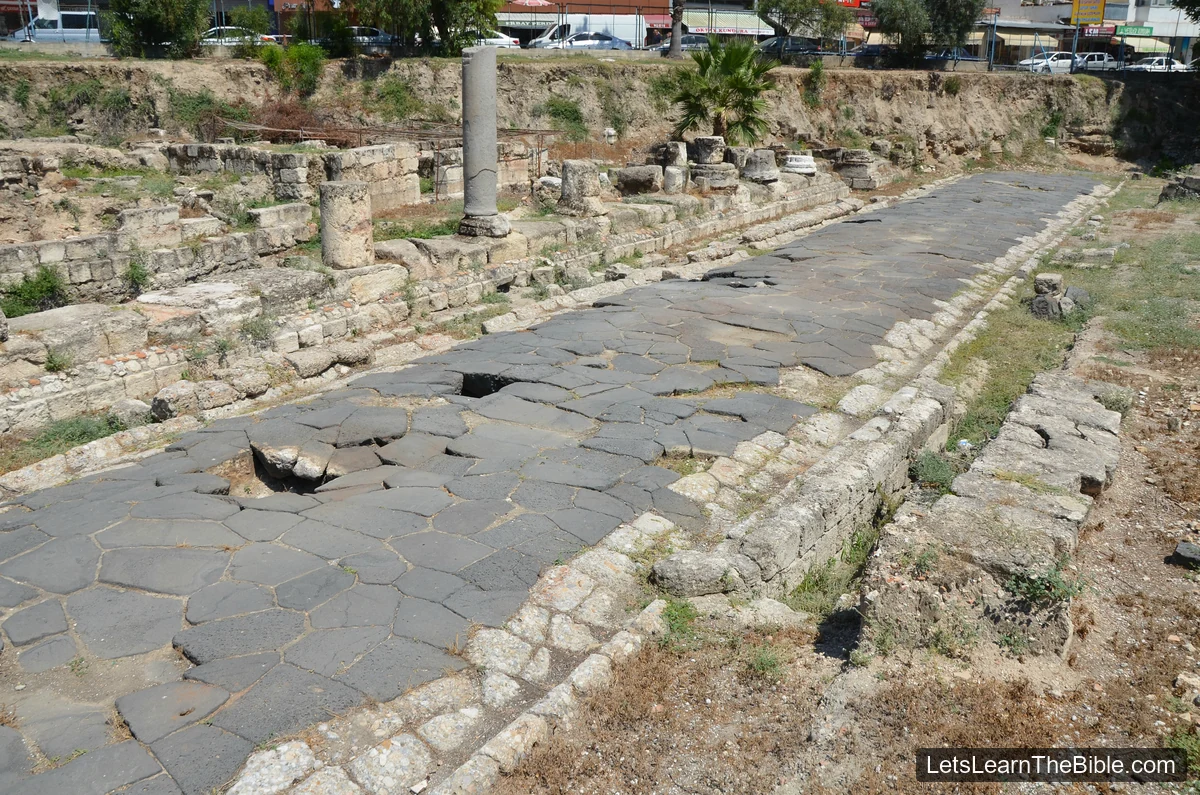
Photograph: “Paved colonnaded street running in an east-west direction with shops and other buildings, Tarsus, Cilicia, Turkey” by Carole Raddato (Following Hadrian). Original title and photo source on Flickr; acquired from the photographer’s own site. CC BY-SA 2.0. Resized from 3072×2035 to 1200×795 and converted to WebP; a LetsLearnTheBible.com site watermark was added in the lower-right corner. No crop or other retouching. This version remains under CC BY-SA 2.0. The watermark identifies the publishing site; photographic credit belongs to Carole Raddato.
In this photograph, follow the dark polygonal paving past the broken column remains, with modern shops and the present-day street above the excavation. The governorate estimates Roman street construction in the first century AD, but separately dates the southwestern columned platform and associated remains to the fourth or fifth century AD. These attributions must not turn every visible column or paving stone into a feature contemporary with Paul, and no evidence here proves he walked this exact surface.
A street may have an earlier origin, later surfaces and buildings added alongside it. The governorate's estimated first-century construction date should be read as an attributed archaeological claim, not as a date supplied by Acts. The different origin and portico dates in a photographer's description require an excavation report before they can be reconciled with it. The photograph shows the surviving street and neighbouring remains; their dates depend on archaeological evidence, rather than their appearance.
How Is the Appeal to Caesar Different?
Acts 25:6–12 places Paul before Festus at Caesarea. When Festus asks about a trial at Jerusalem, Paul says he stands at Caesar's judgment seat, denies having wronged the Jews and appeals to Caesar. After consulting his council, Festus says that Paul has appealed to Caesar and will go to Caesar. This is a later judicial scene, distinct from the threatened scourging at Jerusalem in Acts 22.
The appeal does not say that Tarsus granted Paul Roman citizenship. Acts 22:28 reports that he was born a Roman citizen without explaining the family's acquisition of that status. Read the appeal together with the birthplace and citizenship comparison: Tarsian identity, birth in Tarsus and the Roman legal claim are related facts about Paul, but one must not be substituted as the cause of another.
What Happens between Jerusalem and Antioch?
Acts 9:26–30 reports Saul's reception through Barnabas, his bold speech, opposition and departure when believers learn of a threat to his life. Sending him to Tarsus is part of their response to that danger. It need not be recast as the church punishing an inconvenient member.
Acts 11:19–24 already describes preaching and believers at Antioch before Barnabas brings Saul. Verse 26 then records a whole year of assembly and teaching with the church there. That year belongs to Antioch; it does not measure the preceding Tarsus interval. Galatians 1:21 mentions Syria and Cilicia without saying Paul remains four continuous years within Tarsus.
The evidence therefore supports a return to the city and a later departure with Barnabas. It does not list local churches Paul founds during that interval, prove a precise summer-to-summer chronology or supply the year of his birth.
Sources and Further Reading
The biblical references establish Tarsus in Cilicia and Paul's civic self-description; they do not establish a full pre-Roman city history. Accounts of a Hittite–Assyrian–Persian succession, a satrapal headquarters around 400 BC, Alexander's illness in the Cydnus in 333 BC, Pompey's arrangements and Augustus' municipal privileges need separate historical evidence. Neither the five-reference table nor the street excavation supplies that evidence. Blanket claims about local law, magistrates and exemption from a Roman garrison likewise require Tarsus-specific support.
Stories of Antony and Cleopatra's meeting, feasts and fleet, a 171 BC library of 200,000 books, and coins or rebuilding associated with Hadrian are not established by the evidence used here. A nineteenth-century quotation attributing an educational comparison to Strabo is not a reading of Strabo himself. Nor does it prove Paul's attendance at a particular school. Broad claims about the ethnicity or language of Cilicia's population require contextualized evidence rather than the older label “barbarians.”
The street description is attributed to the Tarsus District Governorate's Antik Cadde (Roma Yolu) page; its dates are kept as estimates and phases. The added appeal summary uses the previously checked KJV passage Acts 25:6–12. For the city's biblical movements and references, return to the five-reference sequence.
Primary reading: Acts 9:10–16, 26–31; 11:19–26; 21:37–40; 22:1–5, 22–29; Galatians 1:15–24, KJV. Name and word forms: BLB G5019 and G5018, linked above. Compare the Cilicia regional guide and the evidence for regional church activity.