Paul's First Missionary Journey
Acts 13–14 records Paul’s first missionary journey as a sequence of preaching, opposition, healing, and the formation of new congregations. The route begins when the church at Antioch sends Barnabas and Saul, crosses to Cyprus, continues into southern Galatia, and returns to Antioch in Syria.
Acts gives the order of the named places, but it does not provide a complete modern date range. The location map below helps identify the named cities; the passage table supplies the journey sequence. The map does not draw this journey or reconstruct its roads and sailing courses.
What Route Does Acts 13–14 Describe?
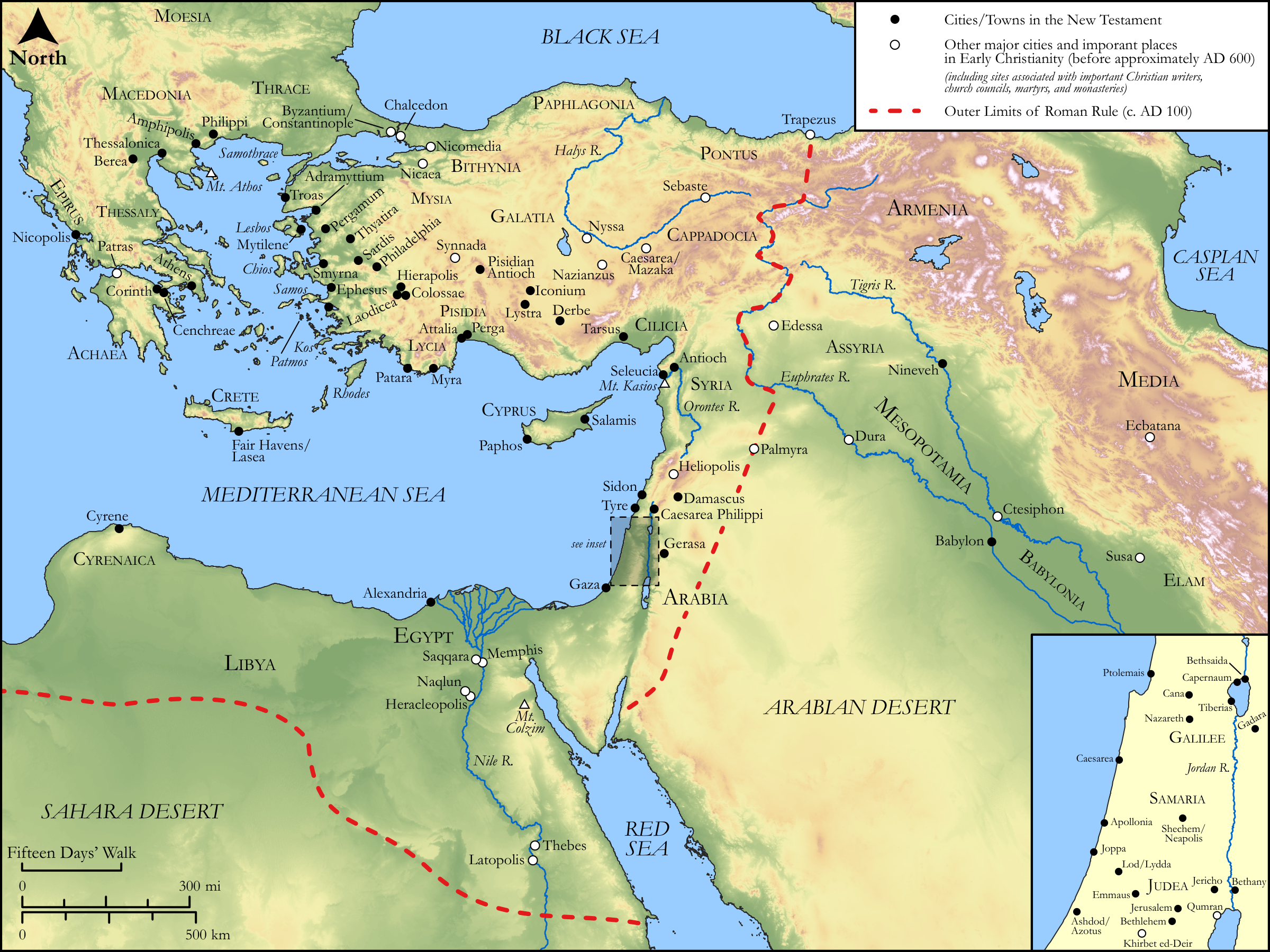

Use the map to find Antioch beside the Orontes in Syria, then nearby Seleucia. On Cyprus, find Salamis on the eastern side and Paphos toward the southwest. On the Asia Minor mainland, locate Perga and nearby Attalia, then Pisidian Antioch, Iconium, Lystra and Derbe inland. Keep the Syrian Antioch separate from Pisidian Antioch. These are ten named cities, with repeated stops described in the passages below; the dots do not supply an itinerary.
The legend has a wider scope than Paul’s travels: filled circles mark New Testament cities and towns, hollow circles include other important places before approximately AD 600, and the red dashed line represents the outer limits of Roman rule around AD 100. Those periods are not dates for this journey, and a city on the map is not automatically a place Paul visited. The inset at the lower right has its own enlarged geography. Read the map for orientation and Acts 13–14 for the outward and return order.
Acts 13:1–4 says the church in Antioch set apart Barnabas and Saul after the Holy Spirit’s direction. John Mark went with them as their assistant. They went down to Seleucia, sailed to Cyprus, and arrived at Salamis. From there they traveled through the island to Paphos, crossed to Perga in Pamphylia, and then went inland to Pisidian Antioch.
| Place or region | Acts reference | What the text records |
|---|---|---|
| Antioch in Syria | Acts 13:1–4; 14:26–28 | The church sends Barnabas and Saul and later receives their report. |
| Seleucia and Salamis | Acts 13:4–5 | The missionaries sail from Seleucia and proclaim the word in Jewish synagogues at Salamis. |
| Paphos | Acts 13:6–12 | They encounter Bar-Jesus (Elymas) and Sergius Paulus, who believes after hearing the teaching. |
| Perga in Pamphylia | Acts 13:13 | John Mark leaves the group and returns to Jerusalem; Paul and Barnabas continue to Pisidian Antioch. |
| Pisidian Antioch | Acts 13:14–52 | Paul speaks in the synagogue, and opposition follows the response of Gentiles and others. |
| Iconium | Acts 14:1–7 | Many Jews and Greeks believe, while a threatened attack leads the missionaries to leave. |
| Lystra | Acts 14:8–20 | A man unable to walk is healed; the crowd calls Barnabas and Paul gods, and Paul is later stoned and dragged out of the city. |
| Derbe | Acts 14:20–21 | Paul and Barnabas preach and teach many people before retracing the route. |
The sequence is more reliable than a line drawn between modern map points. Acts summarizes some travel through regions and gives more detail at places where a speech, conflict, or conversion advances the story.
What Happened in Cyprus?
At Salamis, Barnabas and Saul proclaim the word of God in the synagogues (Acts 13:5). At Paphos they meet a Jewish false prophet named Bar-Jesus, also called Elymas, who opposes them. Paul, filled with the Holy Spirit, announces judgment, and Elymas becomes temporarily blind. Sergius Paulus, the island’s deputy, believes when he sees what happened and is astonished at the teaching of the Lord (Acts 13:6–12).
The passage does not say that every resident of Cyprus converted, nor does it give a travel time between Salamis and Paphos. The island crossing is a named part of the route, while its exact road and duration remain unspecified.
Why Did the Journey Continue Inland?
From Paphos the group sails to Perga. Acts then records John Mark’s departure, without giving his reason (Acts 13:13). Paul and Barnabas continue to Pisidian Antioch, where Paul’s synagogue speech reviews God’s work from the patriarchs through David and presents Jesus’ death and resurrection as the fulfillment proclaimed to Israel (Acts 13:16–41).
The response divides the hearers. Some ask to hear more, many Jews and devout converts follow Paul and Barnabas, and opposition develops from others. The missionaries say they will turn to the Gentiles, and the word spreads through the region (Acts 13:42–49). The account shows a pattern repeated in the next cities: teaching, mixed response, persecution, and movement to another place.
At Iconium, many Jews and Greeks believe, but a planned attack sends the missionaries toward Lystra and Derbe (Acts 14:1–7). In Lystra, Paul heals a man who had never walked. The crowd mistakes the event for a visit from their gods, and the missionaries urgently reject that honor. Later, opponents stone Paul and drag him outside the city, supposing him dead. He rises, enters the city again, and leaves with Barnabas for Derbe (Acts 14:8–20).
How Did Paul and Barnabas Return?
After teaching many people in Derbe, Paul and Barnabas return through Lystra, Iconium, and Pisidian Antioch. They strengthen the disciples, warn that tribulation accompanies entry into God’s kingdom, appoint elders in the congregations, pray with fasting, and commend the believers to the Lord (Acts 14:21–23).
They then pass through Pisidia and Pamphylia, speak in Perga, and go down to Attalia. From there they sail back to Antioch in Syria, the church that had commended them to God’s grace (Acts 14:24–26). Acts closes the journey with a report of what God had done and how he had opened a door of faith to the Gentiles (Acts 14:27–28).
Acts does not identify the trip with the fixed years sometimes assigned to it in modern chronologies. Those years are chronology proposals based on combining several sources. This guide keeps the sequence stated in Acts and leaves the calendar range open.
Common Questions
Did Paul and Barnabas visit Cyprus before Galatia?
Yes. Acts 13 places Salamis and Paphos on Cyprus before the crossing to Perga and the journey to Pisidian Antioch.
Why did John Mark leave at Perga?
Acts 13:13 says he departed from them and returned to Jerusalem. The verse does not state his motive. Acts 15 later records that this disagreement contributed to the separation of Paul and Barnabas, but it does not add a reason for the original departure.
Was Paul killed at Lystra?
Acts 14:19 says the crowd stoned him and dragged him out, supposing him to be dead. The next verse says the disciples stood around him, he rose up, and he entered the city. The narrative therefore reports a severe stoning and recovery, not Paul’s death.
Is a fixed modern date range certain?
No. Acts gives the route and events but no complete modern date range. A proposed date should be labeled as a reconstruction rather than as a statement made by Acts.
Sources and Method
The route and event summaries were checked against Acts 13:1–14:28 in the local KJV corpus and a parallel Bible display. The page uses no former artwork because its provenance and rights were not confirmed. The unchanged Biblica location map is supplied from the Biblica Open Bible Maps repository under CC BY-SA 4.0, as stated in its resource metadata and linked publisher information. It supplies city orientation; place order follows Acts. The map’s wider date ranges and Roman boundary do not date Paul’s journey or prove a visit to every plotted city.
- Bible Gateway: Acts 13–14, KJV — the sending, route, speeches, opposition, and return.
- Digital KJV corpus — verse text used for the local cross-check.
- Biblica Open Bible Maps: NT022 image record — links the reproduced location map.
- Biblica map metadata and publisher information — copyright, CC BY-SA 4.0 permission and required attribution.
Content revised October 29, 2026. Map and source note updated November 4, 2026. Send factual corrections or source questions through our contact page.