Paul's Third Missionary Journey
Paul’s third missionary journey is usually traced from his renewed departure through Galatia and Phrygia in Acts 18:23 to his arrival at Jerusalem in Acts 21:17. Its center is an extended ministry at Ephesus. It then takes him through Macedonia and Greece before a detailed return journey along the Aegean and eastern Mediterranean.
“Third missionary journey” is a convenient way to divide the narrative, rather than a heading supplied by Acts. The useful starting point is the sequence the text actually gives. The table below distinguishes named cities, broader regions and details that would require a chronological reconstruction. A separate return-route reference follows the final stages one by one.
Where Did Paul Travel?
| Stage | Passage | What the text establishes |
|---|---|---|
| Antioch → Galatia and Phrygia | Acts 18:22–23 | After time at Antioch, Paul sets out again and strengthens the disciples through the two regions. Individual cities and the duration of this stage are not supplied. |
| Ephesus | Acts 19:1–20:1 | Paul teaches, a community grows, and opposition culminates in the theater disturbance. The account gives several periods of activity rather than one modern arrival date. |
| Macedonia → Greece | Acts 20:1–3 | He encourages believers through Macedonia, reaches Greece and stays three months. Verse 3 names the region, not Corinth. |
| Back through Macedonia | Acts 20:3–6 | A plot changes his plan to sail for Syria. His return goes through Macedonia; the sailing account resumes with departure from Philippi. |
| Troas → Assos → Mitylene | Acts 20:6–14 | The group reaches Troas in five days and stays seven days. Paul walks to Assos while his companions sail ahead; he rejoins them there. |
| Chios → Samos → Miletus | Acts 20:15–38 | The ship passes opposite Chios and continues through the named stages. Paul calls the Ephesian elders to Miletus instead of returning to Ephesus. |
| Cos → Rhodes → Patara → Tyre | Acts 21:1–6 | At Patara the travelers find a ship bound for Phoenicia. They see Cyprus on the left, pass it, and land at Tyre, where they stay seven days. |
| Ptolemais → Caesarea → Jerusalem | Acts 21:7–17 | They stay one day at Ptolemais, spend additional days with Philip at Caesarea, and then go up to Jerusalem, where believers welcome them. |
Acts 18:22 places the previous return at Antioch, and verse 23 begins a new departure after an unspecified stay. This is Antioch in the Syrian setting of Paul’s earlier travels, not a fresh visit to Pisidian Antioch named in this verse. Galatia and Phrygia are regions here; assigning every church visit to a specific city would add information the passage does not give.
Map of the Return Leg
This map covers the journey’s return from Philippi to Jerusalem, not the earlier travel through Galatia, Phrygia, Ephesus and Greece. Read the detailed return guide alongside its numbered sites. Scroll sideways to explore, or open the full-size diagram.
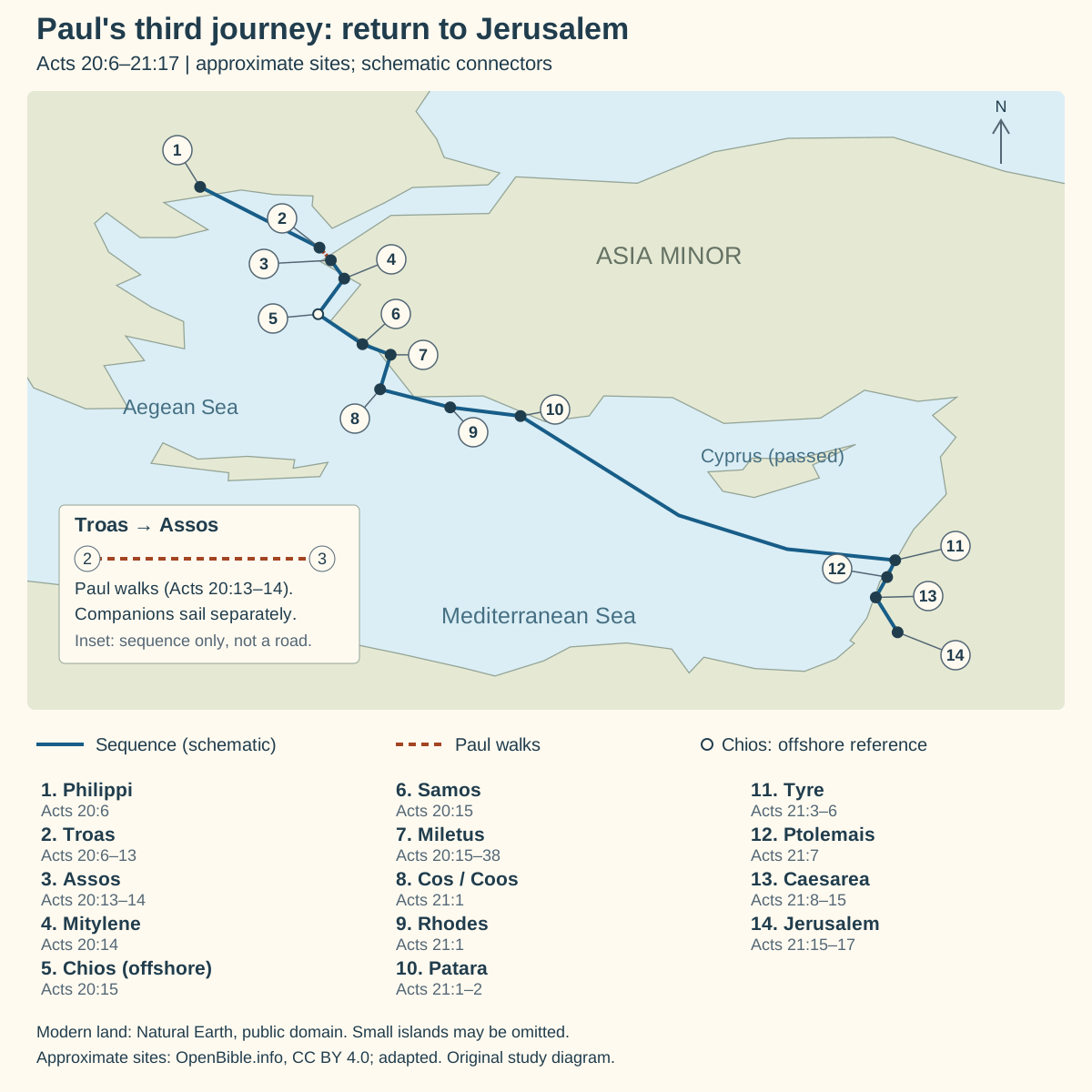
The original study diagram adapts site data from OpenBible.info under CC BY 4.0. Numbering, labels, the inset and sequence lines are new. Land outlines are Natural Earth public-domain data.
What Happened During Paul’s Ministry at Ephesus?
Acts 19 opens with Paul meeting disciples whose knowledge of baptism is associated with John. Paul explains John’s witness to Jesus. They are baptized in Jesus’ name, and after Paul lays hands on them, the Holy Spirit comes upon them (19:1–7). The account calls the men “about twelve”; it does not present a census of exactly twelve or omit the laying on of hands from the sequence.
The ministry then moves from three months of synagogue discussion to daily teaching at the school of Tyrannus, which continues for two years (19:8–10). Acts also describes healings, the failed invocation of Jesus’ name by itinerant exorcists, confession, and the public burning of books associated with magic (19:11–20). These scenes show changes in the community rather than merely a long residence on a travel chart.
The disturbance involves Demetrius and other craftspeople who make silver shrines of Artemis, called Diana in the KJV (19:23–27). Demetrius presents both the trade and the goddess’s honor as threatened by Paul’s teaching. His speech is evidence of the concern he expresses; it is not a set of measured sales figures.
The crowd seizes Gaius and Aristarchus and gathers in the theater. Disciples and some officials urge Paul not to enter. The town clerk eventually dismisses the assembly and points to lawful procedures (19:28–41). Acts 20:1 places Paul’s departure after the disturbance has ended. The narrative does not say that a deity physically drives him from the city or give the departure a precise summer date.
Why Did the Route Turn Back Through Macedonia?
After Ephesus, Paul travels through Macedonia, encourages the believers and reaches Greece. Acts 20:3 gives a three-month stay. When he is about to sail to Syria, a plot leads him to return through Macedonia instead.
This change explains the shape of the return route. It is not a direct voyage from Greece to the Levant. Acts 20:4 names companions from several communities, and verses 5–6 place a group waiting at Troas while the first-person travelers sail from Philippi after the Days of Unleavened Bread.
Corinth is commonly associated with the Greek stay through the wider context of Paul’s letters and travels. Acts 20:3 itself says Greece. A route guide should make that difference visible rather than place the city name inside a verse that does not name it.
What Makes the Return Journey Unusually Detailed?
Acts 20:6–21:17 supplies short travel intervals, ship changes, companions, local meetings and several consecutive coastal stages. At Troas, a first-day gathering continues into the night. Eutychus falls from a window, is taken up dead and is subsequently brought alive, to the group’s comfort (20:7–12). The passage does not attach an April date to the event.
Paul then walks to Assos while his companions travel by ship. They take him aboard and continue to Mitylene (20:13–14). At Miletus he sends for the Ephesian elders. His speech concerns his ministry, coming suffering, the elders’ responsibilities and the need to care for the community (20:17–38). The elders travel to him; this stage should not be drawn as a recorded return visit by Paul to Ephesus.
At Patara the travelers find a ship bound for Phoenicia. Cyprus is seen and passed on the left before the landing at Tyre (21:1–3), so the island is not another recorded landing on this voyage. From Tyre the account continues to Ptolemais, Caesarea and Jerusalem. At Caesarea, Agabus warns of Paul’s bonds; Paul continues despite his companions’ pleas (21:8–17).
For the sequence, transport distinctions and textual note about Trogyllium, use the detailed return-route table.
How Long Did the Journey Take, and Can We Date Every Stage?
Acts supplies several durations and festival references. It does not give a numbered AD year for this journey or enough information to turn every stage into an exact modern date without further assumptions.
| Item | What is stated | How to use it |
|---|---|---|
| Ephesus synagogue teaching | Three months (Acts 19:8). | A stated period within the Ephesian ministry, not a date in the AD calendar. |
| Teaching at Tyrannus’ school | Two years (Acts 19:9–10). | A further stated period. Do not turn it into the duration of every activity or every visit in the city. |
| Paul’s retrospective account | Three years of warning night and day (Acts 20:31). | Read this broader recollection alongside Acts 19; it is not a day-by-day accounting. |
| Greece | Three months (Acts 20:2–3). | An explicit length of stay, but no named winter or numbered year in the verse. |
| Philippi to Troas and stay | Five days traveling, then seven days at Troas (Acts 20:6). | These intervals do not by themselves establish a modern date for Eutychus’ fall. |
| Jerusalem objective | Paul hopes, if possible, to reach Jerusalem by Pentecost (Acts 20:16). | An intended deadline. Acts 21:17 records arrival without stating a calendar date or explicitly confirming arrival on the feast. |
The Ephesian periods should not be mechanically combined into an exact day count and then used to date every other visit. Likewise, a hope to reach Jerusalem by Pentecost does not prove that a particular proposed chronology has identified the correct year or arrival day.
What Can Paul’s Letters Add?
The letters can supplement the travel narrative, provided their plans and recollections are kept distinct from Acts’ itinerary:
- Plans from Ephesus: 1 Corinthians 16:5–9 describes an intended journey through Macedonia, a possible winter stay with the Corinthians and a plan to remain at Ephesus until Pentecost. These are statements of intention, not a completed calendar of movements.
- Titus and Macedonia: 2 Corinthians 2:12–13 describes Paul leaving Troas for Macedonia when he does not find Titus. Second Corinthians 7:5–7 records Titus coming to him in Macedonia. It does not name Philippi as the meeting place. The Troas episode in the letter should not simply be equated with the later seven-day stay in Acts 20:6.
- The Jerusalem collection: Romans 15:25–28 describes a contribution from Macedonia and Achaia for believers in Jerusalem. This helps explain the pastoral and practical purpose of the Jerusalem destination without supplying every ship’s departure date.
- Apollos: Acts 18:24–28 introduces his teaching and Priscilla and Aquila’s help. First Corinthians 16:12 says that he is unwilling to visit Corinth at that time but does not give his motive. His Alexandrian origin alone does not establish a particular rhetorical school or a detailed course of education.
Second Corinthians opens with Paul and Timothy (1:1). References to Titus and unnamed brothers in chapter 8 do not establish that Luke and Titus coauthored the letter. Galatians 2:11–14 describes the Antioch confrontation with Peter, but it does not date it to a particular feast immediately before the third journey. Both examples show why contextual evidence must not become an invented itinerary.
Sources and Method
This guide independently organizes the primary passages, using KJV text for the checks and paraphrasing the events. Route order, duration, plan and inference are treated as different kinds of statements. It does not reconstruct a complete chronology of Paul’s correspondence or certify an ancient sailing track.
- Acts 18:22–21:17: the narrative framework, events and return route.
- 1 Corinthians 16 and 2 Corinthians 2 and 7: travel plans and the meeting with Titus.
- Romans 15:22–29 and Galatians 2:11–14: related purposes and the limits of dating a separate episode.
Read the second-journey guide for the earlier travels, or our New Testament burial guide for what the text does and does not record about Paul’s death. Report corrections through our editorial policy.