Paul's Third Journey: Return Route
The detailed return route in Acts 20:6–21:17 runs from Philippi through the Aegean and eastern Mediterranean to Jerusalem. This reference focuses on that final part of Paul’s third journey. For the earlier travel through Galatia, Ephesus, Macedonia and Greece, read the full journey guide.
The return is especially useful for close study because Acts distinguishes a walk from a voyage, records a ship change, names places passed offshore and supplies several lengths of stay. The tables below preserve those distinctions instead of treating every place-name as an identical visit.
Map of the Return to Jerusalem
Scroll sideways to explore the map, or open the full-size diagram. The numbered key matches the fourteen-stage table below.
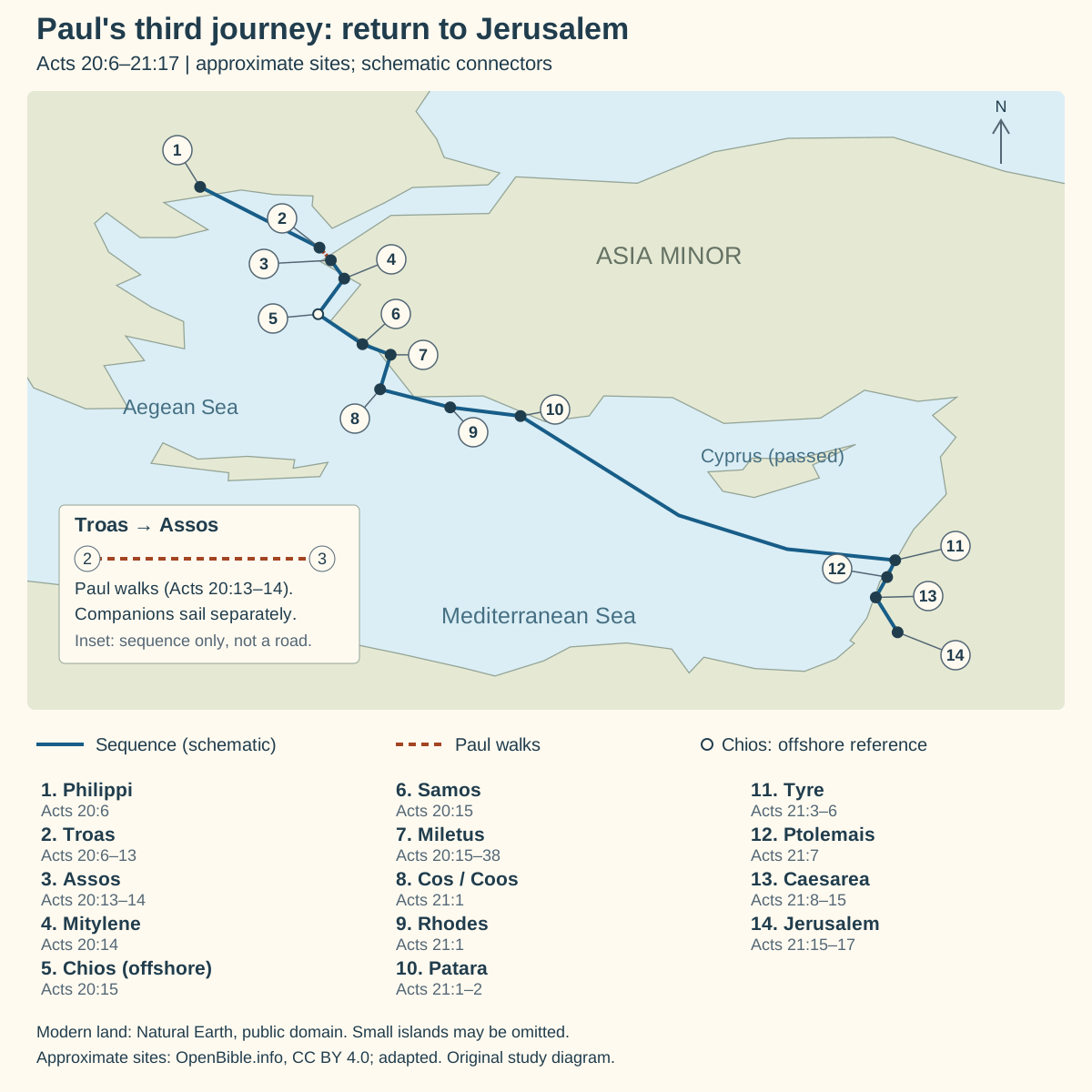
The diagram adapts approximate site data from OpenBible.info under CC BY 4.0, with new numbering, labels, an inset and schematic connectors. Modern land outlines come from Natural Earth, public domain; they do not reconstruct ancient coastlines.
Return Sequence at a Glance
Philippi → Troas → Assos → Mitylene → opposite Chios → Samos → Miletus → Cos → Rhodes → Patara → Tyre → Ptolemais → Caesarea → Jerusalem.
This is an ordered reading aid. It does not specify every road, anchorage or sailing maneuver. Cyprus is seen and passed between Patara and Tyre; it is not another recorded landing. Trogyllium is treated separately below because its inclusion depends on the text and translation being read.
What Happens at Each Named Stage?
Scroll sideways on narrow screens to read all four columns of the table.
| Stage | Passage | Recorded movement or event | Limit or reading caution |
|---|---|---|---|
| 1. Philippi | Acts 20:6 | Departure after the Days of Unleavened Bread. | The narrator says they sail away from Philippi; the verse does not specify every movement between the inland city and a harbor. |
| 2. Troas | Acts 20:6–13 | Arrival in five days, followed by a seven-day stay. | The first-day gathering and Eutychus episode belong to this stay. No modern calendar date is attached. |
| 3. Assos | Acts 20:13–14 | Companions sail ahead; Paul goes on foot and is taken aboard here. | The split travel modes are explicit. The exact walking path and distance are not supplied. |
| 4. Mitylene | Acts 20:14 | The group comes here after taking Paul aboard at Assos. | A named maritime stage, without a stated length of stay. |
| 5. Opposite Chios | Acts 20:15 | The ship comes opposite Chios on the next day. | Passing offshore is not a statement that Paul disembarks on the island. |
| 6. Samos | Acts 20:15 | The next named stage after Chios. | The KJV also includes a stay at Trogyllium. See the translation note below. |
| 7. Miletus | Acts 20:15–38 | Arrival followed by a meeting with elders summoned from Ephesus. | Paul bypasses Ephesus to save time; the elders come to Miletus. The text does not date the meeting to a modern day. |
| 8. Cos / Coos | Acts 21:1 | The travelers launch from Miletus and take a direct course to Cos. | Coos is the KJV spelling. The verse does not describe an extended ministry on the island. |
| 9. Rhodes | Acts 21:1 | The next day’s named stage. | A route stage does not establish the duration or activities of an unreported visit. |
| 10. Patara | Acts 21:1–2 | They find and board a ship sailing to Phoenicia. | The ship change is explicit. Modern routes cannot establish the course taken by that vessel. |
| 11. Tyre | Acts 21:3–6 | After passing Cyprus, they land where the ship unloads cargo and stay with disciples seven days. | Cyprus remains a sighting on this passage, not an additional recorded landing. |
| 12. Ptolemais | Acts 21:7 | Arrival from Tyre and a one-day stay with believers. | The account locates this visit and supplies a duration. |
| 13. Caesarea | Acts 21:8–15 | On the next day they depart and come to Caesarea, staying with Philip for several days. Agabus gives his warning here. | The sentence does not explicitly specify the transport from Ptolemais; do not turn every connector into a sea leg. |
| 14. Jerusalem | Acts 21:15–17 | They go up after the Caesarea stay and are welcomed by the believers. | Arrival is explicit; an exact date or a statement that it occurs on Pentecost is not. |
The fourteen entries are a count of named stages selected for this reference, not fourteen identical landings or a claim to count every place the travelers passed. Chios, for example, is an offshore reference. Miletus includes a substantial meeting; several island names are brief travel notices.
Rhodes: The Island Named in Acts 21:1
Rhodes is the Mediterranean island named between Coos and Patara in the return sequence. The historical lexical entry G4499 locates the island opposite Caria and Lycia and notes a city with the same name. This is a broad geographical identification, not an exact ancient quay or surveyed sailing position. Strong’s proposes a probable connection with the Greek word for a rose; the proposed name origin does not describe an event Paul performs there.
Acts 21:1–3 places Rhodes after the departure from the Ephesian elders and before the ship change at Patara. The destination of this return is Jerusalem. It is distinct from the later prisoner voyage toward Italy in Acts 27. The brief Rhodes notice does not narrate a sermon, a church foundation or the length of a stay on the island.
Why Does Trogyllium Appear in Some Route Lists?
The KJV’s Acts 20:15 includes the words “and tarried at Trogyllium” after Samos. Some modern translations omit that clause. A route list based on the KJV can therefore include an additional named stage that is absent from another reader’s text.
This is a textual difference to disclose, not a reason to suggest that the reader has missed a verse. The fourteen-stage table keeps the shared named sequence and notes the KJV addition in the Samos row. If using a route chart with a class, first identify the translation, then state whether Trogyllium is being included. The clause by itself does not provide modern coordinates or a reconstructed harbor arrangement.
Which Travel Times and Stays Are Actually Given?
| Segment or place | Interval | Reference and limit |
|---|---|---|
| Philippi → Troas | Five days to reach Troas. | Acts 20:6. This is an elapsed journey, not evidence of one uninterrupted voyage without intermediate activity. |
| Troas | Seven days. | Acts 20:6. The narrative then describes the late meeting and departure. |
| Aegean coastal stages | Several next-day transitions. | Acts 20:15; 21:1. These give order and some intervals, not a full departure-and-arrival timetable. |
| Tyre | Seven days. | Acts 21:4–5. |
| Ptolemais | One day. | Acts 21:7. |
| Caesarea | Many days in KJV wording. | Acts 21:10; 21:15 says departure follows those days. No exact number is provided. |
The stated intervals do not form a complete calendar. Time spent gathering the elders at Miletus, finding ships and remaining at Caesarea cannot be assigned an exact number of days merely because some other stages are dated relative to the previous one.
Paul’s hope to reach Jerusalem by Pentecost in Acts 20:16 is conditional on its being possible. The arrival in Acts 21:17 is not accompanied by a named feast day or a numbered year. A proposed modern date requires a separate chronology and its assumptions.
Four Details to Preserve When Drawing or Teaching the Route
Keep Paul’s walk distinct from the companions’ voyage. Acts 20:13–14 divides the group temporarily between Troas and Assos, then reunites them. A single ship line for everyone would erase an explicit detail.
Do not turn the Ephesian elders’ journey into Paul’s. Acts 20:16 says Paul intends to sail past Ephesus. Verse 17 says he sends from Miletus for the elders. His farewell speech occurs at the place where they meet him, not on a narrated second return to Ephesus.
Separate seeing, passing, landing and staying. The account puts the travelers opposite Chios, sees Cyprus on the left and explicitly lands at Tyre. These verbs support different claims. They do not justify marking every island as a place of preaching or an overnight stop.
Distinguish an ancient name from a precise modern point. A geographical illustration may use an approximate location for a town or island. That point does not fix the ancient quay or reveal the path of a vessel. Even a plausible coastline is a general orientation aid unless independently supported for the ancient period.
These distinctions make the return more than a chain of names. They show which details are narrated, which movements are summarized and where a diagram would otherwise introduce certainty that the text does not provide.
Sources and Method
The sequence and intervals were organized directly from Acts, using KJV text for the primary check. This page does not claim to reconstruct every ancient road, harbor or sailing track. Trogyllium’s translation dependence is disclosed rather than presented as a universally printed clause.
- Acts 20:6–16: Philippi, Troas, the walk to Assos and the Aegean stages.
- Acts 20:17–38: the elders summoned to Miletus and Paul’s farewell.
- Acts 21:1–17: the ship change, Cyprus passage, Tyre and the journey to Jerusalem.
- Acts 20:15 in KJV and ESV: compare the printing of the Trogyllium clause.
For the previous journey, see the second-journey route guide. Corrections and source questions can be sent through our editorial policy.