How Old Testament History Moves from Place to Place
The Old Testament's story moves from humanity's beginnings to a family, from that family's migration into Egypt to Israel's life in the land, and from divided kingdoms to exile and return. Following those changes of setting helps explain why Egypt, Canaan, Assyria and Babylon enter the narrative at different moments.
This guide follows that movement through selected passages rather than assigning a calendar year to every event. Its map supplies regional orientation; the sequence below supplies the story connections. For the whole Bible's themes and book groupings, use the broader Bible story overview.
Read the regional map
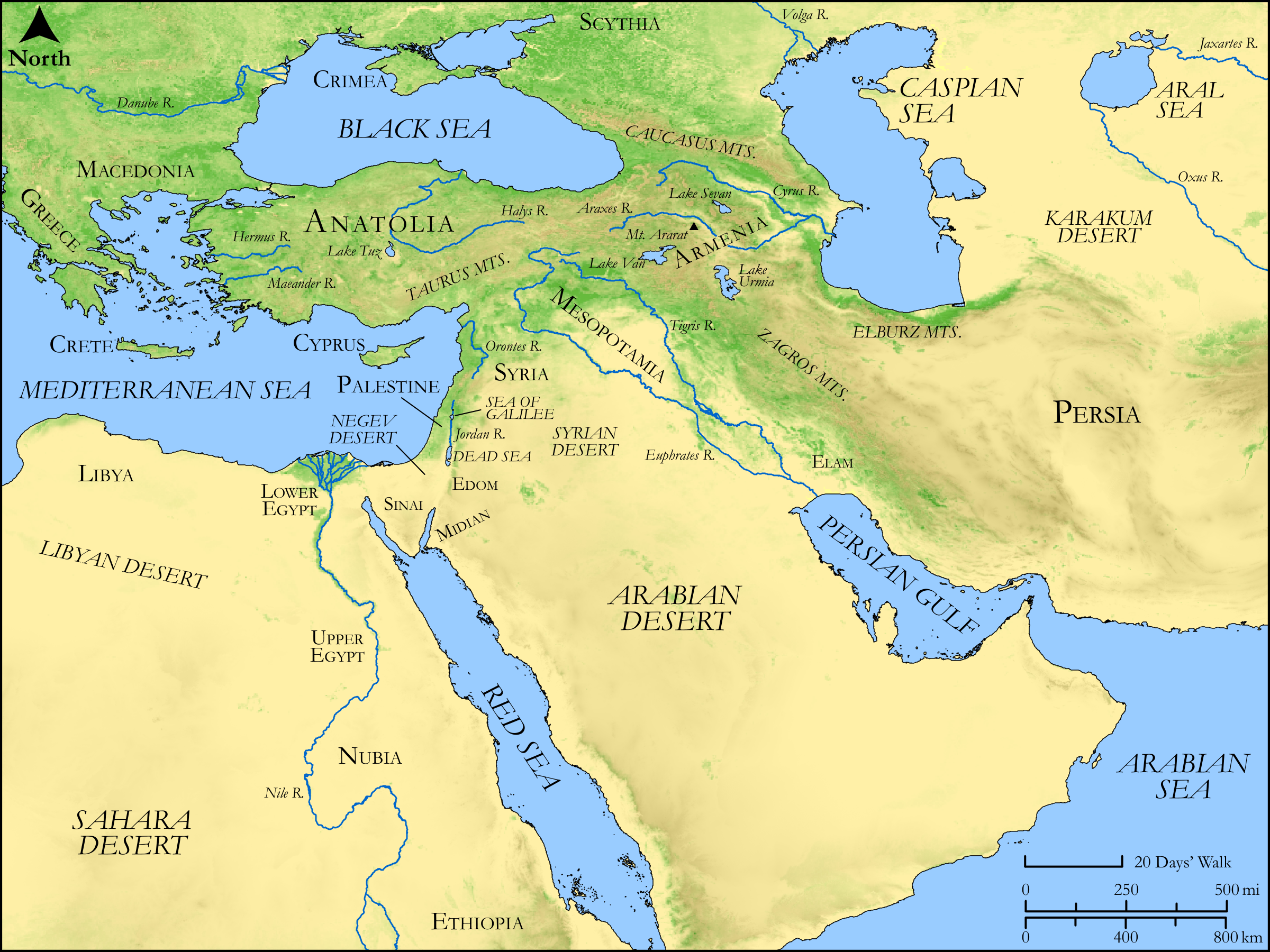

Find the Nile and Lower Egypt on the west, the narrow land east of the Mediterranean, and the Euphrates and Tigris farther east. The map uses the regional label Palestine for the corridor in which many Canaan and Israel narratives take place. That regional label does not describe a single government throughout the Old Testament.
The physical features help relate the settings; they do not trace Abraham's roads, the Exodus crossing or the paths taken by deportees. The marked Mount Ararat is a cartographic feature, not evidence identifying the ark's resting spot. Likewise, the Euphrates label does not establish a modern coordinate for Eden. Read the earliest Genesis scenes before trying to pin every one onto a later regional map.
Nine movements through the story
| Movement | Places and passages | Connection to follow |
|---|---|---|
| 1. Humanity and its responsibilities | Genesis 1:26–31; 2:7–17 | Human life is presented in relation to God, the earth and the garden. These scenes introduce responsibilities before Israel exists as a nation. |
| 2. Judgment, preservation and scattering | Genesis 6:5–8; 8:20–22; 9:1–7; 11:1–9 | The flood account moves toward a renewed human beginning; Babel ends in scattering from Shinar. The text supplies no flood population total. |
| 3. A family called toward Canaan | Ur → Haran → Canaan; Genesis 11:27–32; 12:1–9 | The focus narrows to Abram's household and the promise concerning his descendants. The family reaches Canaan without possessing a kingdom there. |
| 4. Preservation in Egypt, then oppression | Genesis 45:4–11; 46:1–7; Exodus 1:6–14 | Joseph provides a refuge during famine. A later king treats the growing Israelites as a threat. The same country becomes a setting of both rescue and bondage. |
| 5. Departure and covenant | Egypt → wilderness of Sinai; Exodus 12:29–42; 19:1–8 | Release from Egyptian service leads to a people called to covenant responsibility. The mountain scene is more than an intermediate travel stop. |
| 6. Life in the land | Jordan → Gilgal; Joshua 4:19–24; Judges 2:10–19 | Crossing is remembered for future generations. Judges then describes repeated unfaithfulness, oppression and deliverance, rather than uninterrupted security. |
| 7. Monarchy and division | 1 Samuel 8:4–9; 12:13–15; 2 Samuel 5:1–12; 1 Kings 12:12–20 | The request for a king does not remove covenant obligations. David's rule connects Hebron and Jerusalem; later division produces rival kingdoms. |
| 8. Two kingdoms, different conquests | Samaria → Assyria; Jerusalem → Babylon; 2 Kings 17:1–6; 25:1–12 | The northern kingdom's fall and Judah's later catastrophe are separate events. People, cities and imperial powers must not be merged into one exile. |
| 9. Permission to return and rebuilding | Ezra 1:1–4; 6:14–18; Nehemiah 8:1–3 | Cyrus's proclamation permits a return to Jerusalem. Temple completion and public reading of the law show rebuilding as communal and religious work, not merely a reversed migration. |
Why Egypt and the land recur
Compare Jacob's journey with the Exodus before drawing a single arrow labeled Egypt. Genesis 46 presents departure for Egypt under an assurance to Jacob; Exodus 1 describes a later generation subjected to forced labor. Exodus 12 then narrates departure after the final plague. The country name stays the same while the household's circumstances change.
The land promise also connects episodes without making them identical. Abram comes to Canaan with his household in Genesis 12. Joshua 4 describes the people crossing the Jordan much later. Judges 2 asks what happens when a new generation does not know the Lord's works. Arrival, communal memory and continued faithfulness are different parts of the story.
For the named stops in the patriarchal journey, continue with Abraham's early movements. For a place-and-event lookup within the land, use Old Testament event locations. Those detailed guides answer different questions from this regional sequence.
Keep the kingdoms and exiles distinct
Israel can name the broader people in one passage and the northern kingdom in another. Read the ruler and capital alongside the name. In 2 Kings 17 the king is Hoshea, the capital is Samaria and the conquering power is Assyria. In 2 Kings 25 the siege concerns Zedekiah's Jerusalem and Nebuchadnezzar's Babylonian forces.
The latter account includes the burning of the temple, destruction of walls and deportation, while also saying that some poor people remained to cultivate the land. A summary that says everyone vanished erases that distinction. Ezra's return narrative likewise does not mean that every displaced household immediately went home.
Sequence, years and book order
Genesis gives Abram's age as seventy-five when he leaves Haran; it does not attach the label 1885 BC to that departure. A calendar reconstruction requires additional assumptions. The table therefore preserves narrative sequence without endorsing a creation year, an Exodus pharaoh or a complete absolute chronology.
Book order also differs from event order. Chronicles revisits monarchy material rather than placing a second monarchy after the first. Poetry and prophetic books need their own setting read alongside the narrative. Even in this abbreviated sequence, Cyrus's proclamation, the temple's completion under Darius and the assembly in Nehemiah should not become one instantaneous homecoming.
A reading path to try
Read Genesis 12:1–9 and 46:1–7 first. Mark the household's destination and the promise in each. Next read Exodus 19:1–8 and Joshua 4:19–24: ask what the people are expected to remember and do, beyond reaching a new location. Finally compare 2 Kings 25:1–12 with Ezra 1:1–4. Identify what was destroyed, who remained and what the proclamation actually authorizes.
That exercise follows a connected story while leaving the regional map in its proper role. Continue to the New Testament narrative flow for the changing settings of Jesus' ministry and the early church.
Sources and map credit
The table and comparisons paraphrase the following selected KJV readings. The nine movements are an editorial reading aid. The map is a modern physical overview, not independent evidence for the events, their dates or exact routes.
- Genesis origins: selected creation, flood and Babel passages.
- Genesis 11–12, 45–46 and Exodus 1: the household, Egypt and oppression.
- Exodus, Joshua, Judges and Samuel: departure, covenant, land and kingship.
- Monarchy, divided kingdoms, exile and return: selected historical passages.
- Biblica Open Bible Maps: resource and license statement; publisher's information. Copyright and license are retained in the figure credit.
Legacy references from the previous version
This inherited bibliography is retained for the earlier version; these works were not used as sources for the rewritten guide above. The Sources section above identifies its reading and map evidence.
Appointed Times of Jesus the Messiah
Holy Bible, a Faithful Version, page 57
Life and Epistles of Paul
Mysterious Numbers of the Hebrew Kings