Where Did Old Testament Events Take Place?
Joshua's prayer names the sun over Gibeon and the moon in the valley of Aijalon. David's encounter with Goliath belongs to the valley of Elah, between the opposing armies near Socoh and Azekah. These are different geographical settings; neither event should be assigned to a nearby famous city merely because that city has a map label.
This guide links selected Old Testament accounts to their named places. It separates locations visible on the overview from places needing a more detailed map, and distinguishes a text's setting from a claim about an exact archaeological spot.
Use the regional overview
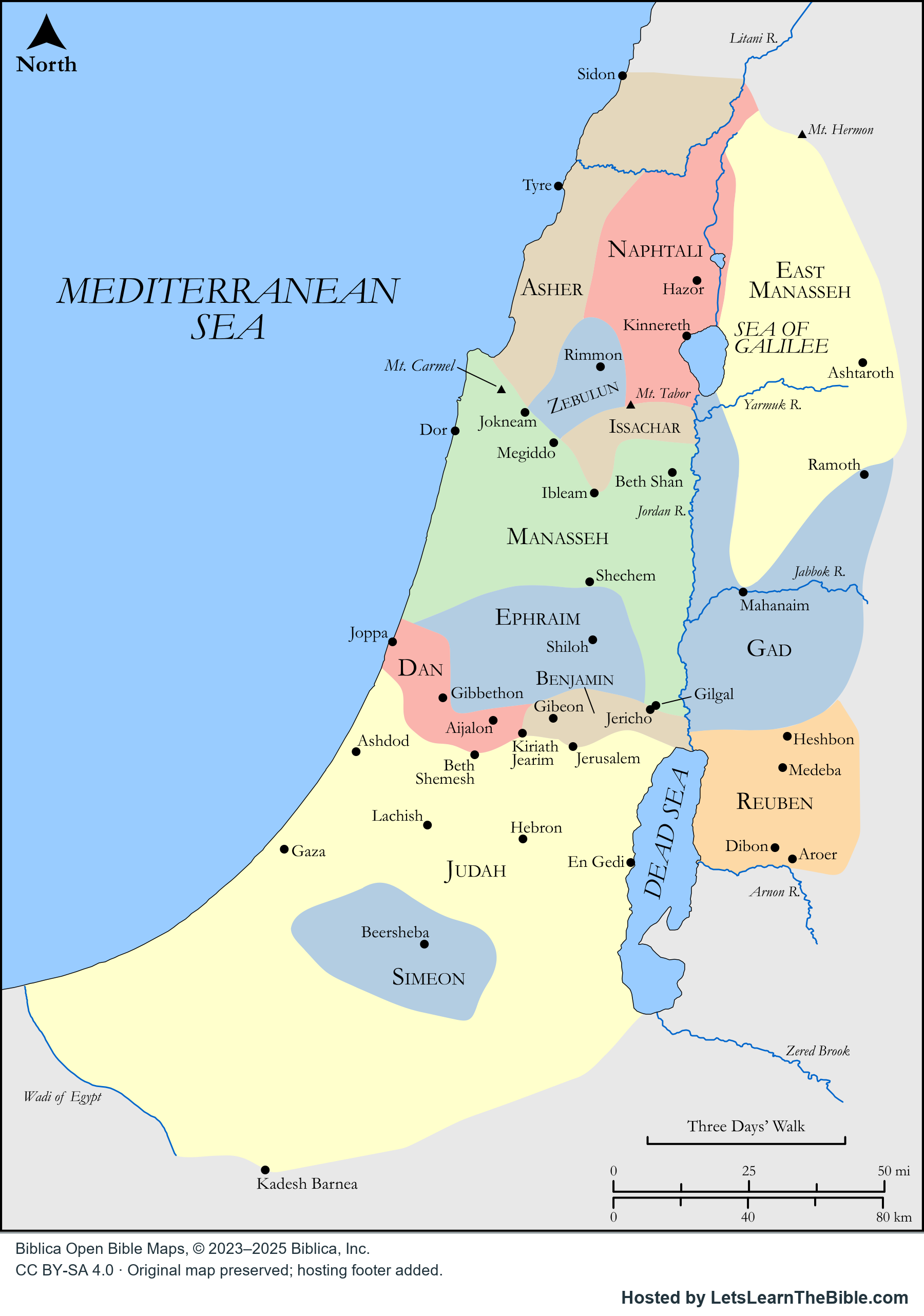

Start with the Mediterranean on the west and the Jordan between the two inland seas. Find Gibeon and Aijalon west of the Jordan, Carmel near the coast and Tabor farther inland in the north. Then compare Gaza in the southwest with Jericho near the Jordan and Jerusalem in the hill country.
The colors summarize tribal-allotment geography associated with Joshua, not the political control of every place in every century. In particular, Gaza's position within an allotment-colored area does not make Samson's Philistine captors Israelites. Patriarchal, judges-era and royal events below are separate episodes that share a region. No new event dots have been added to the map.
Gibeon, Aijalon and Beth-horon
Joshua 10 begins with an alliance attacking Gibeon because its people have made peace with Israel. Joshua marches from Gilgal to help. The fighting and pursuit then connect Gibeon, the way to Beth-horon, Azekah and Makkedah (10:1–11). A summary calling the whole episode an event at Beth-horon collapses a moving battle into a single point.
The prayer in verse 12 names Gibeon for the sun and the valley of Aijalon for the moon. The KJV spells the latter Ajalon; the overview spells it Aijalon. Both Gibeon and Aijalon are labeled here. Beth-horon is part of the pursuit narrative but is not labeled on this particular overview.
Use the two named prayer locations as the first lookup, then return to the chapter for the sequence. The map does not determine where Joshua stood, plot the direction of his gaze or provide a physical explanation of the extraordinary event. Those questions go beyond what its place labels establish.
David and Goliath: the valley of Elah
First Samuel 17:1–3 places the Philistine camp between Socoh and Azekah and Israel's camp by the valley of Elah. The opposing forces occupy slopes with a valley between them. Verses 48–51 narrate David's confrontation with Goliath, while verse 52 describes the pursuit afterward.
The account identifies Goliath as being from Gath. His home is not the battle's location. Verse 54 later says that David brought Goliath's head to Jerusalem; that notice does not move the encounter to Jerusalem either. For the location question, the opening camp description comes before either association.
Elah, Socoh and Azekah are not labeled on this regional overview. Use the passage for those names rather than treating the Jerusalem or Gaza dot as a substitute marker. A detailed local map would be needed to compare proposed battlefield positions; this guide does not select a particular stone, streambed or tourist site as the exact spot.
Events at places marked on the map
| Map label | Account and reference | A distinction to preserve |
|---|---|---|
| Beersheba | Abraham's well dispute and covenant with Abimelech; Genesis 21:22–34. | The naming explanation concerns the oath and well. A city-level dot does not identify the exact well described. |
| Shechem | Abram reaches the place called Sichem in the KJV; Genesis 12:6–7. It is later named among the refuge cities; Joshua 20:7. | A patriarchal stop and a legal designation in Joshua are different episodes. |
| Hebron | Israel's elders anoint David there before his Jerusalem rule; 2 Samuel 5:1–5. Genesis 37:14 also begins Joseph's journey from the valley of Hebron. | A name recurring in different books does not make the episodes simultaneous. |
| Jericho | The procession and fall of the city wall; Joshua 6:12–20. | The account describes one circuit on each of six days and seven circuits on the seventh, rather than the wall falling after six days alone. |
| Gaza | Samson is brought there as a prisoner and dies when the house collapses; Judges 16:21–31. | The city can be located broadly without identifying a surviving building as the house in the account. |
| Mount Tabor | Barak gathers and descends from Tabor in the campaign against Sisera; Judges 4:4–16. | The river Kishon and the subsequent pursuit also belong to the action. The mountain is not the entire battlefield. |
| Mount Carmel | Elijah's confrontation with the prophets of Baal; 1 Kings 18:17–24, 36–40. | The narrative moves from the gathering on Carmel to action at the Kishon. One mountain marker cannot replace that sequence. |
| Jerusalem | David captures the stronghold of Zion; 2 Samuel 5:6–9. Solomon later begins the temple on Mount Moriah; 2 Chronicles 3:1–2. | These are separate reigns and projects. See the Moriah comparison below before attaching Genesis 22 to a precise point. |
Places not marked on this overview
A regional map necessarily omits names. The following accounts can still be looked up in Scripture; omission from this map is not a claim that the named place was unimportant or did not exist.
| Place | What the passage says | Reading limit |
|---|---|---|
| Bethel / Luz | Jacob dreams during his journey toward Haran and names the place Bethel; Genesis 28:10–22. | The named setting is not a map of his exact overnight position. |
| Dothan | Joseph finds his brothers after going first to Shechem; the sale account follows; Genesis 37:12–28. | Keep the earlier destination and the place where he finds them separate. |
| Peniel / Penuel | Jacob names the place after the wrestling encounter near the Jabbok crossing; Genesis 32:22–32. | The river is labeled on the overview, but Peniel is not. The text's theological meaning does not supply an exact modern pin. |
| Adullam | David escapes to its cave and gathers followers; 1 Samuel 22:1–5. | The passage names a cave but does not identify a present visitor attraction. |
| Mount Nebo / Pisgah | Moses sees the land and dies in Moab; Deuteronomy 34:1–8. | The passage explicitly leaves his burial place unknown to its readers. |
| Mount Gilboa | Saul and his sons die during the Philistine battle; 1 Samuel 31:1–6. | The chapter describes the circumstances; it does not name a precise spot for each death. |
| Shunem | A woman provides a room for Elisha and receives a promise of a son; 2 Kings 4:8–17. | The town setting does not identify the house archaeologically. |
| Brook Cherith | Elijah hides by the brook described in relation to the Jordan; 1 Kings 17:1–7. | The account does not give enough cartographic detail here to identify an exact ravine. |
| Haran and Egypt | Terah's household dwells in Haran; Jacob's household later travels to Egypt; Genesis 11:27–32; 46:1–7. | They lie outside the detail of this Canaan overview. Genesis does not say the family founded Haran and named it for Abram's brother. |
| Sodom | Genesis 19:23–29 describes its destruction after Lot reaches Zoar. | No proposed excavation site is adopted as a settled identification by this map or guide. |
Jerusalem, Salem and Moriah
Genesis 14:17–20 calls Melchizedek king of Salem and describes his blessing of Abram. Genesis 22 names the land of Moriah and a mountain to be shown to Abraham; it then describes the intervention that prevents Isaac's sacrifice. Neither passage uses the wording Jerusalem's temple mount to specify an exact location.
Second Chronicles 3:1 does explicitly place Solomon's temple at Jerusalem on Mount Moriah. That later notice is an important comparison, but it should be cited as the comparison being made. It does not turn the overview's city dot into the precise site of every earlier encounter, nor does Genesis 22 report Isaac being killed.
To study another event geographically, first write down the place actually named in its passage. Then check whether a place name describes an origin, a destination, a region, a camp or a later memorial. Finally ask whether the map really marks that location at an appropriate scale. This avoids moving an event to the best-known city in the story.
Use the Old Testament narrative flow for sequence across periods, and Abraham's journey guide for household movements. This page's lookup serves the separate question of where particular accounts place their action.
Sources and map credit
These entries paraphrase the selected KJV passages below. Biblical place names and the map publisher's modern reconstruction have different roles; the figure is not a new site survey or independent proof that an event occurred at a proposed modern location.
- Joshua 10, 1 Samuel 17 and Judges 4: prayer locations, Elah and Tabor.
- Genesis: Beersheba, Bethel, Peniel and Joseph's movement to Dothan.
- Gaza, Carmel, Nebo, Adullam, Shunem and Gilboa: selected passages.
- Salem, Moriah, Jericho, refuge cities, Cherith and Sodom: selected passages.
- Genesis 11–12 and 45–46, with Exodus 1: Haran, Shechem and Egypt; 2 Samuel 5 and related historical readings: Hebron and Jerusalem.
- Biblica Open Bible Maps OT053, Historical: Canaan Overview: map title and Joshua 13–21 association; resource license statement; publisher's information. The existing hosting footer is disclosed above; no cartographic changes were made for this guide.