New Testament History Across Its Changing Settings
To follow New Testament history, begin with Jesus and then trace how the witness to him moves outward from Jerusalem. Paul's journeys are part of that story, alongside Peter, Philip, Barnabas and the communities receiving the message. Revelation addresses churches within this world while looking beyond it to renewed creation.
This guide connects the story's changing centers. It keeps narrated events, intentions expressed in letters and later traditions distinguishable. It does not turn the order of books into a dated travel schedule or supply an unrecorded verdict for Paul's imperial appeal.
Locate the eastern settings
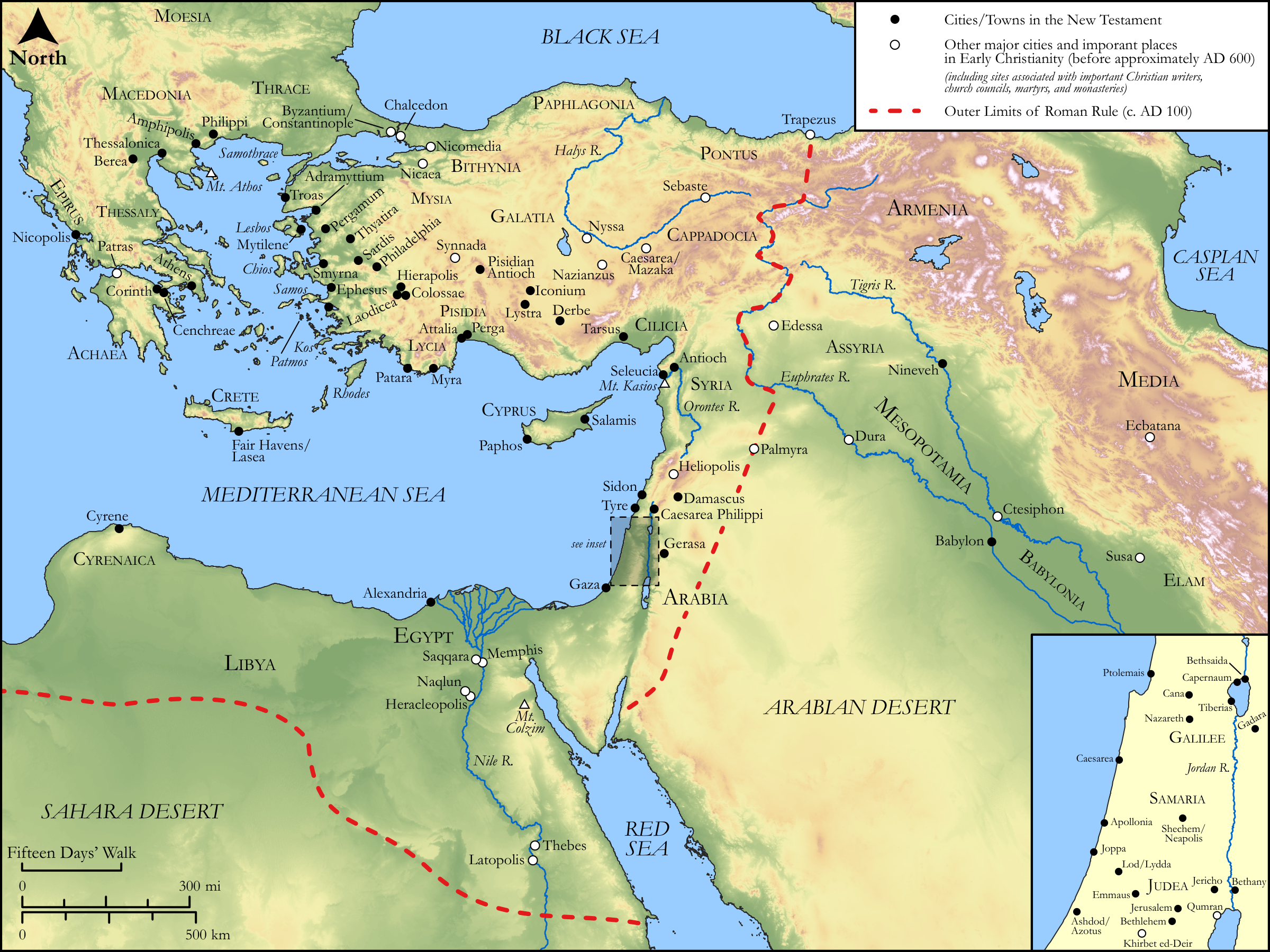

Use the lower-right inset for Jerusalem and the Galilean settings of Jesus' ministry; use the main panel for Syrian Antioch, Cyprus, Ephesus, Macedonia and Achaia. Patmos is marked off the coast of Asia Minor. Rome lies beyond this eastern map and is not supplied with a substitute point.
Read the legend before using its dots. Filled circles identify New Testament cities and towns. Hollow circles include other places important in early Christianity before approximately AD 600; they are not all New Testament stops. The red dashed boundary represents Roman rule around AD 100, not a boundary drawn for every scene in Acts. Neither the dots nor that boundary depicts a missionary itinerary.
From the Gospels to witness
Luke connects Nazareth and Bethlehem in the birth narrative, names John the Baptist's Jordan setting and describes Jesus teaching in Galilee. Its later narrative turns toward Jerusalem. The crucifixion and resurrection are central to the message that Luke 24 commissions the disciples to proclaim, beginning at Jerusalem.
Acts opens by referring back to the earlier account of Jesus' deeds and teaching. It describes appearances over forty days and gives a geographical program for witness: Jerusalem, Judea, Samaria and beyond (Acts 1:1–8). That transition explains why the church's later movement belongs with the Gospel account instead of beginning a separate story about Paul.
The four Gospels should still be read as distinct accounts. This guide uses Luke and Acts as a connected reading path; it does not claim that every Gospel scene can be placed between two entries on a single harmonized calendar.
Follow the changing centers
| Setting | Narrative transition | What to notice |
|---|---|---|
| Galilee and Jerusalem | Luke 4:14–21; 9:51–56; 23–24 | Teaching in Galilee leads toward the Jerusalem events and the commission to proclaim repentance and forgiveness. A location change serves the Gospel's argument, not just its travel log. |
| Jerusalem at Pentecost | Acts 1:1–11; 2:1–13 | The witnesses await the Spirit. The gathering hears speech in its own languages; the listed homelands describe hearers, not journeys already made by the apostles. |
| Judea and Samaria | Acts 8:1–8 | Persecution scatters believers, and Philip preaches in Samaria. Expansion includes people beyond the original group of apostles. |
| Gentile hearers and Syrian Antioch | Acts 10:44–48; 11:19–26 | Peter witnesses the Spirit's reception among Gentiles. Antioch becomes a teaching community in which Barnabas and Saul work together for a year. |
| Cyprus and Asia Minor | Acts 13:1–13; 15:1–12 | Antioch sends Barnabas and Saul through Seleucia to Cyprus. Gentile response also raises a dispute that takes representatives back to Jerusalem. |
| Macedonia, Achaia and Ephesus | Acts 16:6–15; 18:1–4, 9–11; 19:1–10 | The Macedonian vision redirects travel. Long periods of teaching belong alongside crossings and arrivals; eighteen months and two years are not moments on a continuous road. |
| Jerusalem and Rome | Acts 21:27–36; 25:8–12; 28:16–31 | Paul is seized in Jerusalem, appeals to Caesar and later receives hearers in Rome under guard. The book ends with proclamation continuing, not an imperial verdict. |
| Patmos and the churches of Asia | Revelation 1:1–11; 21:1–5; 22:1–7 | John's visions are addressed to actual churches. Their final horizon is life with God and renewed creation, not one more reported stage in Paul's travels. |
The movement is not a simple replacement of one city by another. Jerusalem still matters when Gentile communities grow: Acts 15 brings a dispute there, and Romans 15 describes a contribution from Macedonia and Achaia for Jerusalem's poor. Outward mission and continuing relationships coexist.
For individual stops and durations, use the chapter-by-chapter Acts guide. For the narrative geography of a particular journey, see Paul's second journey. This overview instead asks how the successive settings connect the larger account.
Read the letters alongside the story
A letter's position in the New Testament is not proof that it was written after the preceding book's events. Letters can describe a present situation, remember earlier activity and propose future travel in the same paragraph. Each kind of statement carries different information for a timeline.
Romans 15:22–29 is a useful test. Paul describes his present intention to minister in Jerusalem and his hope of going through Rome toward Spain. The passage establishes the plan; it does not establish its fulfillment. Acts 28 separately narrates his presence in Rome. Joining those passages does not create a narrated Spanish mission.
Second Timothy 4:6–8 presents Paul anticipating his departure and looking back on his course. It does not name a day of execution or describe the execution itself. A history guide should identify those limits before turning the passage into an exact final-life schedule. Likewise, neither the sequence of Acts nor this map proves a particular authorship or composition date for every letter.
Rome, Patmos and the limits of the account
Acts 28 ends with two years in Paul's hired lodging, where he receives visitors and teaches. It supplies no account of an acquittal, a fifth missionary journey or his death. Readers wanting to assess later travel should compare the evidence separately rather than add those events as though they were the next verses of Acts.
Revelation identifies its witness as John and names Patmos, the word of God and the testimony of Jesus (1:9). That verse does not name the emperor, date John's release or report his later death. Nor does it say that he returned to Ephesus and finalized the entire New Testament collection. Those are separate historical claims requiring their own sources.
Even John 21:23 distinguishes a saying about the beloved disciple from the rumor that he would never die. It is not a death notice. This guide therefore stops short of attaching a confident calendar year to John's death. The New Testament's final canonical vision and the last dated event in an apostle's biography are different questions.
Use the guide in a reading session
Start with Luke 24:44–53 and Acts 1:1–11. Mark what the witnesses are told to do and where they are to begin. Compare Acts 8:1–8 with Acts 13:1–4: one outward movement follows persecution, the other a community's deliberate sending. Finally set Romans 15:24–29 beside Acts 28:16–31 and label each travel statement as a plan or a narrated arrival.
Return to the Old Testament history flow for the earlier movements through Egypt, the land and exile. For the political settings behind local names, consult Roman provinces in New Testament passages.
Sources and map limits
The narrative comparisons follow the selected KJV readings below. They use literary sequence and explicit intervals without assigning a uniform AD calendar. The modern map locates selected places; its later historical layers do not prove the events or date each account.
- Luke: birth, ministry, Jerusalem and resurrection commission.
- Acts: Jerusalem, scattering, Gentile hearers and Antioch's sending.
- Acts: the Jerusalem dispute, mission settings and Paul's appeal.
- Acts 28, Romans 15, 2 Timothy 4, Revelation and John 21: compare different kinds of endings.
- Luke 23:44–49 and Acts 18:1–4; 19:1–7: Jesus' death and the Corinth and Ephesus introductions.
- Biblica Open Bible Maps NT022: resource license statement and publisher's information. The original image and legend are preserved.
Legacy references from the previous version
This inherited bibliography is retained for the earlier version; these works were not used as sources for the rewritten guide above. The Sources section above identifies its reading and map evidence.
Appointed Times of Jesus the Messiah
Holy Bible, a Faithful Version, page 57
Life and Epistles of Paul
Mysterious Numbers of the Hebrew Kings