Miletus and the Apostle Paul
Miletus is the port where Paul calls the Ephesian elders to meet him during the voyage toward Jerusalem. Acts 20 distinguishes his arrival at Miletus from their journey out of Ephesus. The city's changing shoreline and the several building phases of its theatre help readers place that meeting without treating the ruins as a photograph of the first century. Read the journey in Acts 20:13–38 alongside the excavation project's account of the Milesian landscape.
A Port Beside a Changing Gulf
Ancient Miletus stood on a peninsula projecting into the Latmian Gulf, also called the Gulf of Miletus. The position connected the city to the Aegean Sea and, through the river now called the Büyük Menderes, to inland Anatolia. The University of Hamburg's Miletus Excavation project explains that this combination of a defensible site and sea and river connections helped the city become a significant commercial port. The older name Meander refers to that river. Source: The Milesian landscape.
The modern landscape needs a different map from the ancient one. According to the excavation project, silting of the gulf and harbours began in the third and fourth centuries BCE; by the Middle Ages the city no longer had direct access to the sea. Lake Bafa survives as a remnant of the former gulf. This long process explains why fields around the ruins should not be read as Paul's shoreline. It does not, by itself, measure the port's economic condition in the particular year of his visit. Source: landscape and silting.
The City Before and During Roman Rule
Miletus was already an important Aegean city in the Archaic period, centuries before Paul. The excavation project's city history describes its maritime wealth, numerous colonial foundations and reputation as the capital of Ionia. These are features of its earlier prominence, rather than a claim that it remained the dominant city throughout every later period. The same account describes a functioning economy and substantial construction under Rome. A story of continuous decline from early silting to Paul's arrival would flatten that history.
Why the Elders Come to Miletus
In Acts 20:13–17, Paul travels overland to Assos while his companions go by ship. After taking him aboard, they continue to Mitylene, pass opposite Chios and proceed through the stages named in verse 15 to Miletus. The KJV includes a stay at Trogyllium in that verse. Verse 16 supplies Paul's stated reason for sailing past Ephesus: he wants to avoid spending time in Asia and hopes to reach Jerusalem by Pentecost. The account gives a travel intention, not a modern calendar date for the meeting.
From Miletus Paul sends to Ephesus for the church's elders. They come to him; the narrative does not turn this into another visit by Paul to Ephesus. It also does not name the theatre as the meeting place, describe the elders' route or say how long their journey takes. Keep the city, the audience and the precise location distinct when using a map or photograph. Acts 20:16–18 establishes the first two and leaves the third unspecified.
The address recalls Paul's humble service and public and household teaching, warns the elders to guard themselves and the flock, and calls them to support the weak. The approaching departure gives urgency to the elders’ responsibility for the people in their care. For its structure, warnings and pastoral implications, continue with Paul's Warning to the Church. The primary passage is Acts 20:18–35.
Departure and the Limits of a Visit Count
The farewell ends with kneeling prayer, tears and accompaniment to the ship. Acts 20:36–21:6 then carries the voyage to Coos, Rhodes and Patara, and onward to Tyre. The explicitly described prayer on the shore with disciples, wives and children belongs to Tyre. A coastal city and a ship do not justify moving that later scene into the Miletus account.
Acts records this visit, but it does not call it Paul's first and only time in Miletus. 2 Timothy 4:20 separately says that Paul left Trophimus sick at Miletum, the KJV form of the name. That short statement does not supply a date or a complete itinerary connecting it with Acts 20. It is therefore better to identify the narrated visit than to impose an exact total on the evidence.
Reading the Theatre in Phases
The theatre is a useful landmark because its visible form contains several periods. The excavation project's theatre study places the original building around the fourth century BCE and explains how it used a hollow on the slope of Kaletepe. It describes a new stage facade under Nero, followed by major rebuilding in the second half of the first century CE. Much later, Byzantine inhabitants adapted the theatre as a fortified settlement and reused material from the upper seating. These successive building phases mean that surviving walls and seating cannot all be treated as contemporary with Paul.
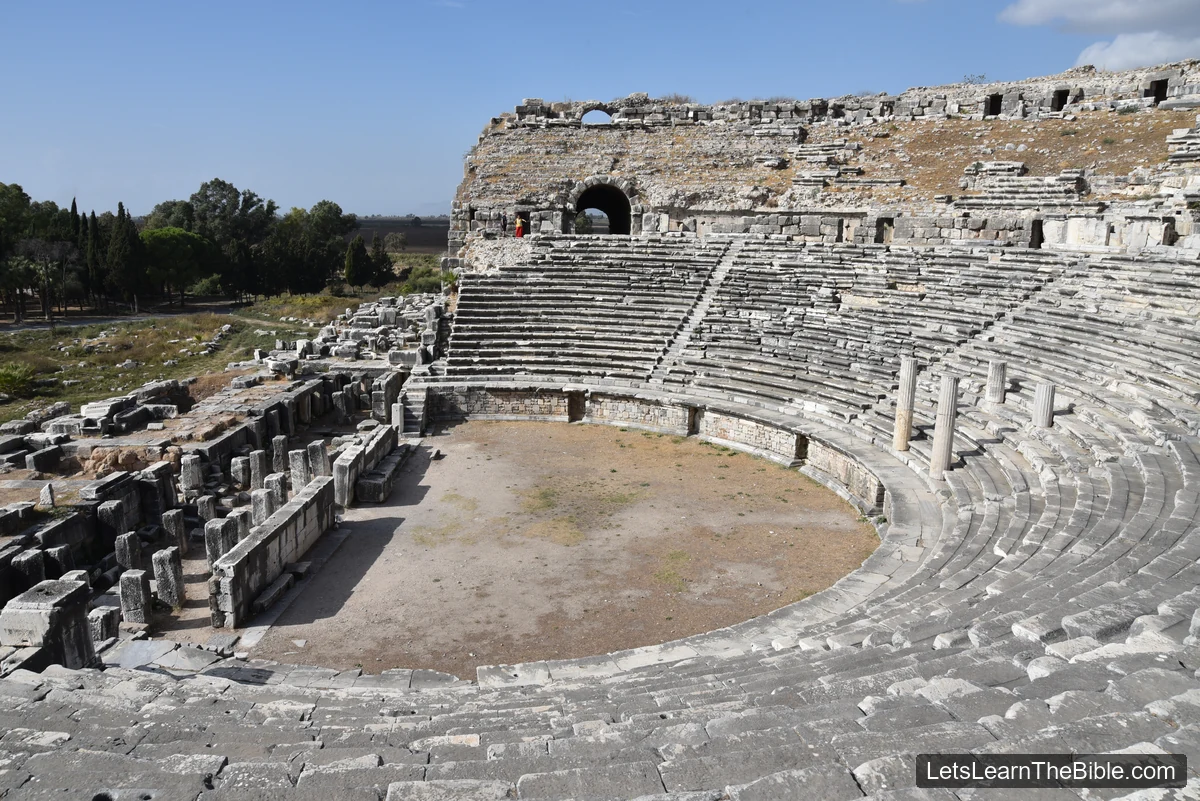
Photograph: “The Theatre, built into a hill in the Hellenistic period to seat 5,300 spectators and significantly enlarged during the Roman period to extend its seating capacity to ca. 15,000, Miletus, Ionia, Turkey” by Carole Raddato (Following Hadrian). Original title and photo source on Flickr; acquired from the photographer’s own site. CC BY-SA 2.0. Resized from 6016×4016 to 1200×801 and converted to WebP; a LetsLearnTheBible.com site watermark was added in the lower-right corner. No crop or other retouching. This version remains under CC BY-SA 2.0. The watermark identifies the publishing site; photographic credit belongs to Carole Raddato.
In this photograph, follow the curved tiers of seats around the orchestra area and locate the arched passage in the upper seating. Then return to the shore and route discussion: the ruin illustrates the city's architectural history, while Acts 20:17–38 supplies the meeting. The photograph is not evidence that Paul spoke inside this building. The excavation project's account supplies the building phases.
Sources and a Reading Exercise
Read Acts 20:13–17 first and mark who moves toward whom. Follow the departure through Acts 21:1–6, keeping Miletus and Tyre separate. Finally, compare the theatre's building phases with the route: geographical setting, architectural survival and the recorded meeting answer different questions.
- Acts 20:13–21:6, KJV; 2 Timothy 4:20, KJV: journey, summons, farewell and the separate Miletum reference.
- University of Hamburg, Miletus Excavation: Mark Ohlrogge, The Milesian landscape and History of the city; Fabian Sliwka, Theater and theater fortress. These excavation accounts support the geography and architectural chronology.