Four Cities, Different Evidence for Believers
Acts names disciples at Damascus and Tyre, brethren at Ptolemais, and friends who received Paul at Sidon. These notices belong to different episodes. They show a network of people who welcomed or helped believers; they do not supply four church-founding dates or identify four founders.
Where Are the Four Places?
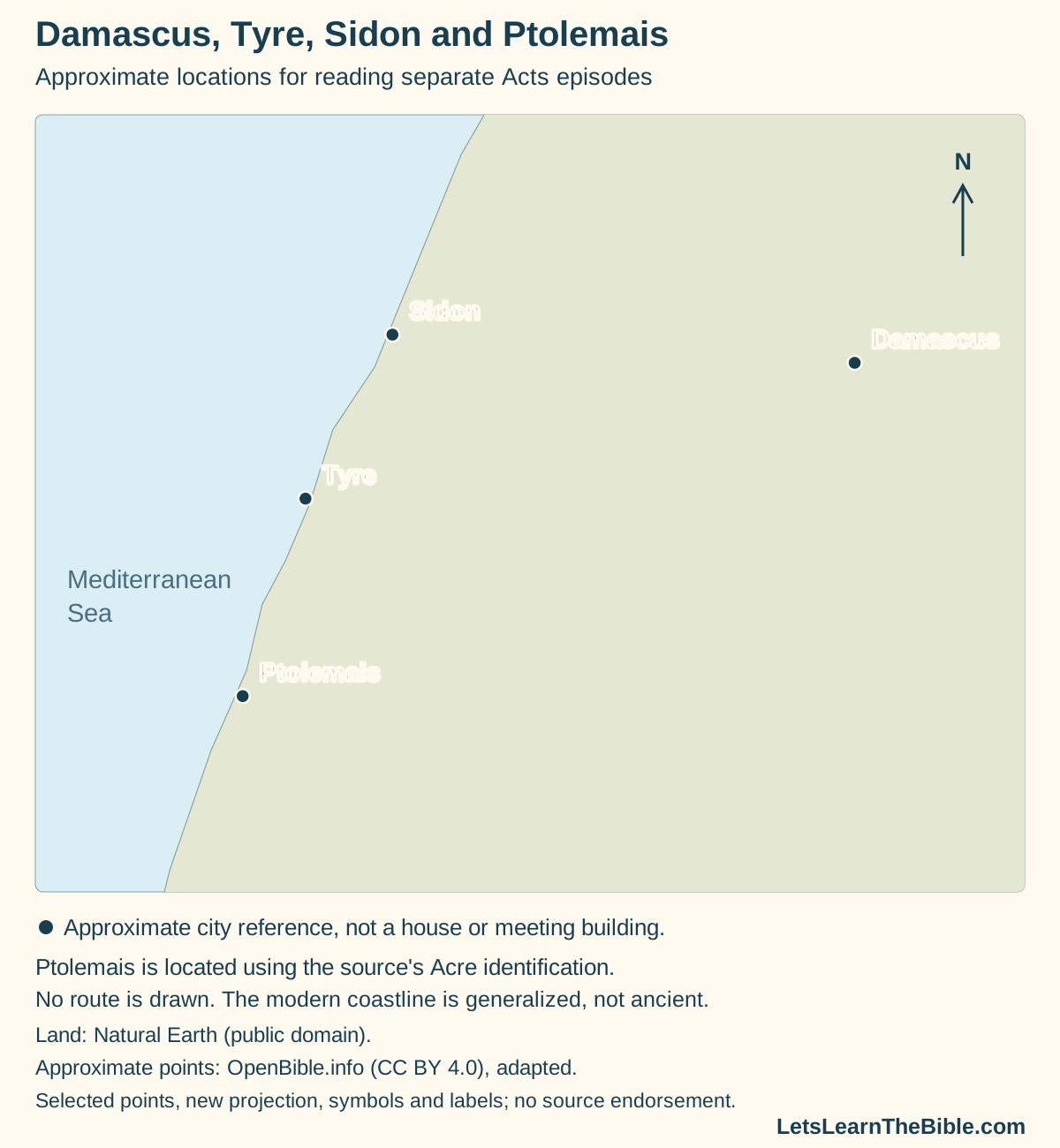
Sidon lies north of Tyre, and Ptolemais south of Tyre; Damascus is inland to their east. This map shows those relative positions against a generalized modern coastline. It does not reconstruct an ancient shoreline, draw national borders, measure a journey or establish the route Jesus or Paul took. The source identifies Ptolemais with Acre; that name helps locate the point without turning Acts 21:7 into a description of a modern city.
What Does Each Notice Actually Establish?
| Place and passage | People or action named | Limit of this evidence |
|---|---|---|
| Damascus · Acts 9:1–25 | Ananias is already a disciple; other disciples receive Saul and later help him escape. | Saul encounters an existing community. The narrative does not name its first evangelist or date its beginning. |
| Tyre · Acts 21:3–6 | The travelers find disciples, stay seven days and leave after a shore-side prayer with families. | A community and a warning are explicit; its founding and the names of its leaders are not. |
| Ptolemais · Acts 21:7–8 | They greet the brethren, stay one day, then continue to Caesarea the next day. | One day describes this visit, not how long the community had existed. |
| Sidon · Acts 27:1–3 | Julius permits the prisoner Paul to visit his friends and receive their care. | The verse says friends; it does not narrate a church service, conversion campaign or founding. |
Were There Disciples in Damascus before Saul Arrived?
Yes. Saul seeks letters authorizing him to bring followers of the Way, women as well as men, bound to Jerusalem (Acts 9:1–2). Ananias is introduced as a disciple in Damascus in verse 10. After Saul regains his sight and is baptized, he stays with the disciples and proclaims Jesus in the synagogues (9:17–22). The city therefore cannot be presented as a community Saul created simply by arriving there.
Acts 9:23–25 places the plot against Saul after “many days” and describes the basket escape. Galatians 1:15–18 adds Arabia, a return to Damascus and a visit to Jerusalem after three years. It does not say that those three years were spent entirely in Arabia, or describe a daily course of private instruction there. Second Corinthians 11:32–33 mentions the governor under Aretas and an escape through a window in the wall. These accounts contribute different details; none of these passages supplies the calendar year 33 AD for the initial journey.
The name Saul is used here because Acts uses it in this episode. This is not a story in which baptism is said to rename him Paul. Nor should hostility from the particular people plotting against him be converted into an accusation against every Jewish resident: Ananias himself is described in Acts 22:12 as devout according to the law and well regarded by the Jews living there.
What Happened during the Seven Days at Tyre?
In Acts 21:3 the ship lands at Tyre to unload cargo. The travelers find disciples and stay seven days. Verse 4 explicitly says that they tell Paul through the Spirit not to go to Jerusalem. That wording should not disappear behind a smooth travel summary. Verses 5–6 also describe the warm farewell: the disciples, their wives and children accompany the travelers out of the city, kneel on the shore and pray.
Later in the chapter, at Caesarea, Agabus portrays Paul’s coming imprisonment; the companions plead with Paul not to go, and he expresses his readiness to suffer (21:10–14). Readers differ over how to relate the Spirit’s warning, the disciples’ counsel and Paul’s decision. What this passage clearly gives us is both warning and affection, rather than an uncomplicated claim that every voice approved the journey. See the study of Paul’s final Jerusalem visit for the larger episode.
Does a One-Day Stay Tell Us Who Started the Community?
No. Acts 21:7 says that the travelers complete the voyage from Tyre, greet the brethren at Ptolemais and remain one day. Verse 8 then takes them to Caesarea, where they stay with Philip the evangelist, one of the seven. The brevity of the Ptolemais notice is evidence about this stop. It does not identify a founder, date the first preaching there, or transfer Philip’s Caesarea residence to Ptolemais.
Keeping this small entry distinct is useful: the seven days at Tyre, one day at Ptolemais and later stay at Caesarea belong to successive stages. They are not interchangeable descriptions of a single coastal congregation.
What Was Paul Allowed to Do at Sidon?
Acts 27 begins with prisoners handed over to Julius for a voyage toward Italy. At Sidon the next day, Julius treats Paul kindly and allows him to visit his friends to be cared for (27:1–3). Paul is traveling toward Rome, not returning from it. The permission concerns a prisoner receiving hospitality; Luke does not use this short notice to describe the establishment of the Sidon church.
The Gospel accounts have an earlier and different purpose. Matthew 15:21–28 and Mark 7:24–31 place the encounter with a woman and the healing of her daughter in the Tyre/Sidon region. Luke 6:17–19 identifies people from that coast among the crowd who come to hear Jesus. A visitor’s place of origin or an account of healing does not, by itself, establish the date of a later local congregation.
How Can We Avoid Combining Different Journeys?
Read Acts 9 for Saul’s encounter and early preaching at Damascus; Acts 21 for the Tyre–Ptolemais–Caesarea sequence on the way to Jerusalem; and Acts 27 for the later voyage toward Italy. The points on the map belong to these separate accounts. Connecting all four with a single line would imply an itinerary this page’s passages do not describe.
For the wider network, use the New Testament churches evidence guide. A named congregation, a group of disciples, travelers’ friends and an individual’s birthplace provide different kinds of information. None should silently replace another.
Sources and Map Credits
- Primary texts, KJV: Acts 9:1–25; 21:1–16; 22:1–16; 26:9–20; 27:1–3; Galatians 1:11–24; 2 Corinthians 11:30–33. Gospel comparison: Matthew 15:21–28; Mark 7:24–31; Luke 6:17–19. Explanations above are this site’s synthesis; references are not quotations from an inherited commentary.
- Approximate city points: OpenBible.info Bible Geocoding, Acts KML, used under CC BY 4.0. Four point records selected; projection, symbols and labels changed. The Sidon record is an approximate city reference, not a claim that a particular excavation was Paul’s destination. The dataset warns that locations can contain errors; it is not archaeological proof of a building or event.
- Modern generalized land: Natural Earth, public domain, 1:50m land layer, cropped and reprojected. No third-party photograph, old map image, road layer or political boundary is reused. The source material is provided without warranties; no source endorsement is implied.