The Ephesus Riot in Acts 19
The disturbance in Acts 19 begins with Demetrius’ warning that the Apostle Paul’s teaching threatens the shrine-making trade and Artemis’ honor. It spreads into a confused assembly in the Ephesian theater, where Paul’s companions are taken. Paul himself is urged to stay away. The town clerk eventually dismisses the crowd after directing complaints toward lawful proceedings.
Following the speakers and movements makes the account clearer than treating everyone in the city as a single opponent. It also separates the narrator’s descriptions from Demetrius’ claims and the official’s attempt to restore order.
How Does the Earlier Short Visit Fit?
Before the longer Ephesian ministry, Acts 18:18–19 describes Paul leaving Corinth with Priscilla and Aquila on a voyage toward Syria and coming to Ephesus. He leaves the companions there and reasons in the synagogue. This relative sequence identifies a short visit; it does not supply an exact spring AD 52 arrival or demonstrate that Paul alone founded the city's first Christian community.
The departure notice mentions a haircut at Cenchrea because of a vow (Acts 18:18). It does not describe the vow's terms or make it the explanation for the later theater disturbance. After the synagogue encounter at Ephesus, Paul declines the invitation to stay longer and expresses his intention to return if God wills (18:19–21).
The KJV wording of Acts 18:21 also includes Paul's statement that he must keep the coming feast at Jerusalem. That wording identifies no particular feast and establishes no modern sailing date. It should therefore be distinguished from a fully dated itinerary.
On the later visit Paul finds disciples who report John's baptism and say they have not heard that there is a Holy Spirit. He explains John's baptism of repentance and its direction toward belief in Jesus. They are baptized in the Lord Jesus' name; after Paul lays hands on them they receive the Spirit, speak in tongues and prophesy. Acts 19:7 calls them about twelve men, and it does not say that John personally baptized them. The baptism study follows the account, while its duration section explains why the notices should not be added into a three-and-a-half-year stay.
Ephesus also receives the message in Revelation 2:1–7, beginning the series of church messages. The Revelation guide examines that message and the city guide separates the biblical notices from later traditions. Neither the short visit nor the theater account establishes John's later residence, death or burial. Priscilla, Aquila and Apollos also belong in the earlier Acts sequence; a claim of an exclusive first founder exceeds what this summary establishes.
Had Paul Already Planned to Leave?
Before the disturbance, Paul intends to travel through Macedonia and Achaia, then go to Jerusalem, with Rome as a further objective. He sends Timothy and Erastus into Macedonia while remaining in Asia for a time (Acts 19:21-22). The route plan therefore precedes Demetrius’ gathering.
Acts 20:1 later places Paul’s departure after the uproar has ceased. This sequence matters: the conflict belongs near the end of his Ephesian ministry, but the account does not say that it first created his travel plans or quantify how many days earlier he left because of it.
What Happens, and in What Order?
| Passage | Movement or speech | Evidence boundary |
|---|---|---|
| Acts 19:21-22 | Paul plans further travel and sends Timothy and Erastus ahead. | The plan is in place before the riot narrative begins. |
| Acts 19:23-27 | Demetrius gathers craftspeople and presents a threat to livelihood and worship. | His assessment is a reported speech, not a financial survey. |
| Acts 19:28-29 | The cry honoring Artemis spreads; Gaius and Aristarchus are seized and taken to the theater. | These two companions, rather than Paul, are named as the people seized. |
| Acts 19:30-31 | Paul wants to enter, but disciples and some influential friends urge him not to do so. | Acts does not narrate a speech by Paul inside the theater. |
| Acts 19:32 | The assembly is confused, with many unaware why they have gathered. | The crowd cannot be treated as having one fully informed motive. |
| Acts 19:33-34 | Alexander is put forward; recognition that he is Jewish prompts a prolonged common shout. | The episode gives no full speech from him and no reliable identification with other Alexanders. |
| Acts 19:35-41 | The town clerk calms the crowd, addresses complaints and dismisses the assembly. | His remarks are an official's intervention, not a narrated trial of Paul. |
| Acts 20:1 | After the uproar ends, Paul calls the disciples to him, embraces them and leaves for Macedonia. | No exact modern departure date is stated. |
Why Does Demetrius Object to Paul's Teaching?
Acts identifies Demetrius as a silversmith who makes silver shrines of Artemis and brings considerable business to the craftspeople (19:24). He begins his address with their income, then says that Paul has persuaded people that gods made by human hands are not gods. He links the resulting danger to the trade with the sanctuary’s reputation and the goddess’s majesty (19:25-27).
The speech combines economic interest, religious allegiance and the city’s reputation. Each element helps explain the appeal to his audience. The passage does not supply sales figures before and after Paul’s arrival, the proportion of the city’s economy represented by the trade, or proof that every traveler bought a shrine.
Demetrius’ statement that the goddess is worshiped throughout Asia and the world expresses the breadth of honor he claims for her. It is not a statistical census. Likewise, his account of Paul’s message is a report by an opponent; Acts does not give a verbatim sermon by Paul at this point.
The temple history guide supplies the wider sanctuary background. Its building phases should be kept distinct from what the speech establishes about this particular conflict.
Was Paul in the Theater, and Who Was Alexander?
What Would a Photograph of the Great Theatre Show?
The Ministry of Culture and Tourism's Ephesus theater section places the Great Theatre on the southern slopes of Panayır Dağı. It describes an initial Hellenistic building, enlargement from the Augustan period and visible remains of the first and second centuries AD. A photograph therefore shows a structure with more than one phase, rather than a single unchanged building preserved exactly as it stood during Acts 19.
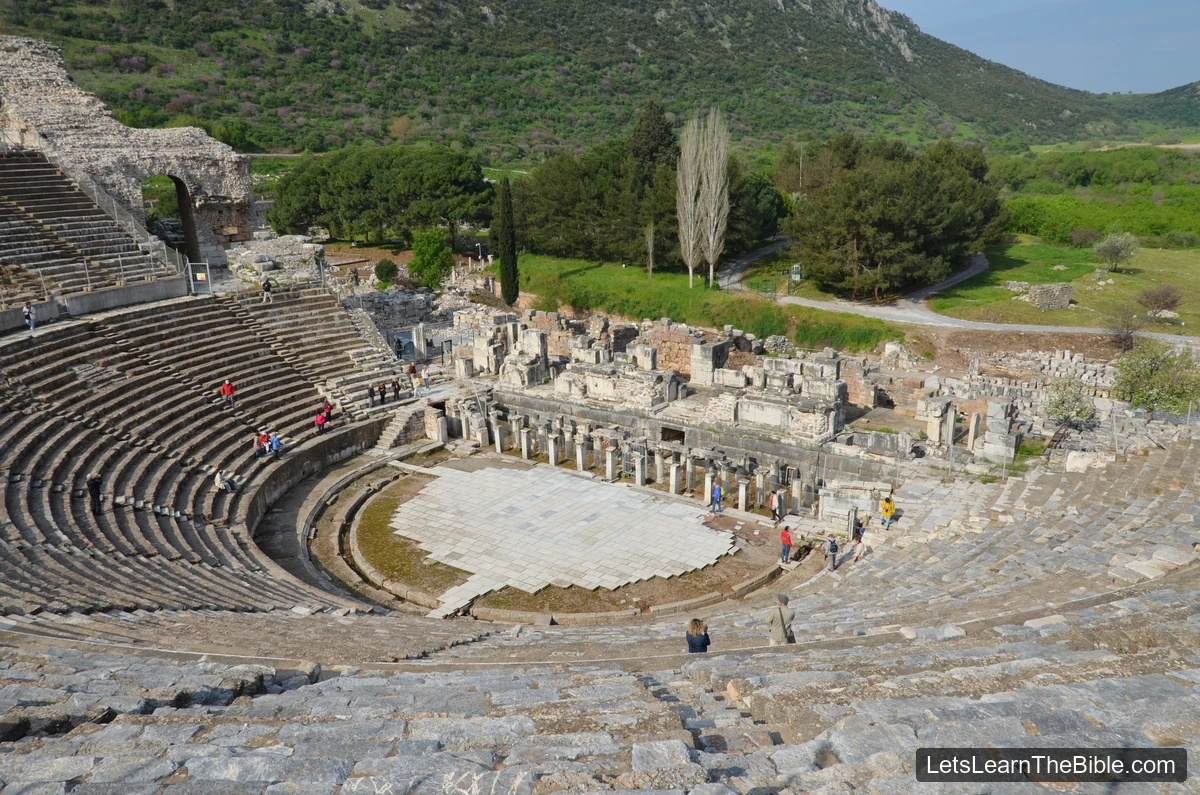
Photograph: “The Great Theatre, Ephesus, Turkey” by Carole Raddato (Following Hadrian). Original title and photo source on Flickr; acquired from the photographer’s own site. CC BY-SA 2.0. Resized from 4928×3264 to 1200×795 and converted to WebP; a LetsLearnTheBible.com site watermark was added in the lower-right corner. No crop or other retouching. This version remains under CC BY-SA 2.0. The watermark identifies the publishing site; photographic credit belongs to Carole Raddato.
In this photograph, follow the curved rows of seats down toward the pale orchestra and the surviving stage-building remains. These visible spaces help readers distinguish the assembly setting from an imagined sermon by Paul. The ministry also reports Roman-period gladiatorial and animal combats; these uses do not date every surviving feature. Exact spectator totals and a largest-in-the-world ranking are unnecessary to explain the Acts episode and are not established here. The photograph illustrates the surviving structure; it does not depict the assembly described in Acts.
The archaeological theater gives a physical setting for the assembly described in Acts 19. The narrative names Gaius and Aristarchus as the companions taken there and says Paul was prevented from entering. It gives no seating count, photograph-level view or gladiatorial scene for this event. Reading the ruins alongside Acts should clarify these limits rather than fill them with invented action.
Gaius and Aristarchus, identified as Paul’s Macedonian traveling companions, are the men seized in Acts 19:29. Paul wishes to go in among the people. The disciples do not allow him, and some prominent men of Asia described as his friends also send warnings (19:30-31). Their friendship does not by itself establish their religious affiliation.
The narrator then describes a confused gathering. Some shout one thing, some another, and most do not know why they have assembled (19:32). This qualification prevents an interpretation in which every participant has heard Demetrius, understood Paul’s teaching and chosen a single common strategy.
Alexander is put forward by members of the Jewish group and signals that he wishes to make a defense. When the crowd recognizes him as Jewish, it shouts in praise of Artemis for about two hours (19:33-34). The passage does not preserve his intended argument or say whether he follows Paul. His name alone does not identify him with another Alexander mentioned elsewhere in the New Testament.
How Does the Town Clerk End the Assembly?
The official first appeals to the city’s acknowledged devotion to Artemis and its sacred image. He urges calm and says the men brought forward are neither temple robbers nor blasphemers of the goddess (Acts 19:35-37). The statement challenges the grounds for immediate crowd action; it should not be expanded into a complete judicial ruling on everything Paul has taught.
He then distinguishes the channels for complaints. If Demetrius and the craftspeople have a case against someone, courts and officials are available. Other matters belong in a lawful assembly. He warns that the current uproar may itself require an explanation and then dismisses those gathered (19:38-41).
The resolution turns from crowd pressure toward legal procedure. Acts does not say that Paul negotiated an agreement with Demetrius, that the temple closed or that the city converted as a result. The immediate narrated result is the assembly’s dismissal.
What Can We Say About Paul's Departure?
Acts 20:1 gives a clear order: the uproar ceases, Paul calls the disciples to him and embraces them, and he departs for Macedonia. Since the Macedonia-Achaia-Jerusalem plan appears before the disturbance, the later departure should be read alongside that earlier intention.
The passage does not label the departure early winter or supply the year AD 57. Such dates belong to a separate chronological reconstruction and require their own evidence. The narrative supports the relative sequence without fixing a modern sailing calendar or asserting that Paul could never again safely enter the city.
This is also distinct from the Jerusalem temple attack. At Ephesus, companions are seized and a civic official dismisses the assembly; at Jerusalem, Paul is attacked and soldiers intervene. Similar crowd language does not make them one incident.
Sources and Method
The archaeological setting above is attributed to the Ministry of Culture and Tourism's “Efes Antik Tiyatrosu - İzmir” section, which credits the İzmir Ephesus Museum Directorate. Its Hellenistic label does not establish an exact Lysimachus construction date. This account also does not establish a population of 250,000, a world population ranking, an Athenian foundation narrative or precise provincial, river and island relationships. Such claims require their own dated sources. For the Artemis sanctuary rather than the theater, follow the existing temple history guide.
The added itinerary and baptism pointers use previously checked KJV passages Acts 18:18–28; 19:1–12 and Revelation 2:1–7. The ministry sequence guide supplies the wider context.
This guide follows the primary narrative, checked against KJV text and independently paraphrased. It distinguishes statements by the narrator, Demetrius and the town clerk, while leaving unreported motives and economic measurements open.
- Acts 19:21-34: plans, Demetrius, the seized companions and Alexander.
- Acts 19:35-20:1: the official’s intervention and subsequent departure.
Read Paul at Ephesus for the earlier teaching and changed practices, or the third-journey route guide for the wider travel sequence. Corrections can be sent through our editorial policy.