Paul's Ministry around the Aegean
Paul's travels connect communities on several sides of the Aegean: Macedonia, the Greek mainland and western Asia Minor. Acts describes preaching, responses, opposition, return visits and coastal journeys across this area. This guide helps you locate those settings across more than one journey, then choose the relevant passage and detailed route guide.
The older description of this area as Paul's “greatest success” gives no common measure for comparing communities. A long stay, a reported response and an account of suffering describe different things. Here the geographical connections organize the study; the places are not ranked by spiritual importance or a calculated conversion total.
Which Regional Names Matter?
Begin with three scales: a named city, a region in the narrative and the wider sea around which the journeys connect. Philippi, Thessalonica and Berea belong to the Macedonian sequence in Acts 16–17. Athens and Corinth follow it; Acts 18:12 identifies Gallio as the deputy of Achaia. Troas, Ephesus and Miletus appear on the Asia Minor side of the maps. The sea gives a useful orientation, while the narrative supplies the particular movements.
“Asia” in these passages should not be read as the whole modern continent. Acts 16:6–10 first describes movement through Phrygia and Galatia, prevention from preaching in Asia and entering Bithynia, and arrival at Troas. Later, Acts 18–19 describes Paul speaking and teaching at Ephesus. The earlier restriction therefore does not mean that he never preached in Asia.
Nor does the Macedonian vision make every location an intended destination from the beginning. The second journey opens with a proposal to revisit believers and a departure through Syria and Cilicia (Acts 15:35–41). At Troas, the group concludes that God has called them to preach in Macedonia. Read that change of direction within the journey rather than beginning the route at Tarsus or supplying the travelers' unreported thoughts.
Choose a Map for the Passage
The two maps answer different questions. Their numbered keys restart with each drawing. Match a number with that map's own legend, then use the place index below for the passage. Both use approximate sites on generalized modern land outlines; their connectors show a sequence rather than a surveyed ancient road or sailing track.
Second journey: the crossing into Macedonia and the return
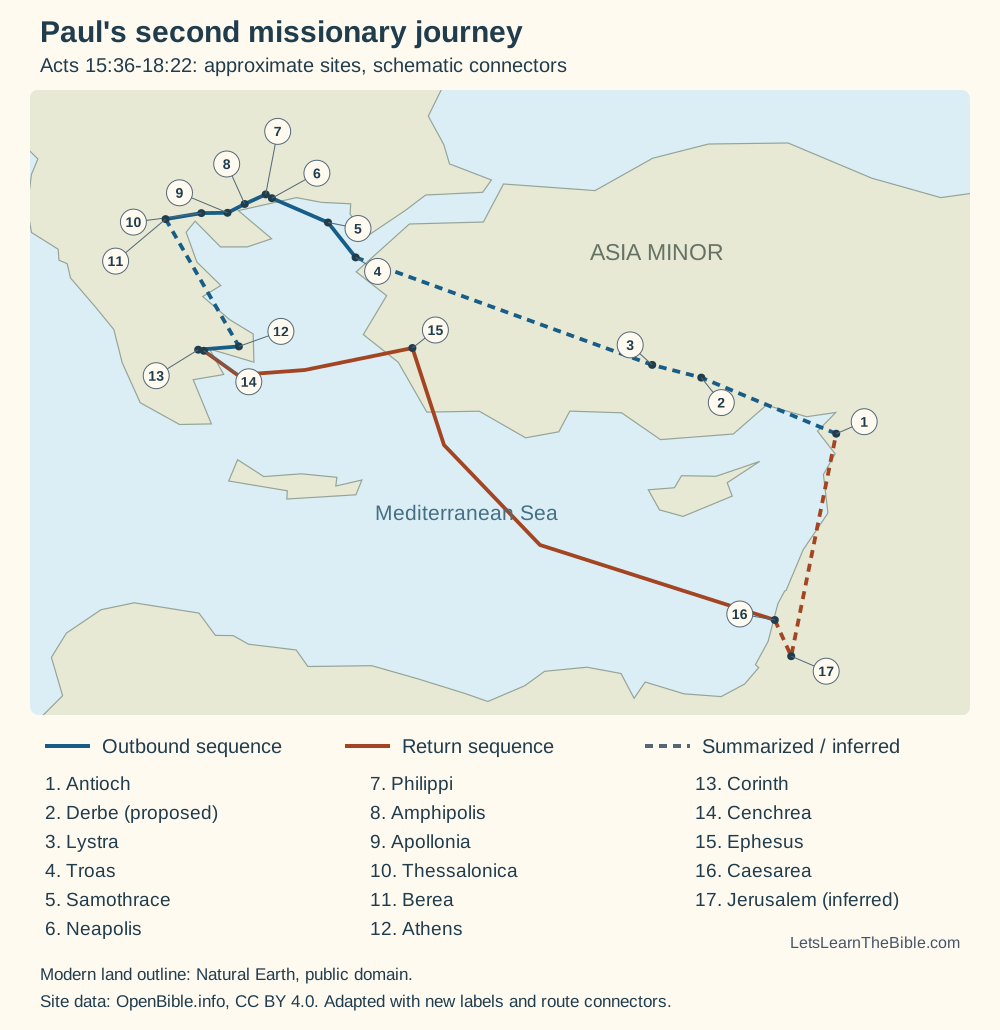
Use this map to find Troas, Neapolis, Philippi, the Macedonian cities, Athens, Corinth and Ephesus in one journey. A stop on a route does not by itself show that Paul established a congregation there. Acts 17:1, for example, says that the travelers passed through Amphipolis and Apollonia before reaching Thessalonica.
Third journey: the return from Philippi toward Jerusalem
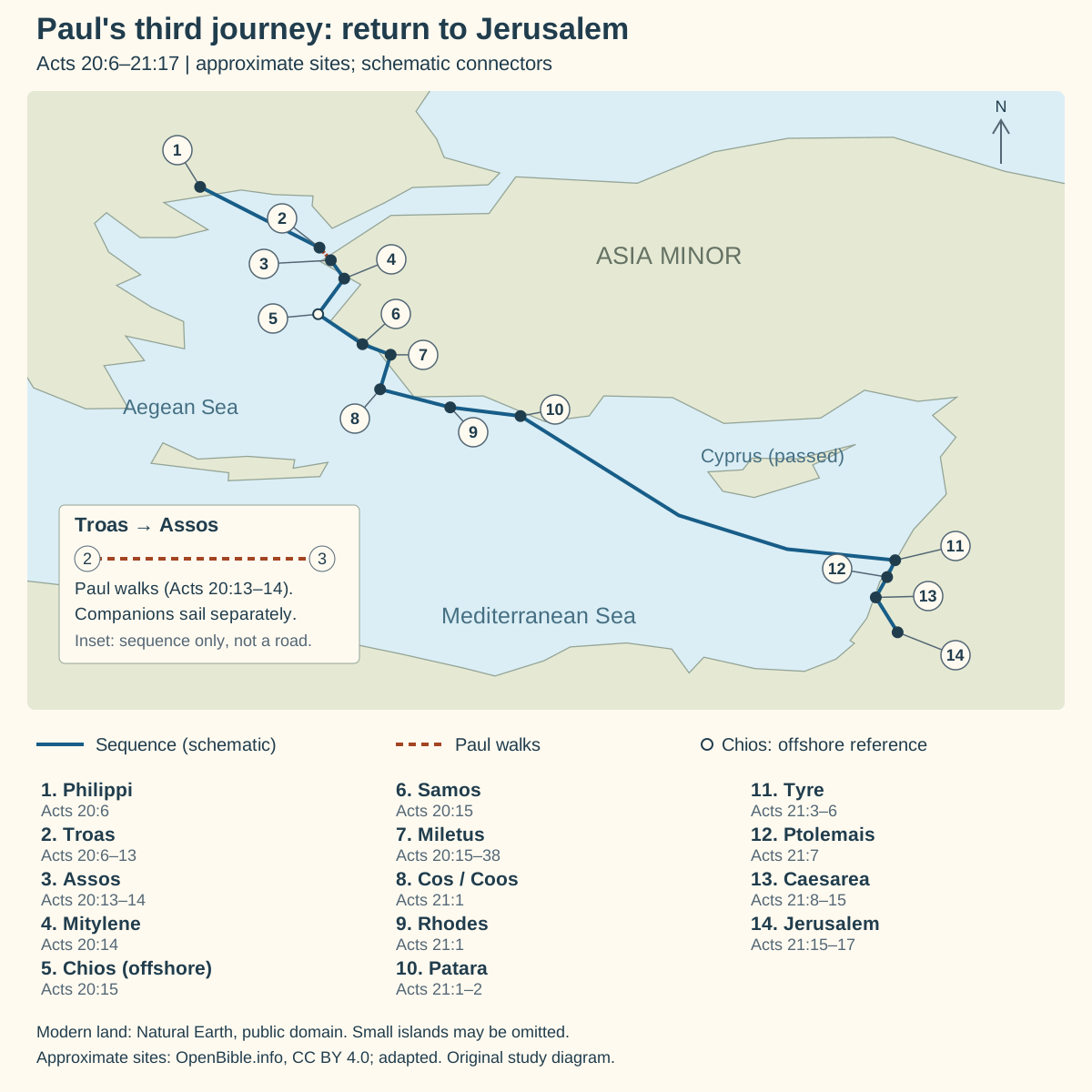
Both existing site diagrams adapt approximate location data from OpenBible.info under CC BY 4.0, with generalized Natural Earth public-domain land outlines. Their labels and sequence lines are editorial aids. The drawings do not supply a complete boundary map of ancient provinces.
Where Does Each Place Fit?
| Place or group | Passage | What to locate or distinguish |
|---|---|---|
| Troas | Acts 16:8–11; 20:5–13 | The Macedonian vision and departure belong to the earlier journey. The later seven-day stay and departure toward Assos are a separate visit. |
| Samothrace, Neapolis and Philippi | Acts 16:11–15; 20:6 | The first passage gives the crossing into Macedonia and the approach to Philippi. The later return account resumes with sailing from Philippi. |
| Amphipolis and Apollonia | Acts 17:1 | Named places passed through on the way to Thessalonica; this verse does not narrate a church founding in either. |
| Thessalonica and Berea | Acts 17:1–15 | Teaching, belief and opposition occur in both settings. Paul then leaves for Athens while Silas and Timothy remain. |
| Athens and Corinth | Acts 17:15–18:17 | Athens includes public discussion and mixed responses. Corinth includes work with Aquila and Priscilla, teaching for eighteen months and a hearing before Gallio. |
| Cenchrea | Acts 18:18 | The departure from the Corinth setting includes a haircut and vow notice before the journey by sea. It is not a second name for Corinth. |
| Ephesus | Acts 18:19–21; 19:1–20:1 | A brief synagogue visit is followed, in the later journey, by extended teaching and a disturbance. Keep those stages separate. |
| Assos and Mitylene | Acts 20:13–14 | Paul walks to Assos, joins the companions' ship there, and continues to Mitylene. The group's transport is not identical on every leg. |
| Chios and Samos | Acts 20:15 | Chios is described as a place opposite the ship's course. Do not convert every island reference into a recorded landing. The detailed return guide discusses the KJV's additional Trogyllium wording. |
| Miletus | Acts 20:15–38 | Paul summons the Ephesian elders to him. Their meeting does not establish another visit by Paul to Ephesus at this point. |
| Cos, Rhodes and Patara | Acts 21:1–3 | Later coastal stages lead toward Phoenicia. At Patara the travelers find another ship; Cyprus is subsequently passed before the landing at Tyre. |
For the broader third-journey movement before this return, see the overview from Galatia and Phrygia through Ephesus, Macedonia and Greece. Acts 20:2–3 names Greece and a three-month stay. It does not itself insert Corinth's name into that stage or give a modern year.
How Do the Letters Connect These Regions?
First Thessalonians 1:1–10 addresses an existing community, recalls its reception of the message amid affliction and describes its example in Macedonia and Achaia. That supplies a regional relationship beyond Paul's physical travel line. It is the letter's account of the community's witness, not a comparable total of conversions for each city.
First Corinthians 16:5–9 describes Paul's plan to travel through Macedonia, possibly remain with the Corinthians over winter, and stay at Ephesus until Pentecost. He describes an effective opening alongside many adversaries. Opportunity and resistance appear together. These plans help explain the relationship between places without becoming a completed schedule.
Romans 15:25–28 describes a contribution from Macedonia and Achaia for poor believers in Jerusalem. The connections therefore include material assistance as well as travel and preaching. Earlier in the chapter Paul describes his wider ministry and aim to preach where Christ has not been named; the passage does not rank the Aegean communities against every other place.
What Should We Leave Open?
Acts 19:10 reports the spread of the word in Asia during the Ephesian ministry. That is wider than a list of Paul's personal city visits. It should not be turned into a route through every settlement. Likewise, Demetrius's complaint in 19:25–27 expresses a perceived threat to his trade and the goddess's honor; it is not a regional sales survey.
Acts 9:15 names Gentiles, kings and the children of Israel in the commission described to Ananias. This does not require assigning one uncertain book or one inferred court appearance to each category. Hebrews does not name its human author in its opening; this regional guide does not use it as proof that Paul wrote to all twelve tribes.
Keep Rome's assurance, appeal and recorded arrival distinct. Acts 23:11 speaks of witness at Rome; 25:10–12 records the appeal to Caesar; 27:24 gives an assurance about appearing before Caesar. Acts 28:16–31 describes Paul's Roman lodging and teaching but does not narrate a hearing before Caesar. These passages do not provide a completed courtroom scene to add to this map.
Sources and Related Guides
This regional index was written from the following bounded KJV passages and compared with this site's separate journey guides. It reuses the two existing maps within their stated scope; it adds no new ancient route, modern date range or success measurement.
- Acts 15:35–21:17: departures, cities, regions, later visits and return stages.
- Romans 15; 1 Corinthians 16; 1 Thessalonians 1: regional relationships, contributions, plans and reported witness.
- Acts 9 and the later Rome-related notices: commission, assurance, appeal and the ending of Acts.
- Hebrews' opening and personal ending: no explicit writer's name in these passages; see the separate authorship guide for the wider discussion.
- Digital KJV corpus: retained text used for the passage checks.
Continue with the second-journey guide, the third-journey overview or the return-leg reference. Send a passage or map correction through the sources and corrections policy.