The First Christians: Jerusalem, Pentecost and the Regional Map
Original reader question: Who were the first Christians in the New Testament? View map showing where they lived!
The earliest community described in Acts gathers in Jerusalem around Jesus' apostles, women disciples, his mother Mary and his brothers. At Pentecost about three thousand people receive Peter's message and are baptized. The map below locates the many regions represented among the hearers; Acts does not identify the birthplace or later home of every person who joins the community.
Followers of Jesus Before the Name Christian
Acts 1:12–15 places the returning disciples in Jerusalem after the ascension. The named apostles pray together with women, Mary the mother of Jesus and his brothers. Peter addresses a gathering of about 120. Matthias is then numbered with the eleven apostles. This is already a community of disciples before Acts narrates Pentecost; the chapter does not present a list of 120 permanent Jerusalem household addresses.
Two different meanings of “first Christians” therefore need to be kept apart. One means the earliest followers gathered around the risen Jesus. The other concerns the first recorded use of the name. Acts 11:26 says the disciples are first called Christians in Antioch. That later naming does not mean there were no followers of Jesus in Jerusalem beforehand. In Acts 1–2 the narrative usually describes disciples, apostles and believers.
Matthew 16:18 supplies an earlier promise to build Jesus' church. Interpreting the “rock” in that verse has its own history of debate; the Pentecost narrative does not require this map to decide between those interpretations. Its immediate concern is what the gathered disciples say, what the hearers understand and how people respond.
A Map of the Gathering's Geographical Reach
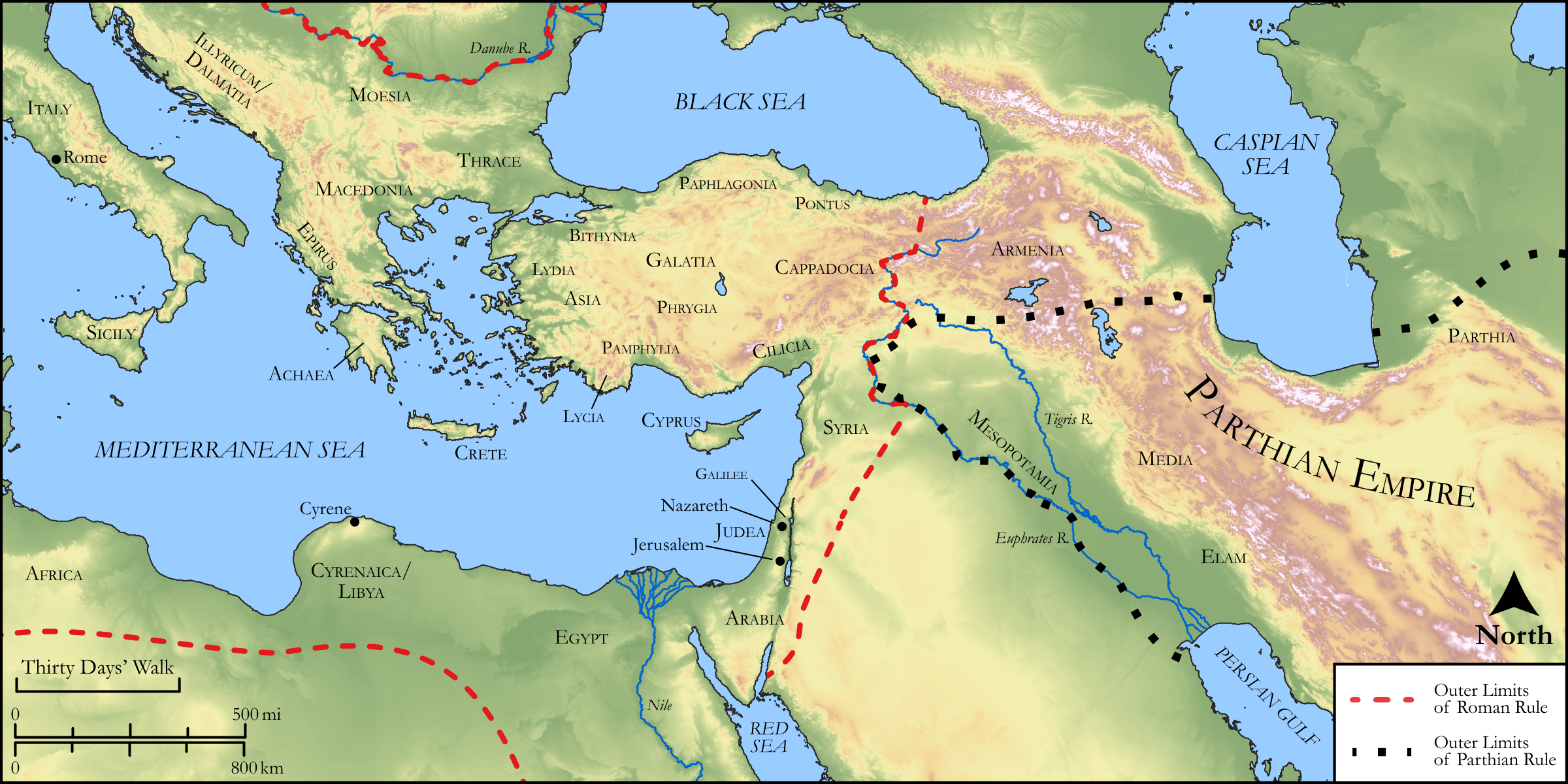
Start with Jerusalem near the eastern Mediterranean coast. Follow the labels west to Egypt, Cyrene, Crete and Rome, north to the regions of Asia Minor, and east through Mesopotamia toward Media, Parthia and Elam. Arabia appears southeast of Judea. The list's reach helps explain why Acts emphasizes people hearing in the languages of their birth.
Acts 2:5 describes devout Jews dwelling in Jerusalem; verses 9–11 also mention visitors from Rome and proselytes. The list mixes peoples, regions, a city and an island. It should not be converted into a set of modern nationalities, or taken to mean that every listed area already has an organized Christian congregation on that day.
Locating the Names in Acts 2:9–11
| Names in Acts | Map orientation | Reading distinction |
|---|---|---|
| Parthians, Medes and Elamites | Eastern portion of the map, beyond the Tigris and toward the Persian Gulf. | Names of peoples and their regional settings; not the identities of all three thousand baptized. |
| Mesopotamia | The Tigris–Euphrates region east of Syria. | A broad regional label rather than one named church or town. |
| Judea | The area around Jerusalem. | The gathering includes a local setting as well as distant origins. |
| Cappadocia, Pontus and Asia | Asia Minor, north and northwest of Judea; Asia here is the western regional label. | “Asia” does not mean the entire modern continent. |
| Phrygia and Pamphylia | Interior and southern Asia Minor. | Ancient regional names do not form a list of modern countries. |
| Egypt and Libya near Cyrene | North Africa, south of the Mediterranean. | Luke specifies the part of Libya near Cyrene, rather than making a claim about every African region. |
| Visitors from Rome, Jews and proselytes | Rome in Italy, in the map's upper left. | Religious affiliation and geographical origin are different features of the description. |
| Cretans | Crete, south of the Aegean. | An island population, not an additional province on the mainland. |
| Arabians | Arabia, southeast of Judea. | The passage supplies no individual hometowns or modern state boundaries. |
About Three Thousand Are Added
The sound, the disciples' speech and the crowd's questions lead into Peter's address. He rejects the accusation of drunkenness, explains the event through Joel, and proclaims Jesus' death, resurrection and exaltation. The hearers ask what they should do. Peter calls them to repent and be baptized, and Acts 2:41 reports that about three thousand receive the message and are added that day.
“About” belongs to the report. Adding that rounded number to the earlier approximate 120 and announcing an exact Pentecost census of 3,120 creates a precision the narrative does not supply. Acts also does not distribute the new believers by region, say that every listener is baptized, or identify which Cyrenian or Roman hearers later carry the message home.
The chapter names Pentecost but gives no AD year or modern calendar date. That dating requires a wider chronology of Jesus' death and resurrection. This geographical guide consequently uses the named festival and the narrative sequence without labeling its map a certain AD 30 residence survey.
Jerusalem Is the First Described Center
Acts 2:42–47 describes teaching, fellowship, breaking bread, prayers, shared resources, temple gatherings and meals from house to house. Jerusalem is therefore a concrete center of community life, not simply a departure point on a world map. The passage does not supply the length of each visitor's stay or a complete account of later return journeys.
Acts 4:32–37 develops the sharing of resources and names Barnabas as a Levite from Cyprus. Acts 6:1–7 records a serious problem: widows among the Greek-speaking group are neglected in the daily distribution. The response appoints seven people to the work while the apostles attend to prayer and the ministry of the word. The growth of this community includes practical obligations and conflict, rather than an uninterrupted story of ideal conditions.
Following the Later Movement in Acts
After the persecution connected with Stephen, Acts 8:1–8 describes believers scattered through Judea and Samaria, with Philip preaching in Samaria. Acts 11:19–26 follows scattered people as far as Phoenicia, Cyprus and Antioch. It specifically mentions people from Cyprus and Cyrene taking part in the Antioch mission, followed by Barnabas and Saul's teaching there.
Those passages provide evidence for later movement; they do not identify these workers as particular members of Pentecost's three thousand. Antioch's community also sends relief to believers in Judea (11:27–30), showing a continuing relationship with the earlier center. For the wider city-by-city survey, continue to the New Testament churches guide.
Sources and Reading Limits
- Acts 1:12–26 and 2:1–47: the gathered disciples, Pentecost, the geographical list, baptism and Jerusalem community.
- Acts 4:32–37; 6:1–7; 8:1–8; 11:19–30: shared resources, distribution, scattering and Antioch.
- Matthew 16:13–20: Jesus' promise concerning his church.
- The map's publisher metadata provides the license; the image is a regional reference and does not independently establish an individual conversion or journey.
The guide paraphrases the KJV and distinguishes the earliest community, the name Christian and the crowd's geographical origins. It does not assign an unsupported homeland to the Magi or treat Acts 2 as a map of every subsequent church.