Mountains in the Bible Map
Biblical mountains become easier to locate when you first find the Jordan, the Sea of Galilee and the Dead Sea. Hermon belongs to the far north, Carmel to the Mediterranean side, and Jerusalem's hills to the central highlands farther south. The map and comparison tables below connect those regions with particular passages while distinguishing a mountain summit, a hill country and a prophetic image.
A Regional Map for Locating the Mountains
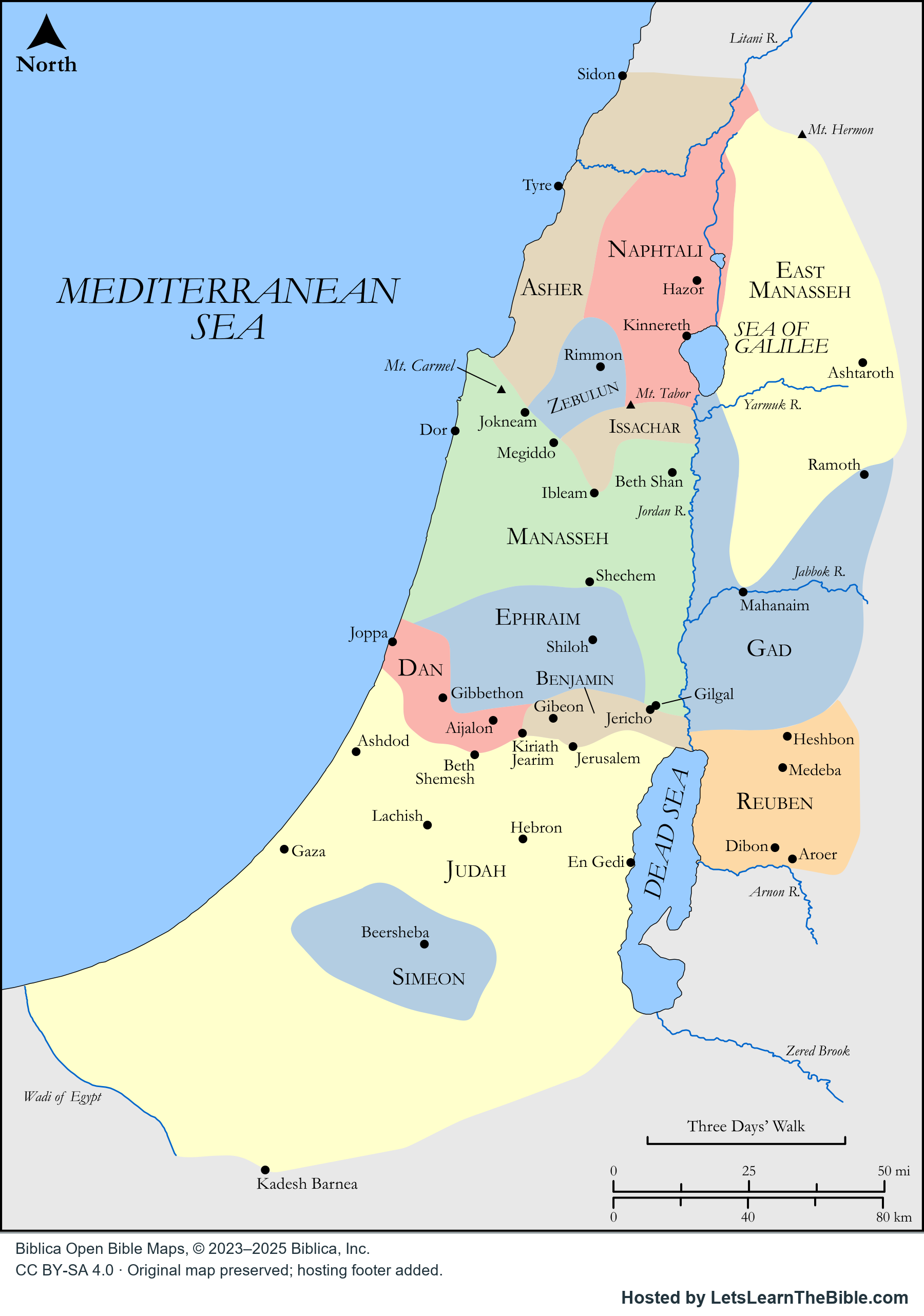
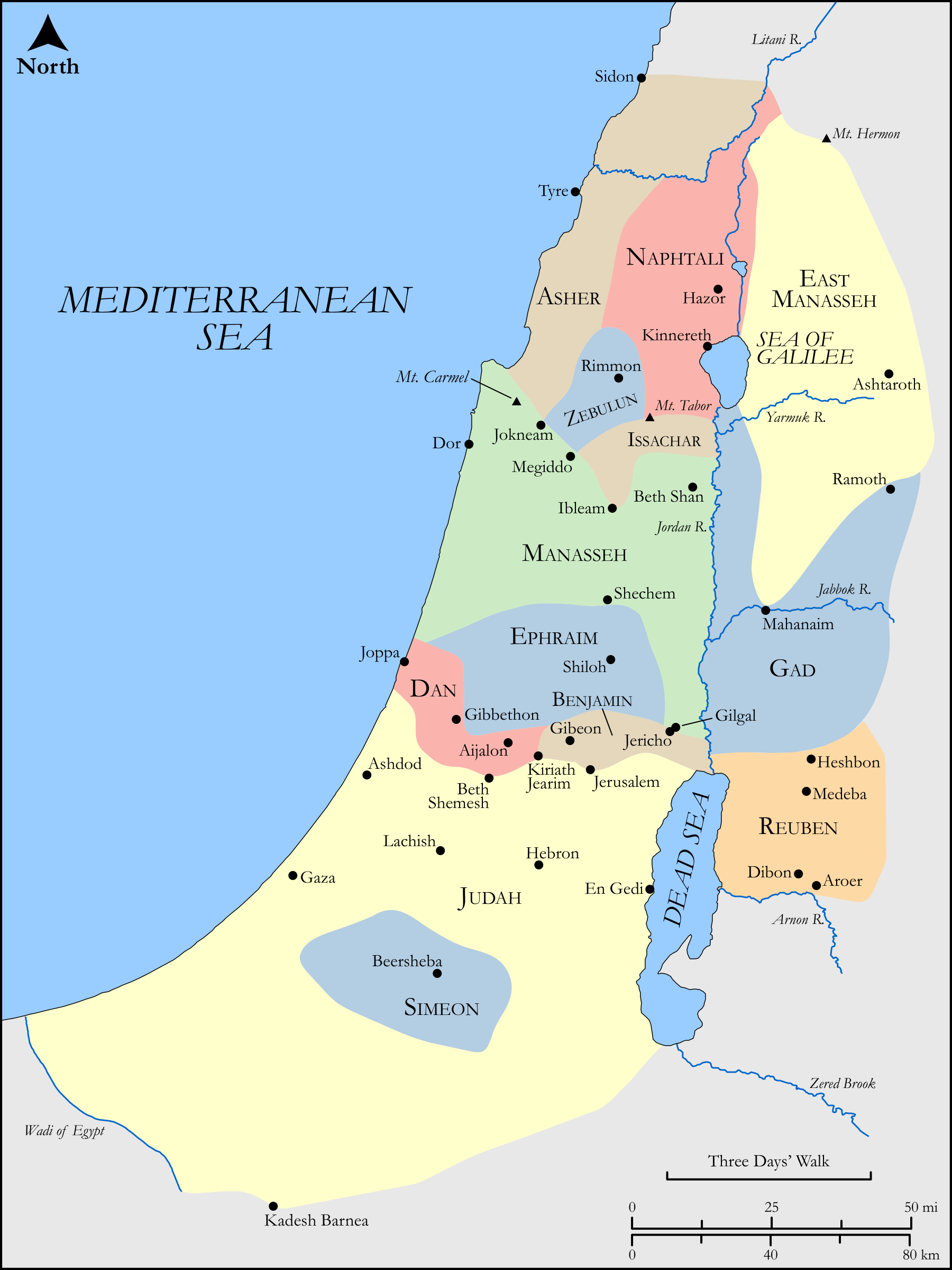
Read its scope: the publisher's colored areas depict a tribal overview, not modern political borders or a map of one battle. Triangles label Hermon, Carmel and Tabor. Other mountains discussed below are not marked as individual summits. Use Shechem, Jerusalem, the Jordan and the two lakes for regional orientation; do not infer an exact summit from the nearest printed town.
Find north at the upper left. Follow the Jordan south from the Sea of Galilee to the Dead Sea. The Mediterranean is west of this corridor; the Transjordan is east. This framework prevents two common errors: treating every mountain as part of Jerusalem and moving an event to a summit merely because a familiar mountain name appears on a regional map.
Hermon, Carmel, Tabor and Gilboa
| Mountain and map orientation | Passage and significance | Keep this distinction |
|---|---|---|
| Hermon Far north on the overview | Deuteronomy 3:8–9 uses Hermon in describing the northern extent of the conquered territory east of the Jordan and records the names Sirion and Shenir. | The passage's geographical limit does not identify Hermon as the site of every unnamed New Testament mountain event. |
| Carmel On the Mediterranean side | 1 Kings 18:19–40 locates Elijah's confrontation and the fire contest at Carmel, followed by action at the Kishon. | The invitation mentions 450 Baal prophets and 400 prophets of the groves. The narrated contest specifically counts 450 Baal prophets; do not silently turn all 850 into described participants. |
| Tabor West of the Sea of Galilee | Judges 4:6–16 describes Barak gathering on Tabor and descending with his force. Sisera assembles at the Kishon; Judges 5:19–21 also names the waters of Megiddo and the Kishon. | Tabor is a gathering and departure point. Saying the entire battle happens on its summit loses the movement in the account. |
| Gilboa Use the Beth Shan region as a reference; the summit is not labeled here | 1 Samuel 31:1–6 records Israel's defeat, the deaths of Saul's sons including Jonathan, and Saul's death after he is wounded. | The overview supplies regional orientation rather than a measured reconstruction of troop positions or a marked place of death. |
The Hermon and Tabor comparison includes a closer northern map. Matthew 17:1 calls the Transfiguration setting a high mountain without naming it. A traditional or proposed identification should therefore be labeled as such, rather than printed as a location explicitly supplied by that verse.
Ebal, Gerizim and Jerusalem's Hills
| Place or expression | Why it matters | Reference and limit |
|---|---|---|
| Ebal and Gerizim Central highlands, using Shechem as a reference | Deuteronomy assigns blessing to Gerizim and cursing to Ebal. Joshua narrates an altar on Ebal, the people divided opposite the two mountains and the reading of the law. | Deuteronomy 11:29–30; Joshua 8:30–35. Judges 9:6–7 connects Gerizim with an address to the people of Shechem. John 4:19–24 later records the Samaritan woman's mountain/Jerusalem worship question and Jesus' teaching on worship in spirit and truth. |
| Hill country of Ephraim | A regional expression should be read as hill country, rather than converted into a single peak bearing all the region's events. | Joshua 17:15 discusses room to settle and clearing woodland. The map's Ephraim area supplies broad orientation; its colored district is not a summit marker or a claim that every place within it has the same elevation. |
| Zion / city of David | David takes the stronghold of Zion, called the city of David. The name belongs to that narrative setting before it is used more broadly in other contexts. | 2 Samuel 5:6–9. For changes in usage and the problem of fixed hill counts, see the Jerusalem hills guide. |
| Moriah | 2 Chronicles explicitly names Mount Moriah at Jerusalem as the temple setting. Genesis describes Abraham going to the land of Moriah and to a mountain God will show him. | 2 Chronicles 3:1; Genesis 22:1–14. Genesis does not print a modern summit name or coordinates; explain any identification of the two locations instead of presenting a map label as proof. |
| Mount of Olives / Olivet | Zechariah places it east of Jerusalem in a prophetic scene. Acts names Olivet in the disciples' return to Jerusalem after Jesus' ascension. | Zechariah 14:4; Acts 1:9–12. These are different literary settings; a location alone supplies no calendar for the prophecy. |
Jerusalem is a town marker on the regional overview, not a detailed plan of Zion, Moriah and the Mount of Olives. Use the Jerusalem map guide for a closer comparison. Counting nearby names does not establish a biblical list of exactly seven hills.
Nebo, Pisgah, Hor, Sinai and Horeb
Deuteronomy 34:1 places Moses' ascent from the plains of Moab to Nebo, to the top of Pisgah, opposite Jericho. The same sentence uses both names. A useful guide preserves that relationship instead of declaring them two unrelated peaks or treating every use of either name as mechanically interchangeable. The passage describes a view of the land and says Moses does not cross into it; it is not a modern visibility calculation.
Numbers 20:22–29 puts Mount Hor by the border of Edom in the account of Aaron's death. Moses transfers Aaron's garments to Eleazar before Aaron dies. This is the southern Hor narrative; the text here gives no modern coordinates. The regional map above does not label its summit, and this page does not add an exact point to fill that gap.
Sinai and Horeb belong to the wilderness and covenant accounts beyond this overview's coverage. They should not be squeezed into a map of Canaan to imply a settled modern site. The Sinai and Horeb guide compares the biblical uses, Moses' and Elijah's encounters, and the limits of modern location proposals.
A Mountain Can Be a Location, a Comparison or Part of a Vision
Start with the surrounding passage. Tabor in Judges 4 is part of an account with gathering, descent and pursuit. The mountain in Matthew 17:20 belongs to Jesus' teaching about faith. Isaiah 2:1–4 depicts the mountain of the Lord's house exalted, nations coming for instruction and an end to warfare. These uses cannot be reduced to one universal rule that every mountain always means a nation, a king or a kingdom.
Revelation 17:9 interprets seven heads as seven mountains, and verse 10 continues with kings. Read those explanations within the vision before choosing a modern city or assembling seven hill names. Neither a relief map nor a hill count settles all the chapter's imagery. A map helps with physical relationships; an interpretation needs to account for the words and relationships of the passage.
Three Ways to Check Your Map Reading
- Find Hermon, Carmel and Tabor without looking at a modern national border map. Describe each in relation to the Mediterranean, Jordan or Sea of Galilee.
- Read Judges 4:6–16. List the gathering point, the descent and the Kishon separately. Explain why a dot at Tabor cannot represent every movement.
- Compare Genesis 22:2, 2 Chronicles 3:1 and Zechariah 14:4. Record whether each text names a land, a particular mountain or a direction from Jerusalem before assigning a location.
Sources and Map License
- Selected northern readings, KJV: Hermon, Tabor, Kishon, Carmel and Gilboa.
- Selected central readings, KJV: Ebal, Gerizim, Zion, Moriah and Olivet.
- Selected readings on other locations and literary settings, KJV: Nebo/Pisgah, Hor, unnamed mountains, prophetic and visionary language.
- Biblica Open Bible Maps metadata and publisher's license notice: OT053 is the Historical Canaan Overview. The original map is preserved with a hosting footer; no new summit coordinates or event routes have been drawn.
Prepared by LetsLearnTheBible.com. Biblical accounts are paraphrased from the KJV; geographical orientation comes from the attributed map. This is a selected study guide, not a list of every mountain named in the Bible or a modern survey of disputed sites.