Maccabean and Hasmonean Expansion Map
Maccabean power did not begin with the full territory shown on a later Hasmonean map. Resistance to Seleucid religious coercion developed into control of Judea, followed by wider territorial expansion under later rulers. The temple's rededication, political independence and the adoption of a royal title were separate milestones. The dynasty's loss of independence under Pompey in 63 BC and its final replacement by Herod in 37 BC were also different stages of its ending.
Study question: How much land did the Maccabees control in Israel? When did they rise to power? What caused their dynasty to end?
Read the expansion map in layers
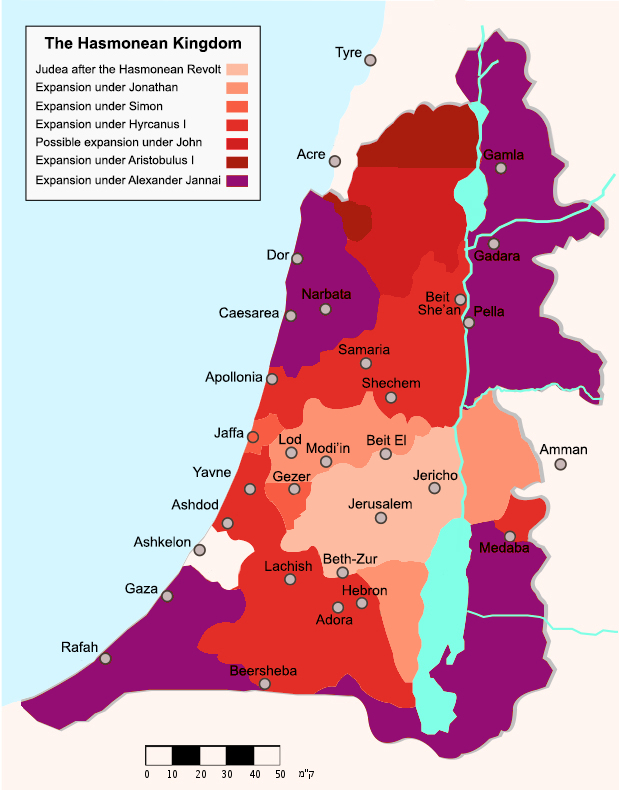

Locate Jerusalem and the Judean hill country first. Then compare the coast around Joppa and Gaza, Samaria to the north, Idumea to the south, and territories east of the Jordan. The map's later colors reach well beyond the revolt's initial Judean setting. They should not all be assigned to Judas Maccabeus.
This is a modern historical reconstruction with a staged legend, not a surviving Hasmonean land survey. Some assignments are tentative, and the distinction between raids, capture, tribute and durable administration matters. A colored region cannot supply a defensible exact square-mile total or establish that every location was controlled continuously.
Who were the Maccabees and what are our sources?
Mattathias and his sons led the resistance described in 1 Maccabees. Judas bears the name Maccabee, which later usage extends to the wider family and movement. “Hasmonean” is the usual name for their ruling dynasty; Alexander Jannaeus belongs to that later family history, not to the original group of brothers.
First Maccabees is an ancient Jewish narrative sympathetic to this family. The USCCB introduction dates its composition to about 100 BC and describes a lost Hebrew original surviving through Greek translation. It is received as Scripture in Catholic and many Orthodox traditions, while Protestant collections commonly classify it as Apocrypha. Those different canonical judgments do not remove its importance as a historical source, but its favorable interpretation of the family's leadership should remain visible.
The passages below use the public-domain KJV Apocrypha for the primary narrative. The text's Seleucid-era years and regnal formulas are distinguished from modern BC conversions. Josephus's later Jewish War supplies evidence for the subsequent rulers and Roman intervention. Neither source is an impartial modern administrative record.
When did they rise to power?
First Maccabees 1:41–64 describes bans on Jewish observance and the profanation of the sanctuary. Chapter 2:15–28 then places Mattathias's refusal and violent resistance at Modin. Lee I. Levine's historical survey dates the persecution to 167 BC and the developing armed struggle to the following period. Antiochus IV's accession and these later measures must not be collapsed into a single event in 175 BC.
| Stage | Evidence | Chronology used here | What changed |
|---|---|---|---|
| Persecution and resistance | 1 Maccabees 1:41–64; 2:15–28 | The profanation is assigned year 145 in 1:54; Levine places persecution in 167 BC. | Mattathias's family resists coercion. This is not yet the later kingdom's maximum extent. |
| Temple rededication | 1 Maccabees 4:36–59 | The text gives 25 Kislev, year 148; Levine dates the rededication to 164 BC. | Worship is restored. Verse 41 still distinguishes enemies in the fortress from the sanctuary work. |
| Simon's independence milestone | 1 Maccabees 13:33–42 | Year 170 in the text; 142 BC in Lawrence H. Schiffman's chronology. | A royal remission of tribute accompanies the narrator's declaration that the foreign yoke was removed. |
| Public confirmation of leadership | 1 Maccabees 14:25–49 | 18 Elul, year 172, Simon's third year. Schiffman places the assembly in 140 BC; Levine uses 141 BC. | Priestly and political authority receive public confirmation. This episode should not be called Simon taking the title “king.” |
| Later monarchy and expansion | Josephus, War I.2–4 | Levine dates Aristobulus I to 104–103 BC and Alexander Jannaeus to 103–76 BC. | Aristobulus adopts the diadem; subsequent conquests enlarge a kingdom that developed after the revolt. |
Hanukkah commemorates the sanctuary's rededication described in 1 Maccabees 4. That religious achievement should not be renamed complete political independence. The same narrative later celebrates a different turning point under Simon. His public authorization in 14:41 is qualified until a trustworthy prophet should arise, a detail that would disappear if the passage were merely paraphrased as an uncomplicated coronation.
How much territory did they control?
The answer depends on which ruler and period are intended. First Maccabees 14:33–37 names Bethsura, Joppa, Gazera and the Jerusalem garrison among Simon's achievements. These named strategic positions are more useful evidence than projecting every later color backward onto the early revolt. Access to the coast mattered alongside control of Jerusalem.
For the later expansion, Josephus War I.2.6–7 describes John Hyrcanus taking places in Idumea and acting against Shechem, Gerizim and Samaria. In I.4.2–3, his account of Alexander Jannaeus includes Gadara, Gaza and Transjordanian campaigns. These are successive campaigns, and the same account records reverses and internal opposition. It does not describe an effortless, permanently settled frontier.
Levine's survey of the later rulers places the greatest territorial growth under Hyrcanus and Jannaeus. His chronological outline also includes Salome Alexandra after Jannaeus. The map helps locate the wider coastal and Transjordanian reach; neither its “possible” layer nor a comparison with modern Israel should be treated as an exact boundary agreement.
Why and when did their rule end?
The family's survival after Simon's assassination already shows why one ruler's death does not necessarily end the dynasty. First Maccabees 16:11–24 describes the murder of Simon and two sons, followed by John's escape and succession. The later state continued through several generations.
After Alexandra's death, her sons Hyrcanus II and Aristobulus II fought over authority. Josephus War I.6 relates their rivalry and the involvement of outside powers. In I.7.6–7, Pompey's victory produces tribute, restoration of Hyrcanus to the high priesthood and removal of cities from Judean control. Using the 63 BC date in Schiffman's survey, this marks the loss of independent Hasmonean power, rather than the immediate disappearance of every Hasmonean officeholder.
Antigonus later ruled from 40 to 37 BC in Levine's outline. Josephus I.18.2–3 describes Jerusalem falling to Herod and Roman forces, Antigonus being taken prisoner and his subsequent execution. Thus 37 BC identifies the final replacement of a reigning Hasmonean king by Herod. Dynastic conflict created opportunities for intervention, and Roman military power determined the outcome; reducing the ending to either a family quarrel alone or a single date loses part of the story.
Sources and map credit
- 1 Maccabees: 1:1–15, 41–64; 2:15–28; 4:36–59; 13:33–42; 14:25–49; 16:11–24. Text checked in the KJV Apocrypha. These alternate passage links display the Douay-Rheims (DRA) translation; their wording is not presented as identical to the KJV.
- USCCB, introduction to 1 Maccabees, for composition, perspective and Catholic canonical framing.
- Josephus, Jewish War, book I, William Whiston translation: chapters 2–7 and 18, selected sections.
- Lee I. Levine, “The Age of Hellenism,” Part II and Part III, in Ancient Israel (1999), hosted by the Center for Online Judaic Studies; Lawrence H. Schiffman, “The Hasmonean Dynasty (142–37 BCE)”, excerpt from From Text to Tradition (1991). Their assembly dating differs and is attributed above.
- Map: Effib and Commons contributors, unchanged CC BY-SA 4.0 image; complete credit and original linked beneath the figure.