Zephaniah Questions and Answers: Fifteen Checks on Judgment and Hope
Read Zephaniah's three chapters, then try these fifteen questions before revealing their answers. Check the named people, places and accusations first. A useful answer can explain both what a passage says and what a proposed date or interpretation adds.
Use the Zephaniah outline for the full sequence and the prophet's background. These questions follow the KJV's 53 verses.
Zephaniah 1: Worship, Judgment and Jerusalem
1. Why does the LORD condemn Judah and Jerusalem?
Zephaniah 1:4–6 names Baal worship, the Chemarims with the priests, rooftop worship of the heavenly host, divided oaths and turning away from the LORD. Verses 8–13 add violence, deceit and complacency about whether God will act. Chapter 3 later exposes unjust leaders. The accusations concern conduct and allegiance, rather than saying that a place-name or ancestry alone makes every inhabitant guilty.
2. Who was Baal in this religious setting?
Baal is a deity whose worship the oracle opposes: 1:4 announces removal of his remnant from Judah and Jerusalem. First Kings 18:17–40 provides a narrative comparison in which Elijah challenges the people to choose between the LORD and Baal, and Baal's prophets call on their god. Second Kings 23:4–5 describes Josiah removing vessels and worship associated with Baal. Those contexts identify the rival worship at issue without requiring a claim that one single god held an identical rank in every Canaanite community and period.
3. Who were the Chemarims?
The KJV uses that term in 1:4 alongside “the priests.” Strong's Hebrew 3649 and BDB identify it as a term for idolatrous priests; the same lexical entry points to 2 Kings 23:5 and Hosea 10:5. In the passage it names religious personnel subject to judgment, rather than an otherwise unexplained nation or a modern church label. Claims about their clothing or a specific ascetic practice require more than the word alone.
4. What kinds of worship does verse 5 condemn?
It names worship of the host of heaven on rooftops and people who swear by the LORD while also swearing by Malcham. Deuteronomy 4:15–31 explicitly warns against worshipping sun, moon, stars and the heavenly host. Second Kings 23:5 names related astral worship, while 23:10,13 separately names Molech and Milcom in Josiah's reforms. These passages help identify the religious problem, but the KJV name Malcham should not be silently replaced by a fully settled identification of every similar name.
Amos 5:8 and 5:26 also distinguish the creator of the stars from idolatrous star-associated worship, and Acts 7:42–43 uses related prophetic words. Recognizing a constellation is different from worshipping it. Modern identifications such as Saturn, or proposed matches between ancient star names and modern constellations, need their own qualified lexical and historical evidence; Zephaniah 1:5 does not supply a complete astronomical list.
5. What is the day of the LORD in Zephaniah, and does it last eighteen months?
Read 1:7–18 together: it is near, a day of wrath, distress, desolation, darkness, trumpet and alarm, from which strength and wealth cannot deliver. The stated reason includes sin. The call to seek the LORD in 2:1–3 follows this warning. Zephaniah does not assign the day an eighteen-month duration, mention a Beast regime or specify its place in one complete sequence of Jesus' return. Matthew 24:1–44 and Revelation's judgment scenes are later Christian comparisons with their own settings; their use should be explained as comparison rather than presented as Zephaniah's explicit calendar.
6. What was Fish Gate, and does Zephaniah say Nebuchadnezzar entered through it?
Fish Gate is one of the named locations from which a cry will arise when judgment reaches the city (1:10). Second Chronicles 33:14 mentions its entrance in an account of Manasseh's wall work; Nehemiah 3:1–8 describes its rebuilding, and 12:27–43 places it in the wall-dedication procession. These are evidence for a Jerusalem gate, without establishing an exact modern entrance coordinate. Zephaniah does not name Nebuchadnezzar or say he entered there. The Babylonian capture narrative in 2 Kings 25 likewise does not identify Fish Gate as his entry route.
7. Why is a trumpet mentioned in 1:16?
It is paired with alarm against fortified cities and high towers within the approaching day of distress. The image makes the threat audible and challenges confidence in defenses. Revelation 8:1–13 describes a later vision of seven angelic trumpets and successive judgments. That supplies a comparison in imagery, not proof that Zephaniah has numbered its trumpet as one particular event in Revelation. The occurrence of “the Lord's day” elsewhere also does not by itself establish an identical timetable.
8. To whom are Zephaniah's prophecies directed?
The book explicitly addresses Judah and Jerusalem (1:4), then the Philistine coast, Moab, Ammon, Ethiopians, Assyria and Nineveh (2:4–15). Its opening threatens human and animal life, and 3:8 gathers nations and kingdoms under judgment. The ending speaks of peoples calling on the LORD, a remnant and restoration. The horizon is therefore wider than one city, while the specific named audiences should remain visible within it.
Zephaniah 2: Seeking the LORD and the Nations
9. How are the humble encouraged in 2:3?
They are told to seek the LORD, righteousness and meekness before his anger comes. The KJV says, “it may be ye shall be hid.” This is an urgent appeal within the warning, rather than a mechanical promise that anyone calling themselves righteous will avoid every calamity. The final remnant's trust and truthful conduct in 3:12–13 help show the sort of response the book values.
10. Who is addressed in 2:4–7, and where are the named cities?
Gaza, Ashkelon, Ashdod and Ekron belong to the Philistine coastal setting. Verse 5 addresses the sea coast, the Cherethites and the land of the Philistines; verses 6–7 turn the desolated coast into pasture for Judah's remnant. The USCCB note identifies the four as Philistine confederation cities and treats Cherethites as a synonym or subgroup with a possible connection to Crete. The passage does not require the name to mean “executioners,” nor does it establish a comparison with Spartan military training. Its practical geographical contrast is between this western coast, the Moabite and Ammonite neighbors east across the Jordan in the following oracle, and Assyria to the north.
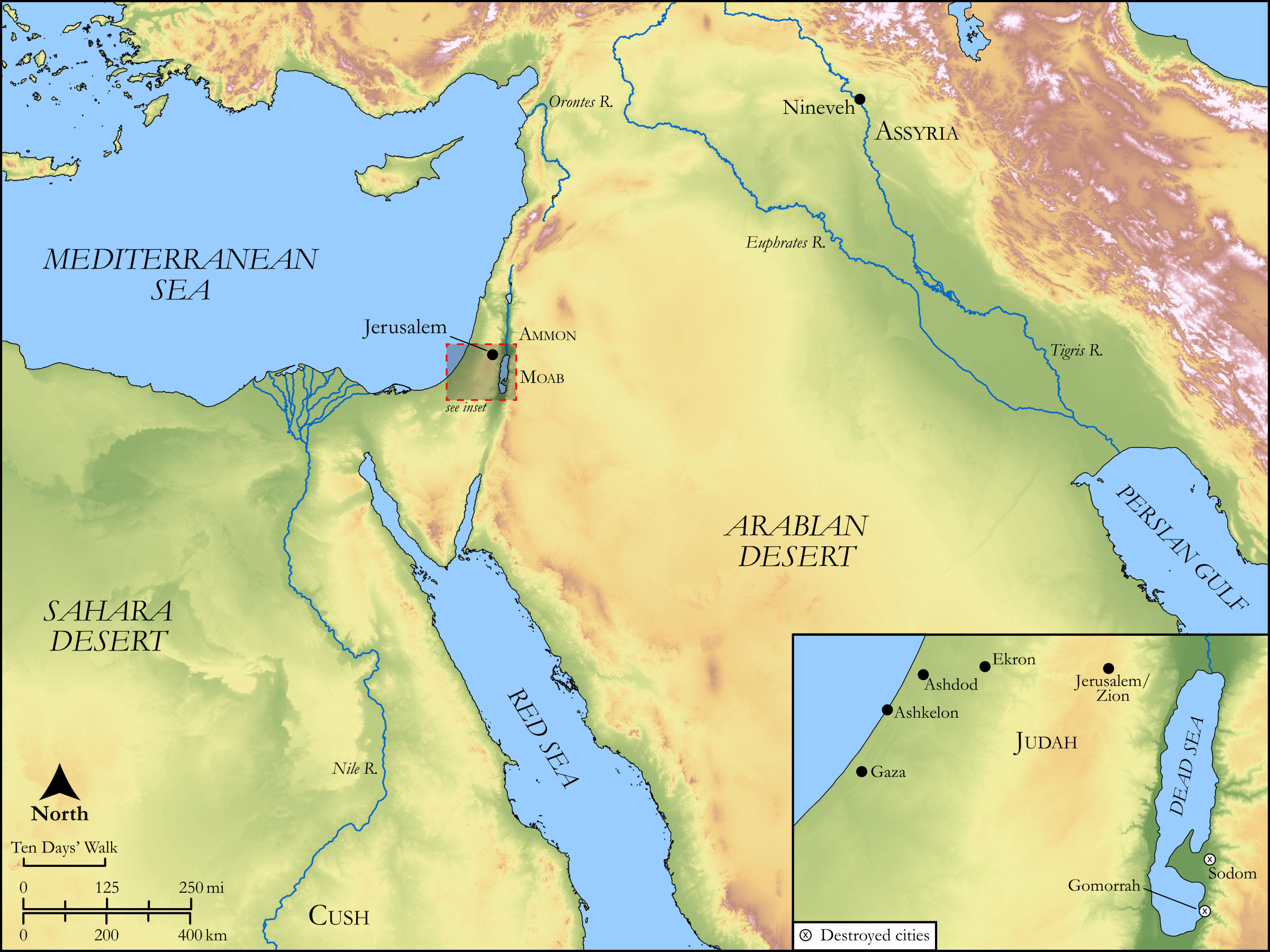

11. Who were Moab and Ammon, and how does their land enter the prophecy?
Genesis 19:30–38 traces Moab and Ben-ammi, ancestor of the Ammonites, to Lot and his daughters. Genesis 11:27–32 identifies Lot as the son of Abram's brother Haran: Lot was Abraham's nephew. Deuteronomy 2:9,19 forbids Israel to seize the land given to Lot's descendants in that journey setting. Zephaniah 2:8–10 instead condemns taunting, territorial arrogance and pride, then announces desolation and possession by the remnant. Read those different settings without making the origin story the personal misconduct of every later Moabite or Ammonite.
12. When did Nineveh fall, and how closely can we date Zephaniah's prediction?
The USCCB introduction to Nahum gives Nineveh's fall as 612 BC. Zephaniah 2:13–15 announces its desolation but does not supply that BC year, an attacker list or a countdown. The heading places Zephaniah in Josiah's reign; a precise claim that his announcement came twenty years before the fall needs a narrower ministry date than the heading alone supplies. Keep the historical date and the prophecy's relative setting distinct.
13. What fault does the oracle expose in Nineveh?
Zephaniah 2:15 depicts a rejoicing city dwelling carelessly, claiming, “I am, and there is none beside me.” Its apparent uniqueness and security become a place for animals and derision. The reversal exposes arrogant confidence. This oracle has its own emphasis; it should not simply be rewritten as Jonah's forty-day warning or as every detail of Nahum's siege imagery.
Zephaniah 3: The Gathered Nations and Restored People
14. What does 3:8 describe, and is Armageddon explicitly named?
It describes the LORD gathering nations and assembling kingdoms to pour out fierce anger, with all the earth consumed by the fire of his jealousy. The preceding verses accuse Jerusalem of rejecting correction; the following verses promise purified speech and a restored community. Armageddon is not named here. Revelation 16:12–21 does name Armageddon within a different vision involving spirits, kings and the gathering for battle. A Christian interpretation may relate the passages, but it should state the argument rather than silently adding Revelation's actors and sequence to Zephaniah's verse.
15. What do 3:11–20 promise, and must every detail be labeled the Millennium?
Pride is removed, an afflicted and poor remnant trusts in the LORD, and lies and deceit cease. Zion and Jerusalem rejoice because judgment and the enemy are removed and the LORD is present as king. God saves, loves and rejoices over his people; the lame and the driven out are gathered, and shame becomes praise. These are the passage's stated conditions. Revelation 20:1–15 explicitly describes a thousand-year period in a later vision; Zephaniah does not give that duration. Identifying its entire closing scene with one millennial scheme is an additional Christian interpretation. It should not replace the concrete changes in worship, conduct, security and care that these verses actually describe.
Sources and Next Reading
Primary reading: Zephaniah 1–3, KJV, read in full and checked against the digital KJV corpus. Contexts read for the answers include Deuteronomy 4:15–31 and 2:1–23; 1 Kings 18:17–40; 2 Kings 22:1–23:30 and 25; Genesis 11:27–32 and 19:30–38; 2 Chronicles 33; Nehemiah 3:1–8 and 12:27–43; Amos 5; Acts 7:35–53; Matthew 24:1–44; and Revelation 8, 16 and 20.
The USCCB introduction supplies the attributed historical frame; its chapter 2 notes supply the regional and qualified Cherethite comparison. The Nahum introduction supplies the 612 BC date. Strong's/BDB H3649 supplies the limited explanation of Chemarims.
Review the sequence in the Zephaniah outline. For narrower questions, see Nineveh, Moab and the Moabites or the separate Joel questions.