Zephaniah Outline: Judgment, the Nations and a Restored Remnant
Zephaniah moves from a devastating day of judgment to the promise of a humble, truthful and restored people. Its warning reaches Judah and Jerusalem, neighboring peoples and the nations. Divided worship, violence, deceit, arrogant confidence and abusive leadership give substance to the judgment; the ending gathers the afflicted and the outcasts into a scene of divine joy.
This outline follows all three chapters and 53 verses of the KJV. For a try-first check of the book's claims and background, use the 15-question Zephaniah self-test.
In the KJV order, Zephaniah is the thirty-sixth book and the ninth of the twelve Minor Prophets. It has three chapters and 53 verses. Printed word totals and size rankings depend on the edition and the treatment of punctuation, hyphens and headings; chapter and verse references give a more stable way to locate its argument.
Who Was Zephaniah, and When Did He Speak?
Zephaniah 1:1 names him as the son of Cushi, son of Gedaliah, son of Amariah, son of Hizkiah, and places the word he received in the reign of Josiah son of Amon, king of Judah. The heading does not explicitly call the last ancestor King Hezekiah or supply an exact writing year. Strong's Hebrew 6846 glosses the name as “Jah has secreted”; the NAS lexical entry gives “Yah has treasured.” These are attributed name explanations, not additional biographical episodes.
The USCCB introduction gives Josiah's reign as 640–609 BC and suggests that the attacks on false worship may belong to the early years before his reforms. Its wording is a proposal: the book's heading establishes the reign, while the narrower 640–622 BC range requires a historical argument. Second Kings 22–23 describes the discovery of the law book and the reforms in Josiah's eighteenth year. It is useful context, but does not date each Zephaniah speech or prove that the finished book was composed at the same moment.
The address to Jerusalem and “from this place” in 1:4 are consistent with a concern for Judah's capital. They do not explicitly identify the prophet's home or the location where every part was written. His book gives no account of his death or burial; this guide does not certify a grave or infer that no later tradition could exist.
Zephaniah 1: Divided Worship and the Approaching Day
1:1–3 — A named setting and an extensive threat. After the heading, the LORD announces the removal of human beings, beasts, birds and fish, together with stumblingblocks and the wicked. The reach is deliberately devastating. The next address becomes specific to Judah and Jerusalem, so neither the local setting nor the broad opening should erase the other.
1:4–6 — Worship divided or abandoned. The hand stretched against Judah and Jerusalem removes Baal's remnant and the Chemarims with the priests. Strong's and BDB's entry 3649 identify the Chemarims as idolatrous priests. Those worshipping the host of heaven on rooftops and swearing both by the LORD and by Malcham are included, together with those who have turned away and have not sought him. The charge concerns compromised and neglected loyalty, rather than a condemnation of studying the stars as created things.
1:7–9 — A sacrifice with an unsettling meaning. Silence is commanded because the day of the LORD is near and a sacrifice has been prepared. Princes, royal children and people in foreign apparel face punishment; violence and deceit fill masters' houses. The ceremonial vocabulary belongs to a judgment scene, not an assurance that every religiously connected household is safe.
1:10–13 — Cries through the city and complacency exposed. Fish Gate, the second quarter, the hills and Maktesh become places of alarm. Merchants and silver-bearers are cut off. The LORD searches Jerusalem with candles and judges those settled on their lees who say he will do neither good nor evil. Their houses and vineyards will not deliver the enjoyment they expect. Fish Gate also appears in 2 Chronicles 33:14 and Nehemiah 3:3; Zephaniah does not identify it as Nebuchadnezzar's entrance route.
1:14–18 — The great day. Nearness, bitter cries, distress, desolation, darkness, trumpet and alarm accumulate. Even the mighty cry, and wealth cannot deliver. Verse 17 explicitly connects the distress with sin and uses severe images of blood and flesh. This is more than a generic warning about difficult times. The chapter itself does not provide an eighteen-month duration, identify a later Beast regime or supply a complete Christian end-time calendar.
Zephaniah 2: Seek the LORD; Judgments Around Judah
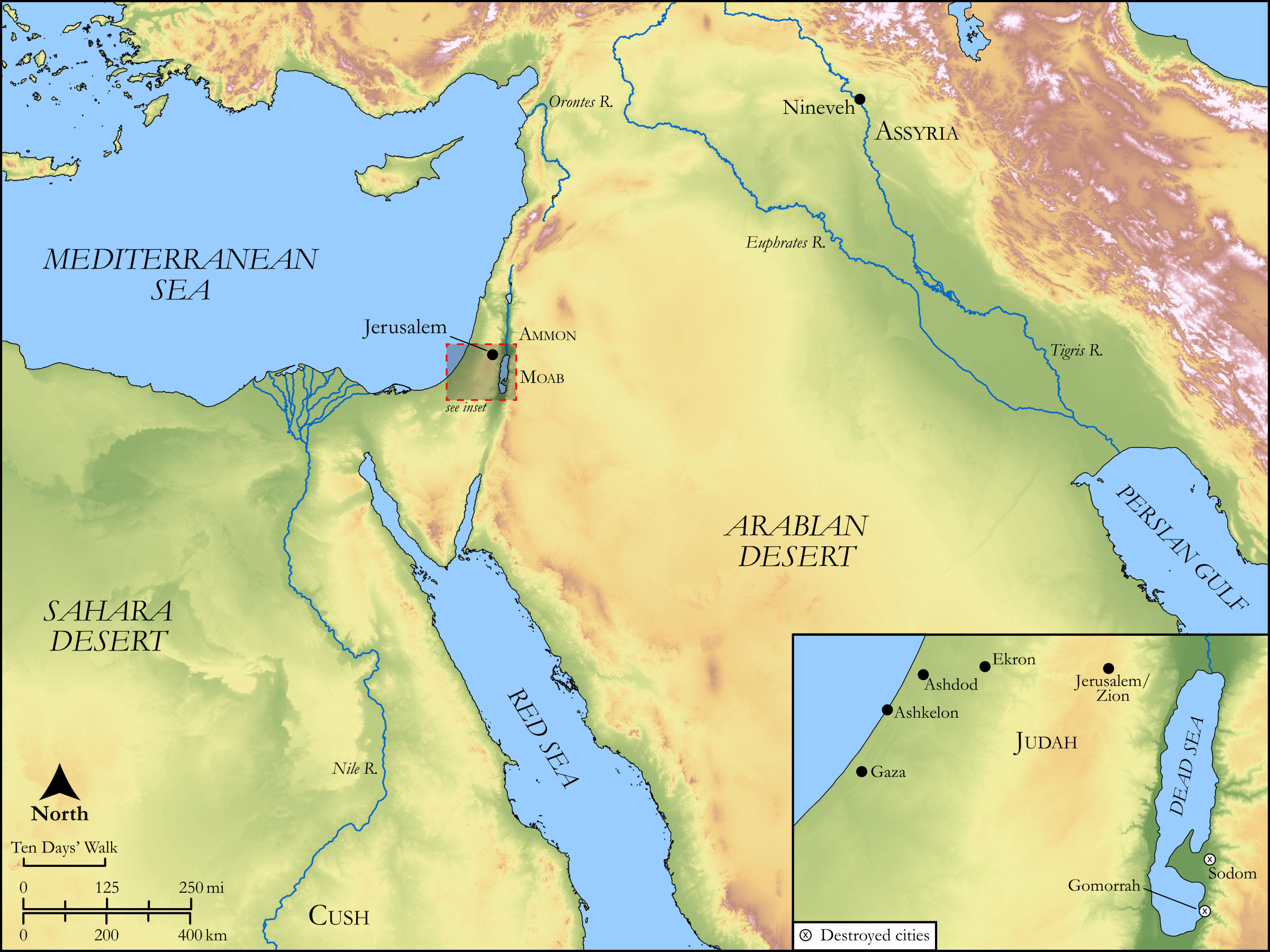

2:1–3 — An urgent appeal before the day. The people are called to gather before the decree and fierce anger come. The meek who have practiced judgment are told to seek the LORD, righteousness and meekness. “It may be ye shall be hid” expresses the appeal's seriousness without converting it into a formula guaranteeing immunity to every reader who claims to be humble.
2:4–7 — The Philistine coast. Gaza, Ashkelon, Ashdod and Ekron are named before the address to the sea coast, Cherethites and the land of the Philistines. Destruction is followed by a promise that the coast will become pasture for the remnant of Judah. The USCCB note identifies these four as Philistine confederation cities and treats Cherethites as a synonym or subgroup, with a possible association with Crete. That qualified explanation is more useful than asserting one certain derivation or making a comparison with Sparta stand in for evidence.
2:8–11 — Moab and Ammon. Their taunts, territorial boasting and pride are the stated charges. Sodom, Gomorrah, nettles and saltpits supply images of lasting desolation; the remnant will spoil and possess their land. The horizon then expands to the gods of the earth and worship from the nations' own places. The USCCB note locates Moab and Ammon east across the Jordan from Judah. Genesis 19:30–38 traces them through Lot, Abraham's nephew, but the ancestral story is not a declaration that every later individual has identical conduct.
2:12 — The Ethiopians. One brief address announces death by the LORD's sword. The NABRE calls them Cushites. Keep the named ancient people and the brief statement visible without assigning collective guilt to a modern population.
2:13–15 — Assyria and Nineveh. The hand stretches north against Assyria, and Nineveh becomes dry wilderness and a dwelling for animals. Its confidence—“I am, and there is none beside me”—is overturned. The USCCB introduction to Nahum dates Nineveh's fall to 612 BC; that historical date is distinct from a year supplied by Zephaniah. An exact twenty-year interval between this prophecy and the fall cannot be obtained from the heading alone.
Zephaniah 3: Corrupt Jerusalem and a Restored People
3:1–5 — A city that rejects correction. The opening city is not named in verse 1, but the surrounding book and the USCCB note identify Jerusalem as the target. She does not obey, accept correction, trust the LORD or draw near. Princes are lions, judges are wolves, prophets are treacherous and priests profane the sanctuary and violate the law. The just LORD in her midst contrasts with this leadership. Read the passage's own charges rather than carrying Nineveh's address unexamined across the chapter boundary.
3:6–8 — Warnings refused and nations assembled. The LORD recalls ruined nations and the expectation that Jerusalem would receive instruction, yet corruption continues. The gathering of nations and kingdoms leads to the outpouring of fierce anger and fire. The severity of verse 8 should remain beside the promise that follows. It does not itself name Armageddon, an Antichrist or a battle duration.
3:9–13 — Purified speech and a humble remnant. The peoples call on the LORD and serve with one consent. Offerings come from beyond the rivers of Ethiopia. Pride is removed, and an afflicted and poor people trust in the LORD. They do not practice iniquity, lies or deceit and lie down without fear. This gives concrete content to restoration: changed worship, speech, character and security.
3:14–17 — Joy instead of fear. Zion, Israel and Jerusalem are summoned to sing. The LORD has removed judgment and the enemy; he is present as Israel's king. The call not to fear or let hands grow slack is followed by the description of God saving, loving and rejoicing over his people with singing. The poem portrays both the people's joy and God's joy, rather than merely promising a change of political leadership.
3:18–20 — The afflicted are gathered. Those burdened by reproach, the lame and those driven out are included. The ending reverses shame through gathering, homecoming and restored praise among the peoples. A reading that ends with universal devastation in verse 8 misses this substantial conclusion.
Connections and Reading Checks
- Seek and refuse: Those who have not sought the LORD appear in 1:6; the humble are told to seek him in 2:3; Jerusalem's refusal to draw near is exposed in 3:2.
- Pride and humility: Moab and Ammon boast; Nineveh claims unique security; pride is finally removed from the restored community.
- The LORD in the midst: His justice contrasts with Jerusalem's wrongdoing in 3:5; his saving presence brings joy in 3:15–17.
- Later Christian comparisons: Matthew 24, Revelation's trumpets and Revelation 20 invite discussion of judgment, gathering and reign. Compare their actual actors and sequences; Zephaniah does not label its scenes with an eighteen-month period or the word Millennium.
Sources and Next Reading
Primary text: Zephaniah 1–3, KJV, read in full and checked against the digital KJV corpus. Contexts include 2 Kings 22:1–23:30; Genesis 11:27–32 and 19:30–38; Deuteronomy 2:1–23; 2 Chronicles 33; Nehemiah 3:1–8 and 12:27–43. Later comparisons include Matthew 24:1–44 and Revelation 8, 16 and 20.
The USCCB introduction supplies the attributed Josiah chronology and conditional pre-reform proposal. Its chapter 2 notes supply regional and Cherethite comparisons; its chapter 3 note identifies Jerusalem. The Nahum introduction supplies the historical 612 BC reference. Lexical readings are limited to Strong's/NAS/BDB at H6846 and H3649, rather than every topical claim on those pages.
Continue with the Zephaniah self-test, the separate Nineveh guide or Zion in its different contexts.