Nahum Study Questions: Nineveh, Thebes and the Siege Imagery
Read each question before opening its answer. Nahum's judgments become easier to follow when the accused city, the people offered relief and the changing images are kept distinct. These fifteen questions retain the book's location, history and interpretation topics while separating the verses from later reconstructions.
Read Nahum 1–3 in the KJV first. Use the chapter outline to locate a scene, then give a verse for your answer. Historical dates and proposed locations require a second kind of evidence beyond a verse reference.
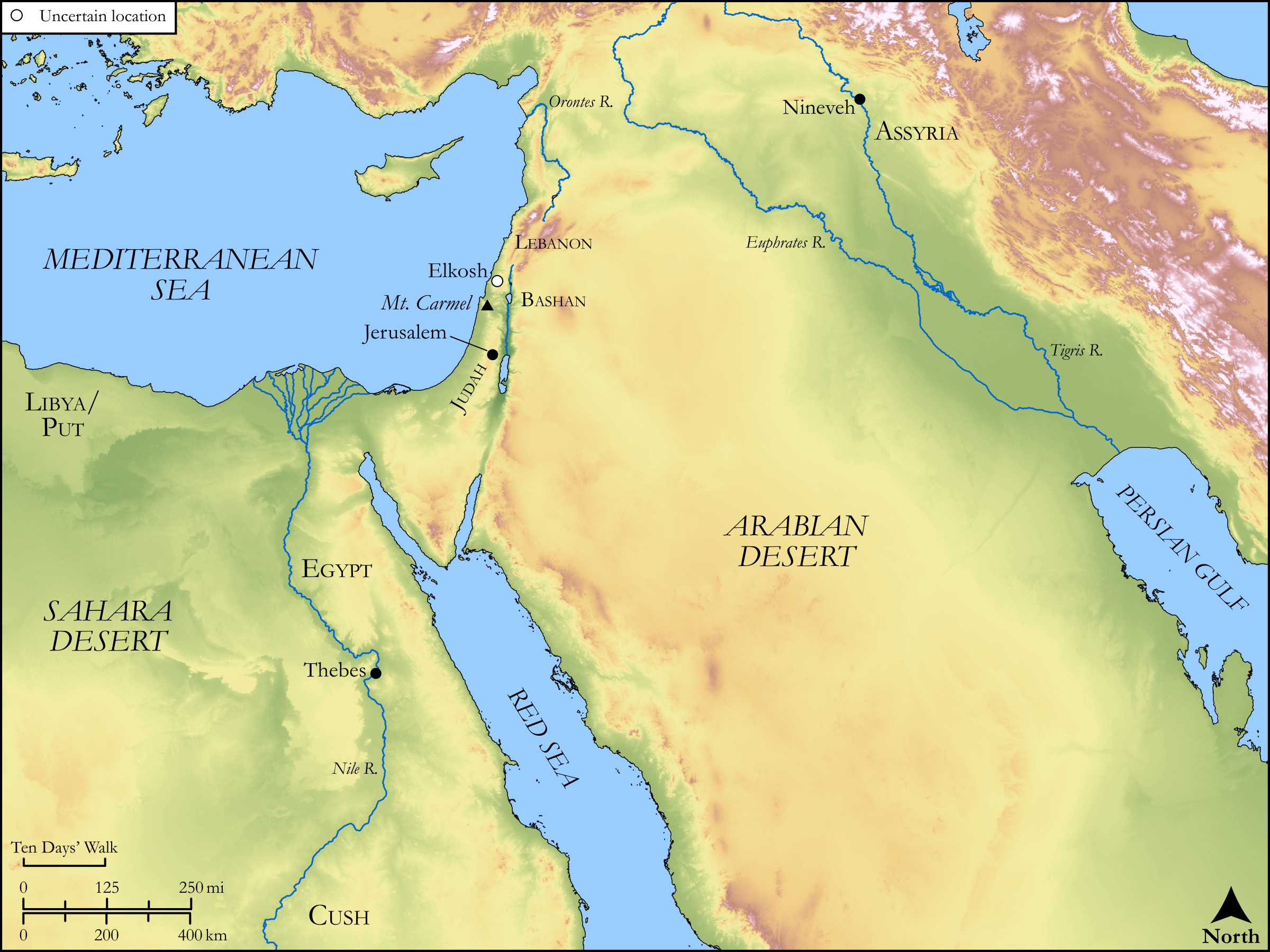

Nahum 1: Vision, Places and Judgment
1. How does the heading describe Nahum's message?
Nahum 1:1 calls it a burden concerning Nineveh and the book of the vision of Nahum the Elkoshite. It identifies the work as a vision without narrating when, where or through what sequence of experiences he received it. Do not turn a literary heading into a detailed biography.
2. How does Nahum relate to Jonah?
Both books address Nineveh. Jonah 3–4 recounts the city's response to a warning, the withholding of disaster and the prophet's anger at mercy. Nahum announces judgment and relief for those oppressed by the city. They should not be treated as two accounts of one visit or as evidence of a personal meeting between the prophets. Zephaniah 2:13–15 also addresses Assyria and Nineveh, so the city's prophetic appearances are not confined to these two books. An exact interval between Jonah and Nahum cannot be calculated from their headings alone.
3. Where was Elkosh, and what does “Elkoshite” mean?
“Elkoshite” connects Nahum with a place called Elkosh; it is not the place's complete name. The heading does not locate it. Easton's Nahum entry records competing Galilean and Mesopotamian proposals. The surviving text does not choose between them, and Judah's appearance in 1:15 does not prove that Nahum was born there.
4. Where was Nineveh, why was it important, and which Assyrian king ruled when Nahum spoke?
Nineveh was an Assyrian capital on the Tigris in northern Mesopotamia. The USCCB introduction identifies it as Assyria's capital and dates its fall to 612 BC. Its position and imperial role explain why a judgment on this city mattered beyond its walls. The Nineveh guide supplies its wider biblical context.
The KJV wording of Genesis 10:11 says that “Asshur” went out and built Nineveh; saying simply that this translation names Nimrod as its builder changes the wording. Jonah 4:11 names more than 120,000 persons unable to discern right from left but gives neither their ages nor a census for Nahum's time. It does not establish a later world population ranking.
Nahum does not name the Assyrian king. Ashurbanipal belongs to the historical account of Thebes' defeat in 663 BC, but that does not by itself prove he was still ruling when Nahum's vision was delivered. The claims of Nineveh's capital status beginning in 705 BC, its being the world's largest city in 668–612 BC, and a precise Ashurbanipal reign range have not been independently established by the sources used here; they are not used to date the book. The specific claim that Assyria conquered the northern kingdom in 723 BC and carried away almost its entire population has not been independently verified in the sources adopted here. The USCCB introduction instead places the fall of Samaria in 722/721 BC; neither date supplies a direct date for Nahum.
5. How does the book hold patience, justice and refuge together?
Nahum 1:2–3 describes vengeance against enemies alongside slowness to anger and great power. Verse 7 calls the LORD good and a stronghold in trouble, while the surrounding passage announces an end for the enemy. The poem's own account of the city's conduct in 3:1–4 and 3:19 explains why judgment is portrayed as relief. “Slow to anger” should neither be omitted nor treated as a promise that abuse will continue without judgment.
6. Where are Bashan and Carmel, and why mention them in 1:4?
Bashan lies east and northeast of the Sea of Galilee; see the Bashan geography guide. Carmel is the ridge reaching the Mediterranean near modern Haifa, as described in Easton's Carmel entry. Nahum mentions Lebanon too. These are images of flourishing land withering before the LORD, not a list of cities along an Assyrian invasion route. The verse does not give a measured length for Carmel, and this answer does not depend on a thirteen-mile estimate.
7. What makes the command in 1:14 so severe?
The sentence combines the ending of a name, the cutting off of carved and molten images, and the making of a grave because the condemned party is vile. It presents an end to status, cult objects and continued power. Reading the verse in 1:9–15 keeps its threat distinct from the encouragement to Judah. It does not locate an archaeological tomb or give the burial place of Nahum.
8. Who was king of Judah when Nahum announced peace in 1:15?
The book does not say. Second Kings 21–22 narrates Manasseh, Amon and Josiah, but does not connect a dated event in their reigns to Nahum's vision. Historical dating proposals may place the prophecy within one of those reigns; the verse itself cannot select a king. The exact regnal-year ranges and the narrower 662–627 BC date for Nahum are not independently established here. Judah's feasts and vows are the verse's direct concern.
Nahum 2: Gates and Plunder
9. Does 2:6 explain exactly how Nineveh's walls fell?
It says the gates of the rivers are opened and the palace is dissolved. Read it with the rushing military scene in 2:3–7 and the pool image in 2:8. Water-related destruction is a possible interpretation, but the verse does not name the Khosr, identify engineers, specify a floodgate sequence or say how much wall fell. A Tigris flood and deliberately released stored water are different reconstructions. Neither becomes an established event merely by being placed beside the verse; the historical accounts behind those claims have not been directly verified for this guide.
10. What is happening in the command to take silver and gold in 2:9?
The city is being plundered. The verse describes abundant treasure, followed in 2:10 by emptiness, waste and terror. The lion passage in 2:11–13 then reverses a predator's earlier accumulation of prey. This supports a reading of the wealthy imperial city losing its security and goods. The verse does not itemize the proportions acquired through tribute, trade and military conquest, and it is not a promise that the reader will receive its wealth.
Nahum 3: Charges, No and Insects
11. What reasons does Nahum give for Nineveh's judgment?
Nahum 3:1 calls it a bloody city, full of lies and robbery; 3:4 uses prostitution and sorcery imagery for the selling of nations and families; 3:19 asks who has escaped its continual wickedness. The judgment against images in 1:14 also belongs to the book's indictment. Those passages provide direct textual grounds. A longer catalogue of Assyrian torture methods or a particular magical ceremony needs separately checked historical evidence, rather than a quotation from a commentary not consulted here.
12. What does the exposure of nakedness in 3:5 mean?
Nineveh is personified as a woman, and exposure before nations portrays the city's public humiliation and loss of prestige. The following verses add filth, contempt and abandonment. This is sexualized violence in a judgment image; the text does not describe an exact legal ceremony for punishing prostitutes. A possible historical custom must not be stated as the verse's verified background, nor should the image be used to justify harming or shaming a person.
13. Why compare Nineveh with populous No in 3:8–10?
No is commonly identified with Thebes in Upper Egypt, on the Nile; Easton's No entry supplies this identification. It is distinct from Nineveh on the Tigris. Nahum asks whether Nineveh is better than a city protected by waters and supported by allies, yet taken into captivity. Rivers, allies and apparent strength did not make that city invulnerable.
The historical campaign account dates Ashurbanipal's taking of Thebes to 663 BC, the usual event associated with this passage. That is historical identification, not a date stated in Nahum. The source also distinguishes Assyrian claims from questions about archaeological traces; this answer does not claim a verified destruction layer or that the city ceased to exist. The comparison warns Nineveh against confidence in its defenses.
14. What is the KJV's “cankerworm” in 3:15–16?
It belongs to the passage's crop-destroying insect imagery, alongside “locusts” in 3:15 and 3:17. The KJV's different words do not by themselves identify a modern species or an exact insect life stage. Read the actions—eating, multiplying, spoiling and flying away—to follow the comparisons. This guide does not claim to have resolved the Hebrew entomological terms from an English translation.
15. Do all the insects in 3:15–17 represent the invading army?
No single identification fits every line. Fire and sword consume like the cankerworm in verse 15; the city is challenged to multiply like insects; its numerous merchants appear in verse 16; and its crowned men and captains are compared with locusts that depart when the sun rises in verse 17. The figures portray consumption, numbers and disappearance. The next verse addresses sleeping shepherds and scattered people without anyone to gather them. It does not say that every inhabitant has been slaughtered, and the officials who vanish should not be silently replaced by an invading swarm.
Sources and Next Reading
Primary reading: Nahum 1–3, KJV, checked in the digital KJV corpus. Comparisons use Genesis 10, Jonah 3–4, Zephaniah 2 and 2 Kings 21–22. The chapter references follow the KJV; in some editions KJV 1:15 is 2:1.
The USCCB introduction provides an attributed historical frame and discussion of oppression. Easton's Nahum, Carmel and No entries are used for the specific name and geographical points identified above, not for every historical assertion in those entries. The Sack of Thebes article supplies the attributed 663 BC campaign discussion; no firsthand reading of its cited Assyrian records or archaeology is claimed.
Return to the Nahum chapter outline to test whether each answer fits the surrounding passage. Compare the distinct tasks of the Jonah questions and the Nineveh reference guide.