Nahum Outline: Nineveh's Judgment and Judah's Relief
Nahum addresses the fall of an oppressive city from the perspective of those it has harmed. Its three chapters move from the LORD's power and goodness to a siege scene and a final explanation of Nineveh's judgment. The book's violence, relief for Judah and accusation against imperial violence belong in the same reading.
This outline follows the KJV's three chapters and 47 verses. Use the Nahum study questions for the disputed river interpretation, the comparison with Thebes and the changing use of locust imagery.
The Prophet, Date and Setting
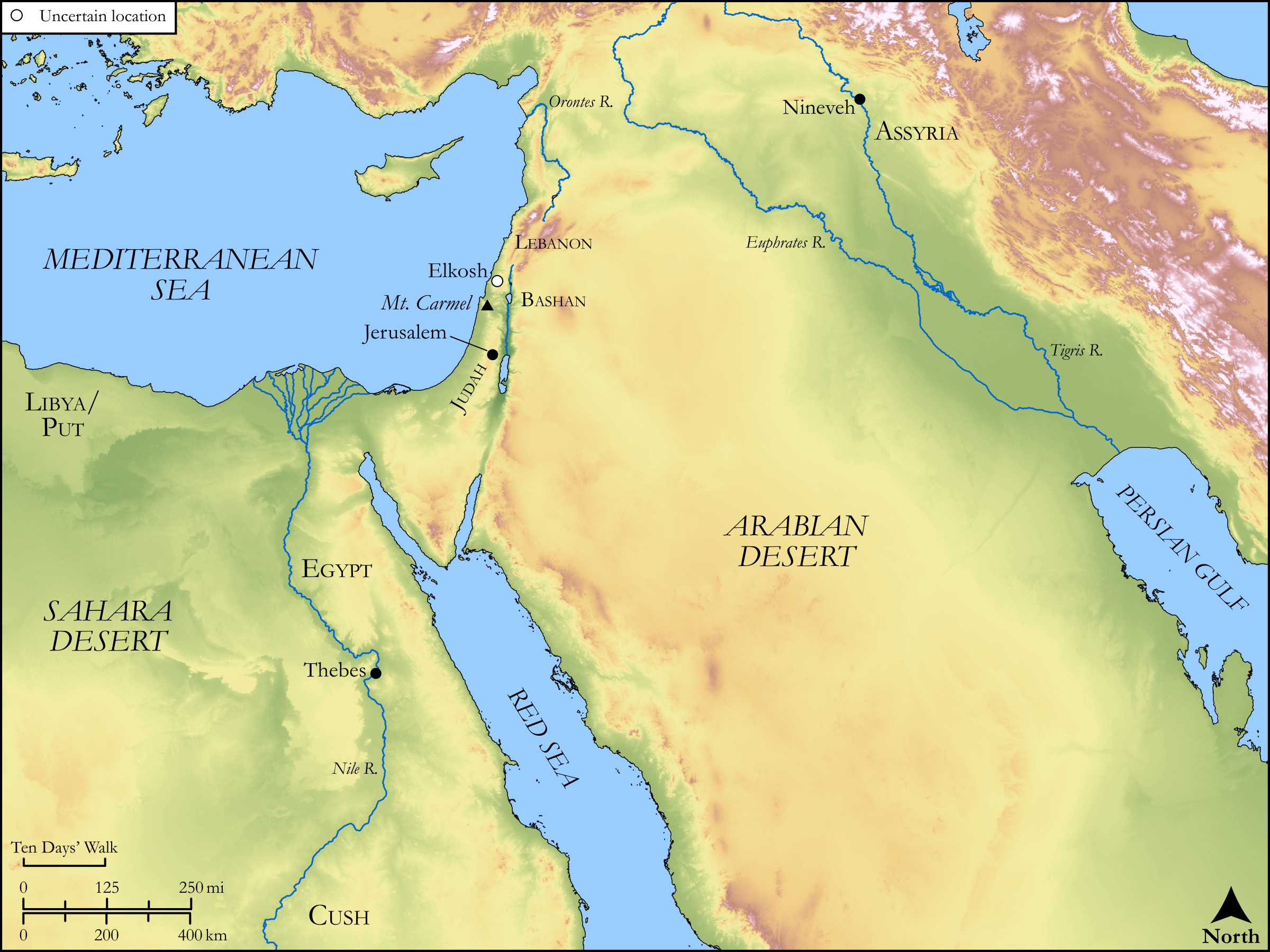
Nahum 1:1 calls the work a burden concerning Nineveh and the book of the vision of Nahum the Elkoshite. “Elkoshite” describes his association with Elkosh; it is not the name of a second prophet or a place called Elkoshite. The verse supplies no father, regnal year, place of writing or account of his death. Easton's entry explains the name as consolation and reports competing location proposals for Elkosh. Neither a Galilean nor a Mesopotamian identification should be presented as established by the heading.
Nahum 3:8–10 looks back on the defeat of No, commonly identified with Egyptian Thebes. The historical association with Ashurbanipal's campaign in 663 BC supplies a proposed lower boundary for dating the prophecy; the anticipated fall of Nineveh in 612 BC supplies an upper boundary in the usual historical reading. The USCCB introduction places the prophecy shortly before the latter event. These are historical arguments, not dates explicitly printed in Nahum. The narrower claim that the book was written between 662 and 627 BC has not been independently established by the sources consulted here. Nor do they establish its exact chronological rank among the Minor Prophets.
Judah is addressed in 1:15, but that does not identify its reigning king or prove that the book was written there. Second Kings 21–22 narrates Manasseh, Amon and Josiah in sequence; Nahum supplies no synchronism that selects one of them. Likewise, assuming Ashurbanipal was the Assyrian ruler when the prophecy was delivered requires a narrower dating argument than the heading gives.
No biblical death or burial account is given. The Nahum biographical article records competing tomb traditions associated with Alqosh in Iraq, Rameh in Galilee and Elcesei in the West Bank. Their existence as traditions is different from identifying a verified grave. None is used here to establish where the prophet lived or died.

Nahum 1: Power, Refuge and Good News
1:1: The heading identifies the subject, Nineveh, and the work as Nahum's vision. It establishes the literary address before the descriptions of judgment begin.
1:2–6: The LORD is described as jealous, avenging, slow to anger and great in power. Storm, drying waters, withering fertile lands and trembling mountains present the reach of that power. Verse 3's patience does not cancel its statement that guilt will not simply be cleared.
1:7–8: The LORD is good, a stronghold in trouble, and knows those who trust in him. The next verse turns to overwhelming flood and an utter end. Keep these neighboring descriptions together: the text makes a distinction between refuge and destruction rather than offering one undifferentiated picture of power.
1:9–14: Plans against the LORD will not succeed. The passage alternates the fate of the enemy with release from affliction and the breaking of bonds. The command against the condemned party includes cutting off its name and images and making its grave. The shifts of address require attention; not every “thee” can be flattened into a generic promise to every reader.
1:15: A herald announces peace, and Judah is called to keep its feasts and vows because the wicked invader will no longer pass through it. This is KJV 1:15; some other editions place the verse at 2:1. Compare references by wording as well as number.
Nahum 2: Siege and the Emptied Lion's Den
2:1–2: The city is challenged to guard its defenses as an attacker comes up. The following statement about the excellence of Jacob and Israel relates the city's exposure to the earlier plundering of God's people.
2:3–7: Shields, warriors, flashing chariots, haste at the walls and opened river gates form a rapid siege scene. The palace is dissolved and the city is exposed. Verse 6 permits discussion of water in the attack, but does not itself name the Khosr, describe closed floodgates or explain a measured breach in a wall. Such reconstructions need evidence beyond the poem.
2:8–10: Nineveh is compared to a pool whose people flee. Commands to stop fail, and the scene turns to plundering silver and gold, emptiness and terror. The order to take spoil in verse 9 concerns the defeated city's wealth; it is not advice to the reader about acquiring money.
2:11–13: The question “Where is the dwelling of the lions?” reverses the image of a secure predator's den. The lion once supplied prey for its young and filled its caves; the LORD's declaration against the city ends with destroyed chariots, cut-off prey and silenced messengers. The imperial hunter becomes the target of judgment.
Nahum 3: Charges, Thebes and the Final Question
3:1–4: The city is accused of bloodshed, lies and robbery. The sounds of battle and heaps of casualties follow. The language of prostitution and sorceries portrays the city's destructive dealings with nations. It should not be expanded into a detailed account of specific rituals that the passage does not name.
3:5–7: The city personified as a woman faces exposed nakedness, shame and public abandonment. This is a violent humiliation image within a judgment poem. An exact reconstruction of a historical punishment custom is not supplied, and the image should not become permission to humiliate or assault people.
3:8–10: Nineveh is asked whether it is better than populous No. The comparison recalls a city surrounded by waters and supported by allies, yet carried away into captivity. Identifying No with Thebes on the Nile makes the comparison geographical as well as political: another powerful river city was vulnerable. The point is not that Nineveh and Thebes were the same place.
3:11–14: Nineveh too will seek refuge. Fortresses are compared to ripe figs that fall when shaken; defenses fail, and commands to draw water and strengthen fortifications expose the futility of preparation against the announced end.
3:15–17: Fire and sword consume, and the figures change repeatedly between cankerworm and locust. The merchants multiply, the cankerworm spoils and flies away, and the crowned men and captains resemble insects that depart when the sun rises. The whole section cannot be reduced to one swarm representing only the invading army: the city's own numerous officials are also compared to insects that vanish.
3:18–19: The king of Assyria is addressed. Sleeping shepherds, resting nobles and scattered people describe failed leadership and a people no one gathers. The incurable wound brings applause from those who hear, and the final question asks who has escaped the city's continual wickedness. Verse 18 does not explicitly say that every scattered person is killed. The closing charge returns the siege poem to the experience of its victims.
Check Nahum's Numbers, Names and Proposed References
Some facts depend on an edition and a counting rule. In the digital KJV used here, count only verse text, treating alphabetic sequences as words and keeping a straight or curly apostrophe within a word. Exclude book labels and headings. Ranking all sixty-six books under that rule gives the following results; these are transcription-specific counts, not universal totals for every printed KJV.
| Book | Words | Rank, shortest first |
|---|---|---|
| Obadiah | 669 | 5 |
| Haggai | 1,130 | 8 |
| Nahum | 1,292 | 9 |
| Jonah | 1,325 | 10 |
The earlier figures of 1,284 for Nahum and 1,320 for Jonah are not reproduced by this rule. In this corpus's sixty-six-book order, Micah and Nahum occupy positions 33 and 34; they are the middle books of that arrangement, not necessarily the middle words or pages of a Bible. A case-insensitive whole-word search finds “Nahum” once in the verse text, at 1:1; that is a specified English spelling search, not an identity census across alternative name forms. The same word-search rule finds “behold” four times in Nahum: 1:15; 2:13; 3:5; and 3:13. Two introduce “I am against thee” (2:13; 3:5).
Short names also need their contexts. No is the city discussed in 3:8; the licensed regional map above locates Thebes on the Nile and Nineveh on the Tigris. Ai is a place in Joshua 7:2, Ar in Numbers 21:15, and On appears in the priest's title in Genesis 41:45. By contrast, Numbers 16:1 names On son of Peleth, a person; 16:11 does not establish an Egyptian city called On. Second Kings 17:4 calls So “king of Egypt,” so that verse should not be counted as another two-letter city name.
| Proposed connection | What the text supports |
|---|---|
| Nahum 1:15 → Romans 10:15 | Good news, peace and the messenger's feet are comparable. Isaiah 52:7 supplies the explicit “How beautiful” wording also used in Romans. Romans says “as it is written” but does not name Nahum; a unique source should not be assumed from a reference list. |
| “Nahum 1:17” → 2 Timothy 2:19 | Nahum 1 has only fifteen verses in this KJV division, so 1:17 is invalid. If 1:7 was intended, the LORD knowing those who trust him is comparable to “The Lord knoweth them that are his.” Numbers 16:5 also concerns the LORD showing who belongs to him. Do not silently repair the number and call the proposed link an established quotation. |
| Nahum 3:4 → Revelation 17:1 | Both use prostitution imagery in judgment. Revelation's surrounding vision names Babylon; it does not identify this as a quotation from Nahum's charge against Nineveh. |
| Nahum 3:17 → Revelation 9:7 | Both use locust imagery, but Nahum compares officials with insects that scatter, whereas Revelation describes a visionary locust army. Shared imagery is a comparison, not proof that the scenes or referents are identical. |
For historical orientation, retain the distinction in the setting discussion between the attributed 663 BC sack of Thebes and 612 BC fall of Nineveh, and an exact year for Nahum's delivery. The book does not name Ashurbanipal or date his death, so a proposed 662–627 BC window requires an additional historical argument. Subtracting selected dates of 612 and 609 gives three years, but arithmetic does not establish an uninterrupted three-year peace for Judah. Second Kings 23:29–35 describes Josiah's death, Jehoahaz's brief reign and Neco's imposition of tribute; deciding how Nahum's relief language relates to those events or to a future fulfillment is an interpretive question.
For practice, choose one reference-table row and write down the words actually shared and the differences in speaker and setting. Read the comparison passages in context; the chapter 3 self-test also examines the Thebes and insect imagery.
Sources and Next Reading
Primary reading: Nahum 1–3, KJV, checked against the digital KJV corpus. Compare Jonah 3–4 and Zephaniah 2:13–15 for other Nineveh passages; they are distinct texts with different scenes and purposes. Second Kings 21–22 provides the Judah succession discussed above, without dating Nahum's vision.
The USCCB introduction supplies the attributed pre-612 historical reading; Easton's Nahum and No entries supply name/location discussions and Thebes identification. The Sack of Thebes article associates the campaign with 663 BC and distinguishes Assyrian accounts from archaeological questions. This guide does not independently verify its account of a complete destruction layer. The Nahum article is used for the existence of competing tomb traditions, not to certify any of them.
Continue with the fifteen study questions or the Nineveh reference guide for the city's wider biblical appearances.