2 Thessalonians Questions and Answers: 17 Reading Checks
Try these 17 questions before revealing the answers. They retain the original subjects while checking the text's actual claims about persecution, the coming day, deception, work and the letter's ending. The three-chapter outline supplies a whole-book locator.
Chapter 1
1. Who was Silas?
Acts 15:22 calls Silas a leading member of the Jerusalem community, and 15:32 calls him a prophet. He accompanies Paul after the separation from Barnabas (15:40), is beaten and imprisoned with him at Philippi, and appears with him in Thessalonica and Berea (Acts 16–17). Silas and Timothy reach Paul in Corinth in Acts 18:5. The letters use the name Silvanus; 1 Peter 5:12 credits Silvanus with help in that letter, without specifying every part of a scribe’s or carrier’s work.
2. When did Paul visit Thessalonica, and how can we locate it?
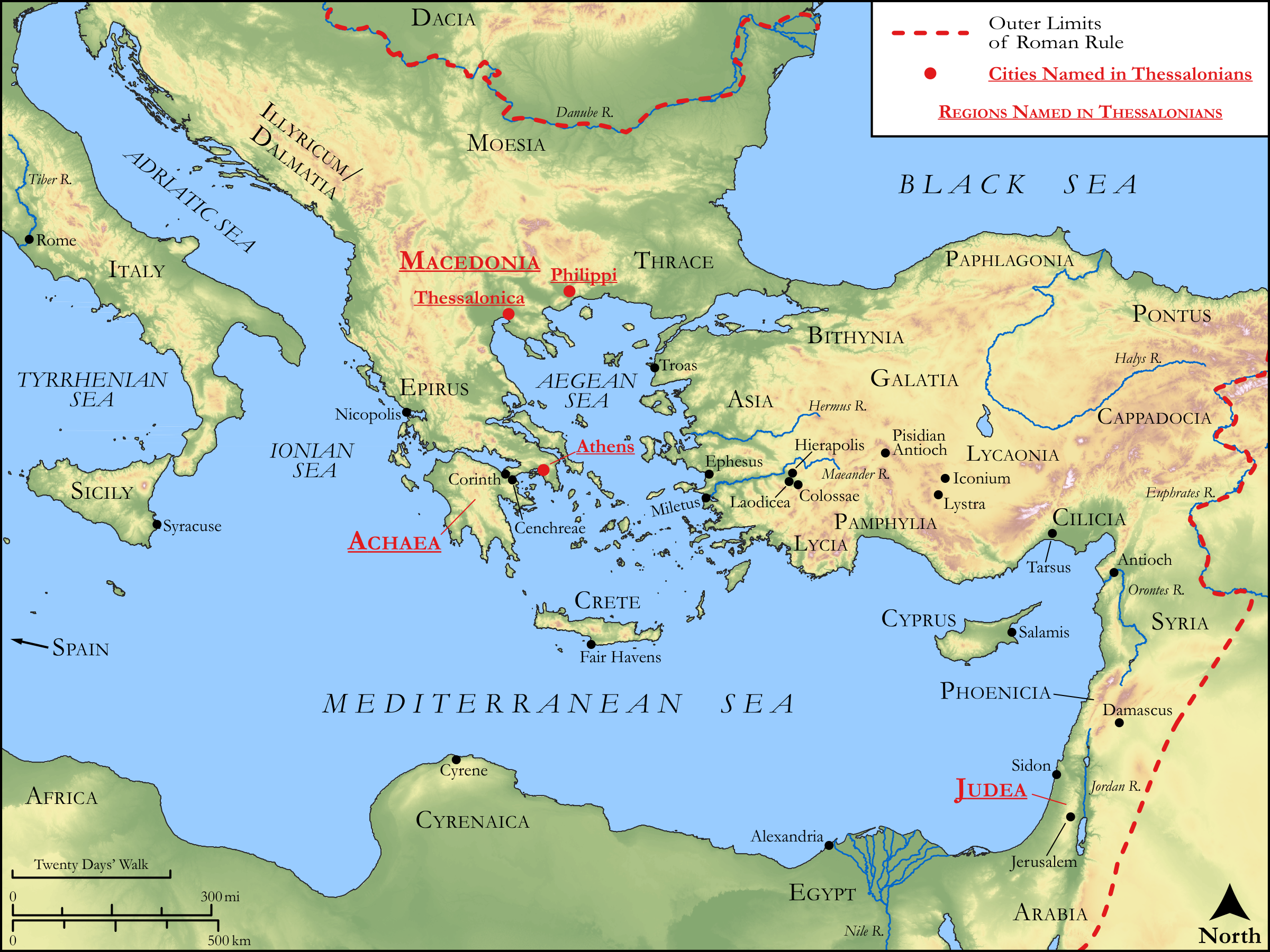
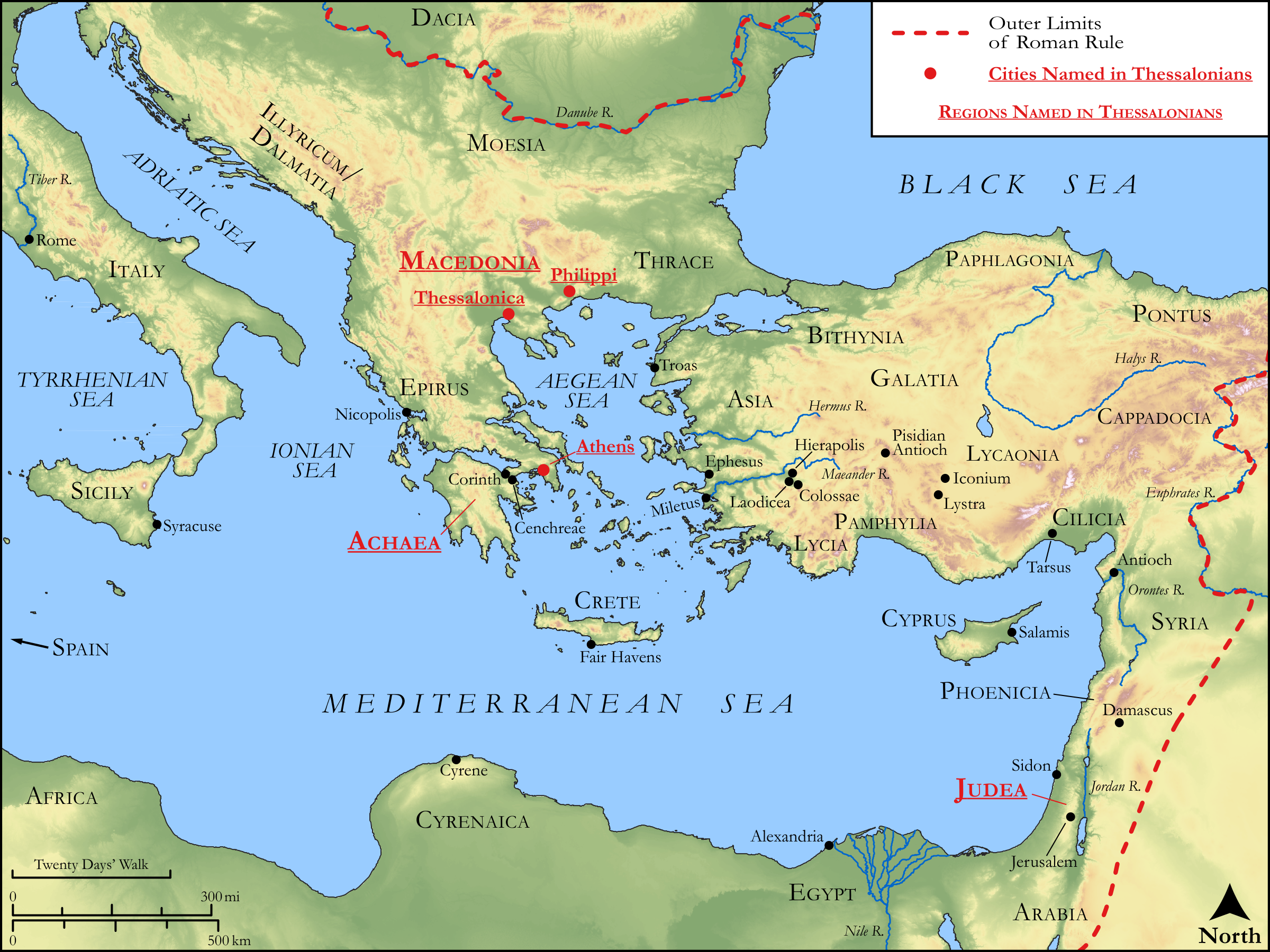
Acts 17:1–9 puts the visit in the journey after Philippi, Amphipolis and Apollonia, before Berea, Athens and Corinth. It gives three Sabbaths of synagogue reasoning, not a complete length for the stay or an AD year. The old map’s heading “churches started, AD 49–52” combined a chronology with church-foundation claims; Acts names believers in Athens without calling every stop a church Paul founded. Use the regional map for orientation and the completed route guide for every named stop, including Berea. Acts 20:1–3 describes later regional travel but does not individually name two return visits to Thessalonica.
3. What caused the persecution mentioned in 1:4?
The letter states that persecution continues, but it does not identify every instigator. Acts 17:5–9 describes opponents at the earlier visit gathering a crowd, attacking Jason’s house and involving civic rulers; 17:13 describes opponents following to Berea. First Thessalonians 2:14 also refers to suffering from local compatriots. The Acts scene is relevant background, not proof that all later pressure had one ethnic source.
4. What does 1:5 reveal about God’s judgment and the believers?
Their endurance is viewed in relation to God’s righteous judgment and their being counted worthy of the kingdom for which they suffer. Verses 11–12 pray for the work of faith and Christ’s glorification in them. The passage supplies hope and a prayer, without explaining the precise divine purpose of every individual injury or making suffering something a person must seek.
5. What is the point of 1:6–9?
God’s justice includes relief for the afflicted and judgment on those who trouble them, connected with the Lord’s revelation. The warning also concerns not knowing God and disobeying the gospel. These are severe theological claims, not a permission for private revenge or a basis for treating an ethnicity as collectively condemned.
6. What event is described in 1:10?
The reference is 2 Thessalonians 1:10: Jesus comes to be glorified in his saints and admired by those who believe. The earlier answer mislabeled it 1 Thessalonians 1:10. Read it with 1:7–12 here, which joins revelation, judgment, relief and prayer; the verse does not itself describe the full sequence of armies and events in Revelation 19.
Chapter 2
7. What is the warning in 2:2?
Do not be shaken by a claimed spirit, message or letter attributed to the senders. The USCCB note explains the alarming claim as the day already being present; the KJV wording “is at hand” needs that translation check. A forged letter is one possible explanation of “as from us,” but no counterfeit document is reproduced or identified. The own-hand greeting at 3:17 belongs with the issue of authentication.
8. How does 2:3–9 answer alarm about the Lord’s coming?
It recalls a falling away and the revealing of the lawless opponent before the day, then describes restraint and the Lord’s victory. The “man of sin” is not simply a biblical name for Satan: verse 9 says that this figure’s coming operates according to Satan’s working. The mystery of lawlessness is already active, but the restrainer is not named. Later links with Revelation are interpretations and do not make a precise calendar explicit here.
9. What does the self-exaltation in 2:4 mean?
The opponent elevates himself above every object of worship and takes a seat in God’s temple while presenting himself as God. The USCCB notes explain the apocalyptic background and discuss temple readings. The clear subject is the opponent’s arrogation of divine status; the verse does not call him Lucifer, supply his angelic biography or explicitly require a new temple in modern Jerusalem.
10. Why does God send delusion in 2:10–12?
The paragraph links judgment with rejection of love for the truth and pleasure in unrighteousness. Deception is not praised as harmless ignorance. The verses do not describe God misleading people who desire the truth, and they do not name a contemporary group as definitively lost. Specific synchronizations with Revelation would be additional interpretations.
11. What does holding the traditions in 2:15 involve?
Stand firm in what the readers were taught by word and by letter from the senders. “Traditions” here refers to the teaching received, rather than any custom merely because it is old. Jude 3 offers a related call to contend for the faith once delivered; the correct Jude reference is verse 3, not verse 11. These comparisons do not turn every later claim of apostolic authority into proof.
Chapter 3
12. Why request prayer in 3:1–2?
That the word of the Lord may spread and be honored, and that the missionaries may be delivered from unreasonable and wicked people. Verse 3 immediately affirms the Lord’s faithfulness. Acts 18:9–10 records encouragement to Paul in Corinth as a separate mission scene; it does not let us identify every unnamed opponent in this prayer or generalize wickedness to Jewish people.
13. What conduct is corrected in 3:6–11?
Some walk disorderly, refuse work and act as busybodies. The missionaries’ labor is offered as the contrasting example. The command is in 3:6, not 2:6. First Thessalonians 4:11–12 and 5:14 provide related earlier instructions, but refusal to work should not be confused with inability, unemployment or the need for assistance.
14. Did expectation of the return cause the idleness?
That is a proposed reconstruction: readers connect the end-time discussion in chapter 2 with the work problem in chapter 3. The letter itself does not explicitly state that causal link or give each person’s reason for refusing work. Its direct remedy is quiet work and responsible conduct; confidence about a hidden motive adds more than the passage supplies.
15. What right is described in 3:9?
The missionaries had a right to support but chose to labor as an example. Compare 1 Corinthians 9:1–18, where Paul discusses support and his choice not to use that right, and 1 Timothy 5:17–18 on those who labor in teaching. A chosen example does not mean ministers never have a right to support, or that people unable to work should be denied food.
16. How should a persistently disobedient member be treated (3:14–15)?
Note the person who disobeys the letter and do not keep company, so the person may be ashamed; then heed the explicit limit: do not count the person an enemy, but admonish as a brother. The text includes real corrective distancing and a continuing family concern. It should not be rewritten as no consequence at all, permission for abuse, or a detailed rule about every modern disciplinary procedure.
17. What is the problem with the Athens subscription printed after the letter?
The numbered 3:18 is the greeting of grace. A notice afterward saying that the second epistle was written from Athens is an appended subscription; printing it nearby does not make it a sentence of verse 18 or a claim made within the letter. This guide has not traced that notice’s manuscript history. A Corinth setting is a reconstruction from coworkers and mission sequence, not proven by saying an unaccompanied Paul could not dictate or write.
Sources and Related Study
Primary reading: all 47 numbered verses of 2 Thessalonians 1–3; 1 Thessalonians 1–5; Acts 15:22–18:28; 20:1–6; 1 Corinthians 9:1–18; 1 Timothy 5:17–18; Romans 16:22; Galatians 6:11; and Jude 3. Short quotations follow the KJV.
- USCCB 2 Thessalonians 2 and notes: the day already present, alleged letter, lawless one, disputed restraint and temple imagery. These are attributed editorial explanations, not an independent manuscript investigation.
- USCCB 1 Thessalonians introduction: the first letter's Corinth/reunion reconstruction, which does not independently date the second letter.
- Dates, places and evidence for Paul's letters; Thessalonica references and appended notices; second-journey route guide.
Send source questions through our contact page.